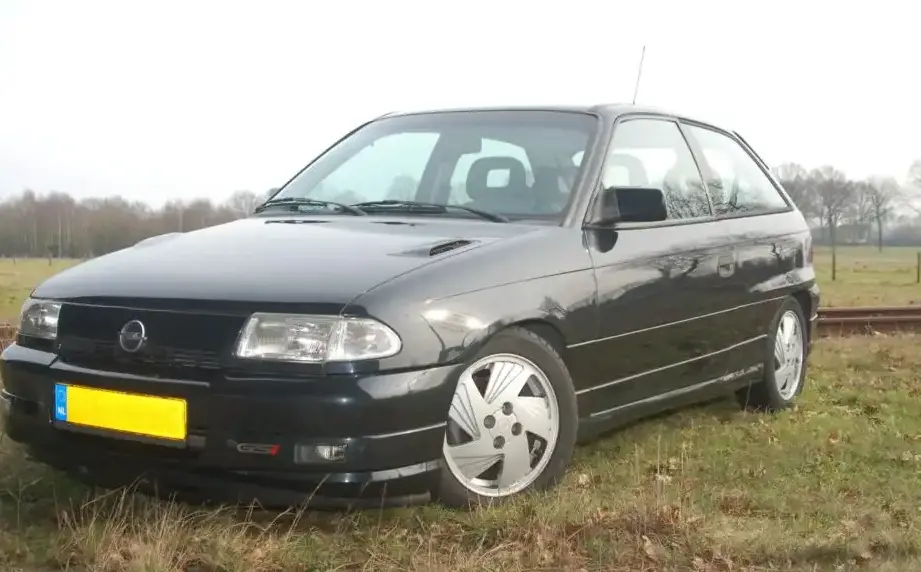
The Opel Astra G Cabrio 2.0i 16V Turbo, produced between December 2002 and October 2005, represented the performance pinnacle of the Astra G Cabriolet range. Positioned as the flagship model, it offered a significant power upgrade over the naturally aspirated engines available, appealing to drivers seeking a more engaging open-top experience. This variant was a key part of Opel’s strategy to offer a sporty and desirable convertible within the competitive European market. It utilized the Astra G platform (1HX0 for the Cabriolet) known for its relatively affordable price point and practical design, but elevated with a potent turbocharged engine.
Technical Specifications
| Brand | Opel |
| Model | Astra |
| Generation | Astra G Cabrio |
| Type (Engine) | 2.0i 16V Turbo (200 Hp) |
| Start of production | December, 2002 |
| End of production | October, 2005 |
| Powertrain Architecture | Internal Combustion engine |
| Body type | Cabriolet |
| Seats | 4 |
| Doors | 2 |
| Fuel consumption (urban) | 12.5 l/100 km (18.8 US mpg, 22.6 UK mpg, 8 km/l) |
| Fuel consumption (extra urban) | 6.8 l/100 km (34.6 US mpg, 41.5 UK mpg, 14.7 km/l) |
| Fuel consumption (combined) | 8.9 l/100 km (26.4 US mpg, 31.7 UK mpg, 11.2 km/l) |
| CO2 emissions | 214 g/km |
| Fuel Type | Petrol (Gasoline) |
| Acceleration 0 – 100 km/h | 8 sec |
| Acceleration 0 – 62 mph | 8 sec |
| Acceleration 0 – 60 mph | 7.6 sec |
| Maximum speed | 242 km/h (150.37 mph) |
| Weight-to-power ratio | 7.1 kg/Hp, 141.3 Hp/tonne |
| Weight-to-torque ratio | 5.7 kg/Nm, 176.7 Nm/tonne |
| Power | 200 Hp @ 5600 rpm |
| Power per litre | 100.1 Hp/l |
| Torque | 250 Nm @ 1950-5500 rpm (184.39 lb.-ft. @ 1950-5500 rpm) |
| Engine layout | Front, Transverse |
| Engine Model/Code | Z20LET |
| Engine displacement | 1998 cm3 (121.93 cu. in.) |
| Number of cylinders | 4 |
| Engine configuration | Inline |
| Cylinder Bore | 86 mm (3.39 in.) |
| Piston Stroke | 86 mm (3.39 in.) |
| Compression ratio | 8.8:1 |
| Number of valves per cylinder | 4 |
| Fuel injection system | Multi-port manifold injection |
| Engine aspiration | Turbocharger, Intercooler |
| Valvetrain | DOHC |
| Engine oil capacity | 4.25 l (4.49 US qt | 3.74 UK qt) |
| Coolant | 7.4 l (7.82 US qt | 6.51 UK qt) |
| Kerb Weight | 1415 kg (3119.54 lbs.) |
| Max. weight | 1835 kg (4045.48 lbs.) |
| Max load | 420 kg (925.94 lbs.) |
| Trunk (boot) space – minimum | 330 l (11.65 cu. ft.) |
| Fuel tank capacity | 52 l (13.74 US gal | 11.44 UK gal) |
| Length | 4267 mm (167.99 in.) |
| Width | 1709 mm (67.28 in.) |
| Width including mirrors | 1989 mm (78.31 in.) |
| Height | 1390 mm (54.72 in.) |
| Wheelbase | 2606 mm (102.6 in.) |
| Front track | 1467 mm (57.76 in.) |
| Rear (Back) track | 1456 mm (57.32 in.) |
| Front overhang | 812 mm (31.97 in.) |
| Rear overhang | 849 mm (33.43 in.) |
| Drag coefficient (Cd) | 0.32 |
| Minimum turning circle | 11 m (36.09 ft.) |
| Drivetrain Architecture | ICE drives front wheels |
| Drive wheel | Front wheel drive |
| Number of gears | 5 gears, manual transmission |
| Front suspension | Independent, McPherson with coil spring and anti-roll bar |
| Rear suspension | Semi-independent, coil spring |
| Front brakes | Ventilated discs |
| Rear brakes | Disc |
| Assisting systems | ABS |
| Steering type | Steering rack and pinion |
| Power steering | Hydraulic |
| Tires size | 215/40 R17 |
| Wheel rims size | 7.5J x 17 |
Powertrain & Engine Architecture
The heart of the Astra G Cabrio 2.0i 16V Turbo is the Z20LET engine, a 1998cc inline-four cylinder powerplant. This engine is a member of Opel’s ‘Ecotec’ family, known for its focus on efficiency and performance. The Z20LET utilizes a cast iron block with an aluminum cylinder head, featuring dual overhead camshafts (DOHC) and four valves per cylinder. Crucially, it’s equipped with a Garrett GT2256V turbocharger with an intercooler, boosting power output to 200 horsepower at 5600 rpm and 250 Nm (184 lb-ft) of torque available from a low 1950 rpm through to 5500 rpm. Fuel delivery is managed by a multi-port fuel injection system. The engine’s relatively high 8.8:1 compression ratio, combined with the turbocharging, provides a good balance between responsiveness and reliability. The standard transmission for this model was a five-speed manual gearbox, optimized for the engine’s powerband.
Driving Characteristics
The 2.0i 16V Turbo Cabriolet offered a noticeably more spirited driving experience than the lower-powered Astra G Cabrio models. The turbocharger provides a surge of power in the mid-range, making overtaking and climbing hills significantly easier. While not a dedicated sports car, the 0-60 mph time of around 7.6 seconds and a top speed of 150 mph were respectable for the early 2000s. The five-speed manual transmission allowed drivers to fully exploit the engine’s torque, although the gear ratios were somewhat widely spaced. Compared to the naturally aspirated 1.8L models, the turbo variant felt considerably more responsive and capable. The added weight of the turbo system and associated components did slightly impact handling, but the well-tuned suspension helped to mitigate this.
Equipment & Trim Levels
The 2.0i 16V Turbo Cabriolet typically came with a generous level of standard equipment. This included power windows, central locking, power steering, ABS brakes, and a decent audio system. Interior upholstery was usually cloth, but leather options were available. Common optional extras included alloy wheels (often 17-inch), a wind deflector, and upgraded audio systems. The dashboard layout was typical of the Astra G, with a functional and straightforward design. The trim level generally sat at the top of the Cabriolet range, offering a more premium feel than the base models.
Chassis & Braking
The Astra G Cabriolet utilized a McPherson strut front suspension and a semi-independent torsion beam rear suspension. This setup provided a reasonable balance between comfort and handling. The 2.0i Turbo models often featured slightly stiffer springs and dampers compared to the lower-powered variants to cope with the increased power. Braking was handled by ventilated discs at the front and solid discs at the rear, with ABS as standard. The braking system was adequate for the car’s performance, but not exceptionally powerful.
Market Reception & Comparison
The Astra G Cabrio 2.0i 16V Turbo was generally well-received by automotive critics. It was praised for its strong performance, comfortable ride, and relatively affordable price. However, some reviewers noted that the interior quality wasn’t quite as refined as some of its competitors, such as the Volkswagen Golf Cabriolet. Compared to the 1.8L models, the 2.0i Turbo offered significantly more power and a more engaging driving experience, but at the cost of slightly higher fuel consumption. The 1.8L models were often favored by buyers prioritizing fuel economy and lower running costs.
Legacy
The Z20LET engine has proven to be a relatively robust and reliable unit when properly maintained. However, like all turbocharged engines, it’s susceptible to issues if neglected, such as turbocharger failure or oil leaks. Today, the Astra G Cabrio 2.0i 16V Turbo is gaining a following among classic car enthusiasts, particularly those seeking an affordable and enjoyable open-top experience. Well-maintained examples are becoming increasingly sought after, and prices are slowly rising. The engine’s tuning potential also makes it popular with those interested in modifications. Its blend of performance, practicality, and affordability has cemented its place as a desirable variant within the Astra G Cabriolet lineage.