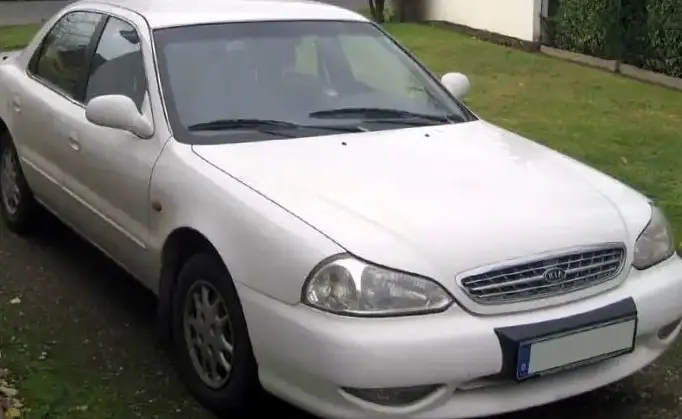
The Kia Clarus (GC) 1.8i 16V, produced between 1998 and 2001, represented Kia’s attempt to establish a foothold in the mid-size sedan segment, particularly in markets outside of North America. Positioned as a step up from the earlier Sephia, the Clarus aimed to offer a more refined and spacious alternative to established Japanese and European competitors. This specific 1.8-liter, 16-valve variant, producing 116 horsepower, was often considered the entry-level or mid-range offering within the Clarus lineup, appealing to buyers prioritizing fuel efficiency and affordability over outright performance. It was a key model for Kia as they expanded their global presence and sought to improve their brand image.
Technical Specifications
| Brand | Kia |
| Model | Clarus |
| Generation | Clarus (GC) |
| Type (Engine) | 1.8i 16V (116 Hp) |
| Start of production | 1998 |
| End of production | 2001 |
| Powertrain Architecture | Internal Combustion engine |
| Body type | Sedan |
| Seats | 5 |
| Doors | 4 |
| Fuel consumption (urban) | 12.1 l/100 km (19.4 US mpg) |
| Fuel consumption (extra urban) | 7.8 l/100 km (30.2 US mpg) |
| Fuel consumption (combined) | 9.3 l/100 km (25.3 US mpg) |
| CO2 emissions | 216 g/km |
| Fuel Type | Petrol (Gasoline) |
| Acceleration 0 – 100 km/h | 10.7 sec |
| Acceleration 0 – 62 mph | 10.7 sec |
| Acceleration 0 – 60 mph | 10.2 sec |
| Maximum speed | 185 km/h (114.95 mph) |
| Emission standard | Euro 2 |
| Weight-to-power ratio | 10.5 kg/Hp |
| Weight-to-torque ratio | 8 kg/Nm |
| Power | 116 Hp @ 5750 rpm |
| Torque | 152 Nm @ 4500 rpm (112.11 lb.-ft. @ 4500 rpm) |
| Engine layout | Front, Transverse |
| Engine Model/Code | T8 |
| Engine displacement | 1793 cm3 (109.42 cu. in.) |
| Number of cylinders | 4 |
| Engine configuration | Inline |
| Cylinder Bore | 81 mm (3.19 in.) |
| Piston Stroke | 87 mm (3.43 in.) |
| Compression ratio | 9.5:1 |
| Number of valves per cylinder | 4 |
| Fuel injection system | Multi-port manifold injection |
| Engine aspiration | Naturally aspirated engine |
| Valvetrain | DOHC |
| Engine oil capacity | 4 l (4.23 US qt | 3.52 UK qt) |
| Kerb Weight | 1220 kg (2689.64 lbs.) |
| Max. weight | 1750 kg (3858.09 lbs.) |
| Max load | 530 kg (1168.45 lbs.) |
| Trunk (boot) space – minimum | 444 l (15.68 cu. ft.) |
| Trunk (boot) space – maximum | 784 l (27.69 cu. ft.) |
| Fuel tank capacity | 60 l (15.85 US gal | 13.2 UK gal) |
| Length | 4731 mm (186.26 in.) |
| Width | 1770 mm (69.69 in.) |
| Height | 1420 mm (55.91 in.) |
| Wheelbase | 2659 mm (104.69 in.) |
| Front track | 1500 mm (59.06 in.) |
| Rear (Back) track | 1500 mm (59.06 in.) |
| Minimum turning circle | 10.6 m (34.78 ft.) |
| Drivetrain Architecture | Front wheel drive |
| Drive wheel | Front wheel drive |
| Number of gears | 5 gears, manual transmission |
| Front suspension | Coil spring |
| Rear suspension | Coil spring |
| Front brakes | Ventilated discs |
| Rear brakes | Drum |
| Assisting systems | ABS (Anti-lock braking system) |
| Steering type | Steering rack and pinion |
| Power steering | Hydraulic Steering |
| Tires size | 195/65 R14 |
| Wheel rims size | 14 |
Powertrain & Engine Architecture
The heart of the Clarus 1.8i 16V is the Kia-developed T8 engine, a 1.8-liter inline-four cylinder powerplant. This engine utilized a multi-port fuel injection system, a relatively common setup for the time, providing adequate fuel atomization for efficient combustion. The 16-valve configuration, achieved through a dual overhead camshaft (DOHC) design, allowed for improved breathing and higher engine speeds compared to older, simpler valvetrain designs. The T8 engine produced 116 horsepower at 5750 rpm and 152 Nm (112 lb-ft) of torque at 4500 rpm. While not a powerhouse, it was considered sufficient for comfortable everyday driving. The engine’s design prioritized reliability and ease of maintenance over outright performance. The 5-speed manual transmission was the standard offering, providing a reasonable balance between fuel economy and driver control.
Driving Characteristics
The Clarus 1.8i 16V offered a comfortable, if not particularly exciting, driving experience. Acceleration from 0 to 60 mph took around 10.2 seconds, placing it firmly in the mainstream for its class. The 5-speed manual transmission allowed drivers to make the most of the engine’s powerband, although the relatively low horsepower meant that frequent downshifting was often necessary for overtaking maneuvers. Compared to the more powerful 2.0-liter versions of the Clarus, the 1.8L felt noticeably less responsive. However, it offered better fuel economy and a smoother, more relaxed driving experience. The gear ratios were tuned for fuel efficiency rather than outright acceleration, resulting in a slightly less engaging driving experience than some of its competitors.
Equipment & Trim Levels
The 1.8i 16V trim typically included standard features such as power windows, power steering, central locking, and an AM/FM radio. Air conditioning was often standard, but could be optional depending on the specific market. Interior upholstery was typically cloth, with higher trim levels offering optional leather seats. The dashboard layout was functional and straightforward, prioritizing ease of use over stylistic flair. Optional extras included a sunroof, upgraded audio system, and alloy wheels. The Clarus aimed to provide a good value proposition, offering a reasonable level of equipment for its price point.
Chassis & Braking
The Clarus utilized a conventional front-wheel-drive chassis with coil spring suspension at all four corners. The front suspension featured MacPherson struts, while the rear employed a multi-link setup. This configuration provided a comfortable ride quality, although handling was not particularly sporty. The braking system consisted of ventilated discs at the front and drum brakes at the rear. Anti-lock braking system (ABS) was standard, enhancing safety by preventing wheel lockup during hard braking. The suspension was tuned for comfort, prioritizing a smooth ride over sharp handling. Stabilizer bars were included to reduce body roll during cornering, but the overall handling characteristics were geared towards everyday usability rather than performance driving.
Market Reception & Comparison
The Kia Clarus 1.8i 16V was generally well-received by critics as a competent and affordable mid-size sedan. However, it often faced criticism for its lack of refinement compared to established Japanese and European competitors. Fuel economy was considered to be average for its class, and reliability was generally good, although not exceptional. Compared to the higher-output 2.0-liter Clarus variants, the 1.8L offered better fuel economy but significantly less performance. It was often seen as a sensible choice for buyers prioritizing practicality and affordability over driving excitement.
Legacy
The Kia Clarus, while not a groundbreaking vehicle, played an important role in Kia’s evolution as a global automaker. The 1.8i 16V variant, in particular, offered a relatively affordable and reliable entry point into the mid-size sedan segment. Today, the Clarus is a relatively uncommon sight on the roads, but well-maintained examples are sought after by enthusiasts and collectors. The T8 engine, while not known for its exceptional performance, proved to be a durable and reliable powerplant. Parts availability can be a challenge, but the Clarus remains a relatively affordable and easy-to-maintain classic car.