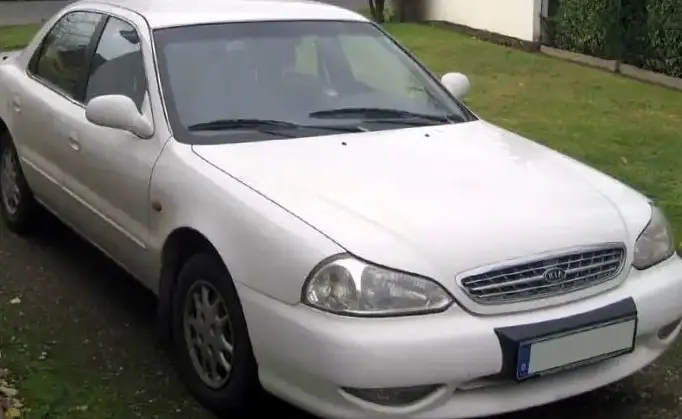
The Kia Clarus (K9A), produced between 1996 and 1998, represented a significant step forward for the South Korean automaker in the mid-size sedan segment. Positioned as a family vehicle offering a blend of comfort, practicality, and affordability, the Clarus aimed to compete with established Japanese and European rivals. The 1.8 i 16V variant, equipped with a 1.8-liter engine producing 116 horsepower, served as a core model within the Clarus lineup, offering a balance between fuel efficiency and acceptable performance for everyday driving. It was primarily marketed towards buyers seeking a reliable and spacious sedan without the higher price tag of more powerful or luxurious trims.
Technical Specifications
| Brand | Kia |
| Model | Clarus |
| Generation | Clarus (K9A) |
| Type (Engine) | 1.8 i 16V (116 Hp) |
| Start of production | 1996 |
| End of production | 1998 |
| Powertrain Architecture | Internal Combustion engine |
| Body type | Sedan |
| Seats | 5 |
| Doors | 4 |
| Fuel consumption (combined) | 8.9 l/100 km |
| Fuel consumption (US mpg) | 26.4 US mpg |
| Fuel consumption (UK mpg) | 31.7 UK mpg |
| Fuel consumption (km/l) | 11.2 km/l |
| Fuel Type | Petrol (Gasoline) |
| Acceleration 0 – 100 km/h | 10.7 sec |
| Acceleration 0 – 62 mph | 10.7 sec |
| Acceleration 0 – 60 mph | 10.2 sec |
| Maximum speed | 185 km/h (114.95 mph) |
| Weight-to-power ratio | 10.5 kg/Hp, 95.1 Hp/tonne |
| Weight-to-torque ratio | 8 kg/Nm, 124.6 Nm/tonne |
| Power | 116 Hp @ 5750 rpm |
| Power per litre | 64.7 Hp/l |
| Torque | 152 Nm @ 4500 rpm (112.11 lb.-ft. @ 4500 rpm) |
| Engine layout | Front, Transverse |
| Engine Model/Code | T8 |
| Engine displacement | 1793 cm3 (109.42 cu. in.) |
| Number of cylinders | 4 |
| Engine configuration | Inline |
| Cylinder Bore | 81 mm (3.19 in.) |
| Piston Stroke | 87 mm (3.43 in.) |
| Compression ratio | 9.5:1 |
| Number of valves per cylinder | 4 |
| Fuel injection system | Multi-port manifold injection |
| Engine aspiration | Naturally aspirated engine |
| Valvetrain | DOHC |
| Engine oil capacity | 4 l (4.23 US qt | 3.52 UK qt) |
| Kerb Weight | 1220 kg (2689.64 lbs.) |
| Max. weight | 1750 kg (3858.09 lbs.) |
| Max load | 530 kg (1168.45 lbs.) |
| Trunk (boot) space – minimum | 424 l (14.97 cu. ft.) |
| Trunk (boot) space – maximum | 764 l (26.98 cu. ft.) |
| Fuel tank capacity | 60 l (15.85 US gal | 13.2 UK gal) |
| Length | 4691 mm (184.69 in.) |
| Width | 1770 mm (69.69 in.) |
| Height | 1420 mm (55.91 in.) |
| Wheelbase | 2659 mm (104.69 in.) |
| Front track | 1500 mm (59.06 in.) |
| Rear (Back) track | 1500 mm (59.06 in.) |
| Drivetrain Architecture | The Internal combustion engine (ICE) drives the front wheels of the vehicle. |
| Drive wheel | Front wheel drive |
| Number of gears and type of gearbox | 5 gears, manual transmission |
| Front suspension | Wishbone |
| Rear suspension | Coil spring |
| Front brakes | Ventilated discs |
| Rear brakes | Disc |
| Assisting systems | ABS (Anti-lock braking system) |
| Steering type | Steering rack and pinion |
| Power steering | Hydraulic Steering |
| Tires size | 195/65R14 |
Powertrain & Engine Architecture
The heart of the Clarus 1.8 i 16V is the Kia T8 engine, a 1.8-liter inline-four cylinder powerplant. This engine utilizes a multi-port fuel injection system, delivering fuel directly into the intake ports just before the intake valves. The engine features a double overhead camshaft (DOHC) valvetrain, operating 16 valves (four per cylinder) to optimize airflow and improve volumetric efficiency. The 9.5:1 compression ratio was a common figure for naturally aspirated engines of this era, balancing performance and fuel economy. The T8 engine, while not particularly groundbreaking, was known for its relative simplicity and durability. The 5-speed manual transmission was the standard offering for this trim, providing a direct connection between the engine and the front wheels. The transmission’s gear ratios were tuned for a balance of acceleration and highway cruising, though it wasn’t designed for particularly sporty driving.
Driving Characteristics
The 116 horsepower and 152 Nm (112 lb-ft) of torque produced by the 1.8-liter engine provided adequate, but not exhilarating, performance. Acceleration from 0 to 60 mph took around 10.2 seconds, making it competitive with other similarly sized and priced sedans of the time. The manual transmission allowed for reasonable control over the engine’s power band, but the engine lacked the low-end torque found in larger displacement engines. Drivers often needed to downshift to maintain momentum when climbing hills or overtaking. Compared to potential upgrades like a V6 engine, the 1.8L offered a more economical driving experience, prioritizing fuel efficiency over outright speed. The steering was light and easy to use, making it well-suited for city driving, but lacked the feedback desired by more enthusiastic drivers.
Equipment & Trim Levels
The 1.8 i 16V trim of the Kia Clarus typically included standard features such as power steering, air conditioning, and a basic audio system. Interior upholstery was generally cloth, with a relatively simple dashboard layout. Optional extras included power windows, central locking, and an upgraded audio system. The Clarus aimed to provide a comfortable and functional interior without excessive luxury. The trim level sat in the middle of the Clarus range, offering more features than the base model but falling short of the higher-end trims with larger engines and more premium appointments.
Chassis & Braking
The Clarus utilized a front-wheel-drive layout with a wishbone front suspension and a coil spring rear suspension. This setup provided a comfortable ride quality, absorbing bumps and irregularities in the road surface effectively. The front brakes were ventilated discs, offering good stopping power, while the rear brakes were solid discs. An anti-lock braking system (ABS) was included as standard, enhancing safety by preventing wheel lockup during hard braking. The suspension tuning was geared towards comfort rather than sporty handling, resulting in a slight degree of body roll during cornering.
Market Reception & Comparison
The Kia Clarus 1.8 i 16V was generally well-received by critics as a practical and affordable family sedan. It offered a good value proposition, providing a spacious interior, decent fuel economy (around 26.4 US mpg combined), and a reasonable level of equipment for its price point. Compared to other trims in the Clarus lineup, the 1.8L version was more fuel-efficient and less expensive to purchase than the V6 models, but it lacked the latter’s superior performance. Reliability was generally considered to be good, although some owners reported minor issues with the fuel injection system and electrical components.
Legacy
The Kia Clarus played a crucial role in establishing Kia as a credible player in the global automotive market. The 1.8L engine, while not known for exceptional performance, proved to be relatively durable and reliable. Today, well-maintained examples of the Clarus 1.8 i 16V are becoming increasingly rare, but they are often sought after by enthusiasts looking for a classic, affordable, and relatively simple-to-maintain sedan. The Clarus laid the groundwork for Kia’s subsequent success, demonstrating the brand’s ability to produce vehicles that offered a compelling combination of value, practicality, and reliability.