Technical Specifications
| Brand | Peugeot |
| Model | 5008 |
| Generation | 5008 I (Phase II, 2013) |
| Type (Engine) | 1.6 HDi (115 Hp) FAP 7 Seat |
| Start of production | 2013 |
| End of production | 2015 |
| Powertrain Architecture | Internal Combustion engine |
| Body type | MPV |
| Seats | 7 |
| Doors | 5 |
| Fuel consumption (urban) | 5.9-6.2 l/100 km (39.9 – 37.9 US mpg, 47.9 – 45.6 UK mpg, 16.9 – 16.1 km/l) |
| Fuel consumption (extra urban) | 4.3-4.6 l/100 km (54.7 – 51.1 US mpg, 65.7 – 61.4 UK mpg, 23.3 – 21.7 km/l) |
| Fuel consumption (combined) | 4.9-5.2 l/100 km (48 – 45.2 US mpg, 57.6 – 54.3 UK mpg, 20.4 – 19.2 km/l) |
| CO2 emissions | 128-135 g/km |
| Fuel Type | Diesel |
| Acceleration 0 – 100 km/h | 12.9 sec |
| Acceleration 0 – 62 mph | 12.9 sec |
| Acceleration 0 – 60 mph | 12.3 sec |
| Maximum speed | 183 km/h (113.71 mph) |
| Emission standard | Euro 5 |
| Weight-to-power ratio | 13.1 kg/Hp, 76.6 Hp/tonne |
| Weight-to-torque ratio | 5.6 kg/Nm, 179.8 Nm/tonne |
| Power | 115 Hp @ 3600 rpm |
| Power per litre | 73.7 Hp/l |
| Torque | 270 Nm @ 1750 rpm (199.14 lb.-ft. @ 1750 rpm) |
| Engine layout | Front, Transverse |
| Engine Model/Code | 9HD DV6C |
| Engine displacement | 1560 cm3 (95.2 cu. in.) |
| Number of cylinders | 4 |
| Engine configuration | Inline |
| Number of valves per cylinder | 2 |
| Fuel injection system | Diesel Commonrail |
| Engine aspiration | Turbocharger, Intercooler |
| Engine oil capacity | 3.75 l (3.96 US qt | 3.3 UK qt) |
| Kerb Weight | 1502 kg (3311.34 lbs.) |
| Max. weight | 2250 kg (4960.4 lbs.) |
| Max load | 748 kg (1649.06 lbs.) |
| Trunk (boot) space – minimum | 194 l (6.85 cu. ft.) |
| Trunk (boot) space – maximum | 1754 l (61.94 cu. ft.) |
| Fuel tank capacity | 60 l (15.85 US gal | 13.2 UK gal) |
| Length | 4529 mm (178.31 in.) |
| Width with mirrors folded | 1888 mm (74.33 in.) |
| Width including mirrors | 2118 mm (83.39 in.) |
| Height | 1622 mm (63.86 in.) |
| Wheelbase | 2727 mm (107.36 in.) |
| Front overhang | 934 mm (36.77 in.) |
| Rear overhang | 868 mm (34.17 in.) |
| Ride height (ground clearance) | 108-112 mm (4.25 – 4.41 in.) |
| Minimum turning circle | 11.1 m (36.42 ft.) |
| Drivetrain Architecture | Front wheel drive |
| Number of gears and type of gearbox | 6 gears, manual transmission |
| Front suspension | Independent type McPherson |
| Rear suspension | Semi-independent, coil spring |
| Front brakes | Ventilated discs |
| Rear brakes | Disc |
| Assisting systems | ABS (Anti-lock braking system) |
| Steering type | Steering rack and pinion |
| Tires size | 215/55 R16; 215/50 R17; 215/45 R18 |
| Wheel rims size | 16; 17; 18 |
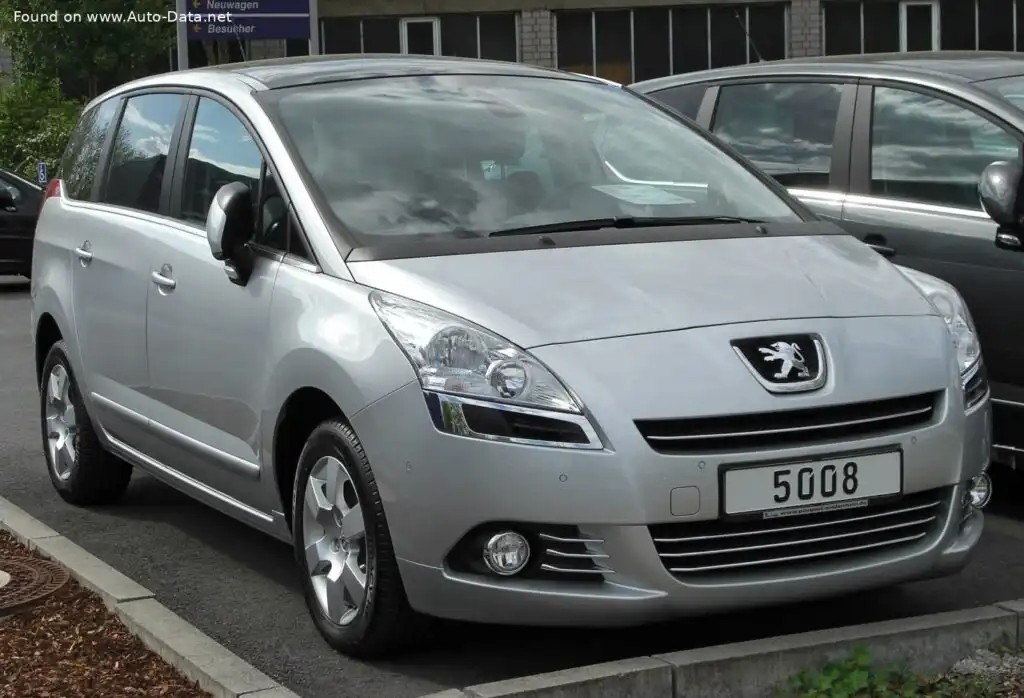
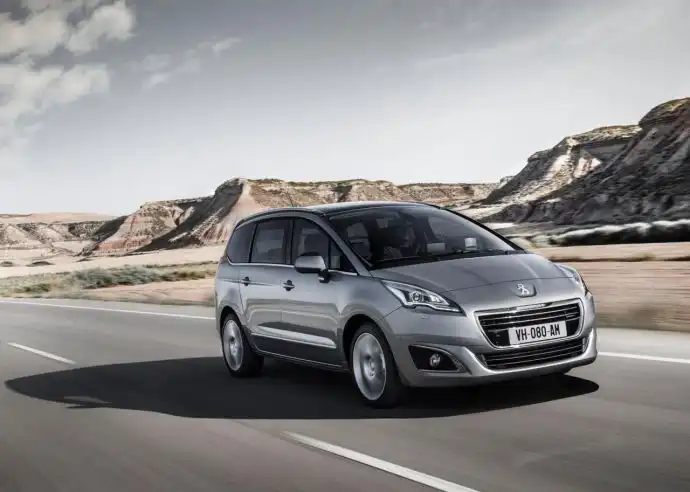
The Peugeot 5008 I (Phase II) 1.6 HDi 115, produced between 2013 and 2015, represents a practical and economical option within the compact MPV segment. This version of the 5008, part of the first generation (introduced in 2009 and facelifted in 2013), was designed to appeal to families needing flexible seating and cargo space. The “Phase II” update brought cosmetic changes, improved interior materials, and enhancements to the infotainment system. The 1.6 HDi engine, a mainstay of Peugeot’s diesel lineup, was chosen for its balance of fuel efficiency and reasonable performance. The seven-seat configuration made it a versatile choice for larger families or those requiring occasional extra passenger capacity.
Powertrain & Engine Architecture
At the heart of this 5008 variant lies the 9HD DV6C 1.6-liter four-cylinder diesel engine. This engine is a member of the DV6 family, known for its robust design and widespread use in PSA Group vehicles (Peugeot, Citroën, and DS Automobiles). It utilizes a common rail direct injection system, delivering fuel at high pressure for optimized combustion. The engine features a turbocharger with an intercooler, boosting power output and improving torque delivery. The 115 horsepower output is achieved at 3600 rpm, while peak torque of 270 Nm (199 lb-ft) is available from 1750 rpm. This torque curve provides good low-end responsiveness, making it suitable for everyday driving. The engine also incorporates a Diesel Particulate Filter (DPF), denoted by the “FAP” in the model name, to reduce particulate emissions and comply with Euro 5 emission standards. The engine is paired with a six-speed manual transmission, offering a good balance between fuel economy and driver control.
Driving Characteristics
The 1.6 HDi 115 hp version of the 5008 offers a comfortable, if not particularly sporty, driving experience. Acceleration from 0-100 km/h takes around 12.9 seconds, which is adequate for most driving situations but noticeably slower than higher-powered variants like the 2.0 HDi. The strength of this engine lies in its mid-range torque, making overtaking and merging onto highways manageable. The six-speed manual transmission is well-matched to the engine, allowing drivers to keep the engine in its optimal power band. Compared to the 2.0 HDi models, the 1.6 HDi feels less strained when fully loaded with passengers and luggage. However, it requires more frequent gear changes, especially when climbing hills. The steering is light and precise, making it easy to maneuver in urban environments. The suspension provides a comfortable ride, absorbing bumps and imperfections in the road surface effectively.
Equipment & Trim Levels
The 1.6 HDi 115 variant of the 5008 typically came with a reasonable level of standard equipment. This included air conditioning, electric front and rear windows, a CD/radio player with USB connectivity, and ABS brakes with Electronic Brakeforce Distribution (EBD). Higher trim levels, often denoted by names like “Active” or “Allure”, added features such as alloy wheels, rear parking sensors, automatic headlights and wipers, cruise control, and a more advanced infotainment system with a touchscreen display. Interior upholstery was typically cloth, with options for upgraded materials on higher trims. The seven-seat configuration featured folding second and third-row seats, allowing for flexible cargo space. Optional extras included a panoramic sunroof, navigation system, and leather upholstery.
Chassis & Braking
The 5008’s chassis utilizes an independent McPherson strut suspension at the front, providing good handling and ride comfort. The rear suspension employs a semi-independent torsion beam setup, which is a cost-effective solution for MPVs. Braking duties are handled by ventilated discs at the front and solid discs at the rear. ABS (Anti-lock Braking System) is standard, enhancing braking performance and stability, particularly in emergency situations. The steering system is a rack and pinion type, offering precise and responsive steering feel. The 5008’s weight-to-power ratio of 13.1 kg/hp reflects its focus on efficiency rather than outright performance.
Market Reception & Comparison
The Peugeot 5008 1.6 HDi 115 was generally well-received by automotive critics as a practical and economical family vehicle. Its fuel efficiency was a major selling point, with combined fuel consumption figures ranging from 4.9 to 5.2 l/100 km. Compared to the more powerful 2.0 HDi variants, the 1.6 HDi offered a lower purchase price and lower running costs, making it attractive to budget-conscious buyers. However, some critics noted its lack of outright performance, particularly when fully loaded. The 1.6 HDi was considered a more sensible choice for drivers who prioritize fuel economy and practicality over sporty driving dynamics. Compared to competitors like the Renault Grand Scénic and Citroën Grand C4 Picasso, the 5008 offered a distinctive styling and a comfortable interior.
Legacy
The 1.6 HDi engine, in general, has proven to be a reliable unit, although the DPF system can be prone to clogging if the vehicle is primarily used for short journeys. Regular servicing and the use of high-quality diesel fuel are essential for maintaining the engine’s longevity. The 5008 I (Phase II) 1.6 HDi 115 remains a popular choice in the used car market, offering a good balance of practicality, fuel efficiency, and affordability. Its seven-seat configuration and flexible interior make it a versatile option for families. However, potential buyers should be aware of the potential maintenance costs associated with the DPF system and ensure that the vehicle has been properly maintained.