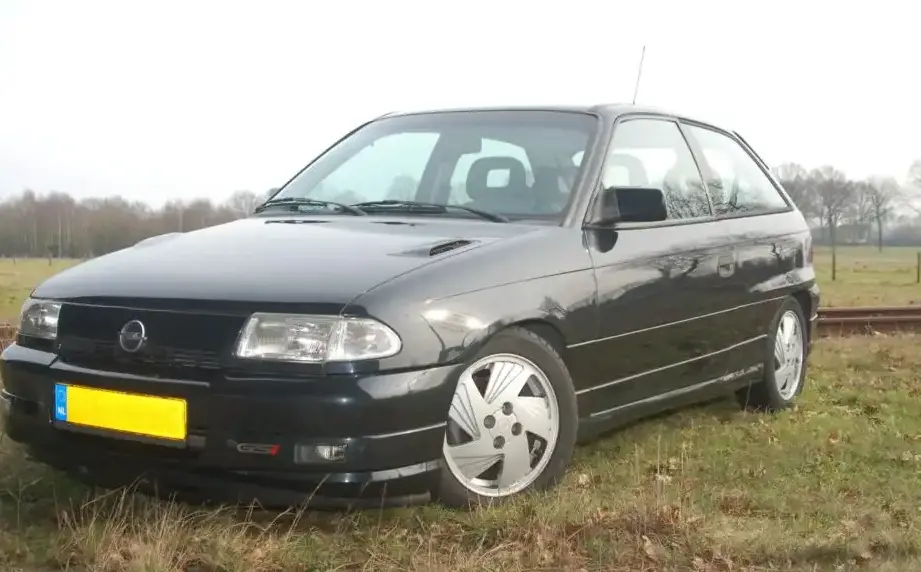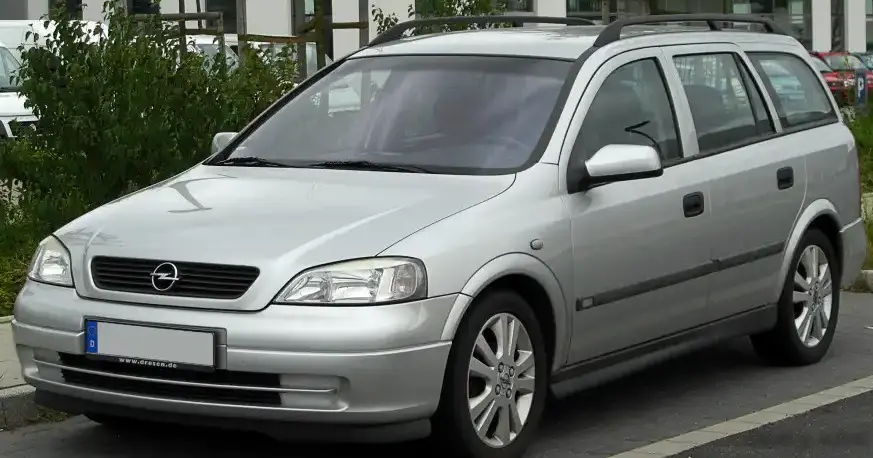
The Opel Astra G Caravan 1.6, producing 75 horsepower, was a mainstay of the European family car market from its introduction in October 1998 until its production run ended in June 2000. Positioned as an entry-level variant within the broader Astra G Caravan (estate) range, it offered practical transportation with a focus on affordability and fuel economy. This model occupied the lower end of the spectrum, appealing to buyers prioritizing value over outright performance. It was part of the G generation of the Astra, built on the GM240 platform, also known as the 1HX0 for the Caravan body style.
Technical Specifications
| Brand | Opel |
| Model | Astra |
| Generation | Astra G Caravan |
| Type (Engine) | 1.6 (75 Hp) |
| Start of production | October, 1998 |
| End of production | June, 2000 |
| Powertrain Architecture | Internal Combustion engine |
| Body type | Station wagon (estate) |
| Seats | 5 |
| Doors | 5 |
| Fuel consumption (urban) | 9.9 l/100 km (23.8 US mpg, 28.5 UK mpg, 10.1 km/l) |
| Fuel consumption (extra urban) | 5.9 l/100 km (39.9 US mpg, 47.9 UK mpg, 16.9 km/l) |
| Fuel consumption (combined) | 7.5 l/100 km (31.4 US mpg, 37.7 UK mpg, 13.3 km/l) |
| CO2 emissions | 180 g/km |
| Fuel Type | Petrol (Gasoline) |
| Acceleration 0 – 100 km/h | 15 sec |
| Acceleration 0 – 62 mph | 15 sec |
| Acceleration 0 – 60 mph | 14.3 sec |
| Maximum speed | 165 km/h (102.53 mph) |
| Emission standard | Euro 2 |
| Weight-to-power ratio | 14.5 kg/Hp, 69.1 Hp/tonne |
| Weight-to-torque ratio | 8.5 kg/Nm, 118 Nm/tonne |
| Power | 75 Hp @ 5200 rpm |
| Power per litre | 46.9 Hp/l |
| Torque | 128 Nm @ 2800 rpm (94.41 lb.-ft. @ 2800 rpm) |
| Engine layout | Front, Transverse |
| Engine Model/Code | X16SZR |
| Engine displacement | 1598 cm3 (97.52 cu. in.) |
| Number of cylinders | 4 |
| Engine configuration | Inline |
| Cylinder Bore | 79 mm (3.11 in.) |
| Piston Stroke | 81.5 mm (3.21 in.) |
| Compression ratio | 9.6:1 |
| Number of valves per cylinder | 2 |
| Fuel injection system | Multi-port manifold injection |
| Engine aspiration | Naturally aspirated engine |
| Valvetrain | SOHC |
| Engine oil capacity | 3.25 l (3.43 US qt, 2.86 UK qt) |
| Coolant | 5.8 l (6.13 US qt, 5.1 UK qt) |
| Kerb Weight | 1085 kg (2392.02 lbs.) |
| Max. weight | 1605 kg (3538.42 lbs.) |
| Max load | 520 kg (1146.4 lbs.) |
| Trunk (boot) space – minimum | 480 l (16.95 cu. ft.) |
| Trunk (boot) space – maximum | 1500 l (52.97 cu. ft.) |
| Fuel tank capacity | 52 l (13.74 US gal, 11.44 UK gal) |
| Max. roof load | 100 kg (220.46 lbs.) |
| Permitted trailer load with brakes (12%) | 900 kg (1984.16 lbs.) |
| Permitted trailer load without brakes | 600 kg (1322.77 lbs.) |
| Permitted towbar download | 75 kg (165.35 lbs.) |
| Length | 4288 mm (168.82 in.) |
| Width | 1709 mm (67.28 in.) |
| Width including mirrors | 1989 mm (78.31 in.) |
| Height | 1510 mm (59.45 in.) |
| Wheelbase | 2611 mm (102.8 in.) |
| Front track | 1464 mm (57.64 in.) |
| Rear (Back) track | 1452 mm (57.17 in.) |
| Drag coefficient (Cd) | 0.31 |
| Minimum turning circle | 10.8 m (35.43 ft.) |
| Drivetrain Architecture | The Internal combustion engine (ICE) drives the front wheels of the vehicle. |
| Drive wheel | Front wheel drive |
| Number of gears and type of gearbox | 5 gears, manual transmission |
| Front suspension | Independent, type McPherson with coil spring and anti-roll bar |
| Rear suspension | Semi-independent, coil spring |
| Front brakes | Ventilated discs |
| Rear brakes | Drum |
| Assisting systems | ABS (Anti-lock braking system) |
| Steering type | Steering rack and pinion |
| Power steering | Hydraulic Steering |
| Tires size | 185/65 R15; 195/60 R15; 205/50 R16 |
| Wheel rims size | 6J x 15; 6.5J x 15; 6.5J x 16 |
Powertrain & Engine Architecture
The Astra G Caravan 1.6 utilized the Opel X16SZR engine, a 1.6-liter inline-four cylinder petrol engine. This engine was a common sight in various Opel and Vauxhall models of the era. The X16SZR featured a single overhead camshaft (SOHC) valvetrain operating two valves per cylinder. Fuel delivery was managed by a multi-port fuel injection system, providing a balance between efficiency and performance. The engine’s relatively simple design contributed to its reliability and ease of maintenance. The 75 horsepower output was achieved at 5200 rpm, with peak torque of 128 Nm (94.41 lb-ft) arriving at 2800 rpm. The engine was transversely mounted in the front of the vehicle, driving the front wheels. The standard transmission for this variant was a five-speed manual gearbox, although a four-speed automatic transmission was also offered as an option, albeit less common.
Driving Characteristics
The 1.6-liter engine, paired with the five-speed manual transmission, provided adequate, but not exhilarating, performance. Acceleration from 0 to 100 km/h (0-62 mph) took approximately 15 seconds. The engine felt somewhat strained when pushed hard, particularly when fully loaded. The automatic transmission option further dulled performance, increasing acceleration times. However, for everyday driving and commuting, the 1.6L engine proved sufficient. The gear ratios were tuned for fuel efficiency rather than outright speed. Compared to the more powerful 1.8-liter and 2.0-liter variants, the 1.6 offered a smoother, more relaxed driving experience, but lacked the punch needed for spirited driving or frequent overtaking.
Equipment & Trim Levels
The 1.6-liter Astra G Caravan typically came with a basic level of equipment. Standard features included power steering, central locking, and an adjustable steering column. Interior upholstery was typically cloth, and the dashboard featured a simple, functional design. Optional extras included air conditioning, electric windows, and an upgraded audio system. Trim levels varied slightly depending on the market, but generally, the 1.6 represented the entry point into the Astra G Caravan range. Higher trim levels, such as the Elegance or Sport, offered more luxurious features and upgraded interior appointments.
Chassis & Braking
The Astra G Caravan featured an independent McPherson strut suspension at the front, providing a comfortable ride and decent handling. The rear suspension was a semi-independent torsion beam setup, which was cost-effective but less sophisticated than a fully independent system. Braking was handled by ventilated discs at the front and drum brakes at the rear. Anti-lock Braking System (ABS) was standard, enhancing safety. The chassis was designed to balance ride comfort with reasonable handling characteristics, prioritizing practicality over sporty dynamics. Stabilizer bars were fitted to both the front and rear axles to reduce body roll during cornering.
Market Reception & Comparison
The Astra G Caravan 1.6 was generally well-received as a practical and affordable family car. Critics praised its fuel economy and spacious interior, but noted its lack of performance. Compared to the higher-output variants, the 1.6 offered significantly lower running costs but lacked the driving excitement. The 1.8-liter version, while more expensive, provided a noticeable performance boost. The diesel variants, such as the 1.7 TDI, offered even better fuel economy but were often noisier and less refined. The 1.6L automatic was often criticized for its sluggish performance and dated transmission technology.
Legacy
The Opel Astra G Caravan 1.6, while not a performance icon, proved to be a reliable and durable vehicle. The X16SZR engine is known for its longevity, and many examples are still on the road today. In the used car market, these models are often sought after by buyers looking for an affordable and practical estate car. Maintenance costs are relatively low, and spare parts are readily available. However, potential buyers should be aware of common issues such as corrosion and wear and tear on suspension components. The Astra G Caravan 1.6 remains a testament to Opel’s commitment to providing practical and affordable transportation for the masses.