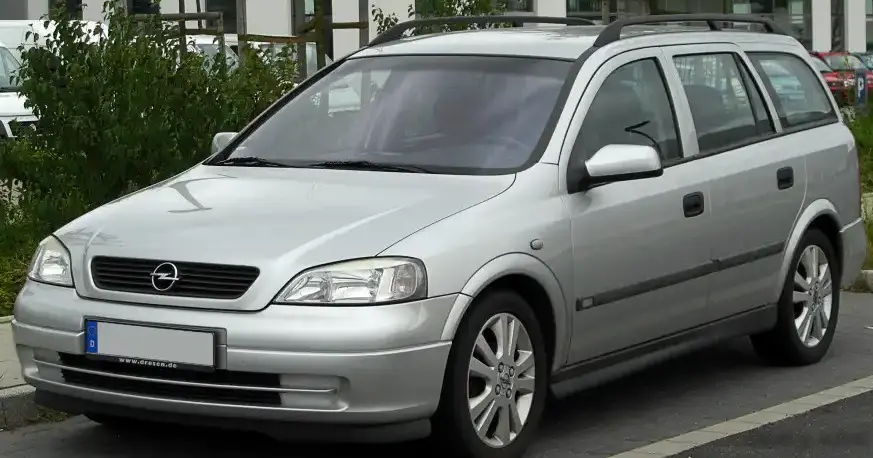
The Opel Astra G Caravan 1.6i, producing 85 horsepower with an automatic transmission, was a mainstay of the European family car market from 2000 to 2002. Positioned as an entry-level to mid-range offering within the broader Astra G Caravan (estate) lineup, it provided a practical and affordable option for buyers prioritizing fuel efficiency and ease of use over outright performance. This variant was part of the G generation of the Astra, internally designated as the 1HX0/A3 platform, which represented a significant step forward in Opel’s design and engineering. The Caravan body style, a station wagon, was particularly popular in Europe for its increased cargo capacity and versatility.
Technical Specifications
| Brand | Opel |
| Model | Astra |
| Generation | Astra G Caravan |
| Type (Engine) | 1.6i (85 Hp) Automatic |
| Start of production | July, 2000 |
| End of production | 2002 |
| Powertrain Architecture | Internal Combustion engine |
| Body type | Station wagon (estate) |
| Seats | 5 |
| Doors | 5 |
| Fuel consumption (urban) | 11.4 l/100 km (20.6 US mpg, 24.8 UK mpg, 8.8 km/l) |
| Fuel consumption (extra urban) | 6.6 l/100 km (35.6 US mpg, 42.8 UK mpg, 15.2 km/l) |
| Fuel consumption (combined) | 8.4 l/100 km (28 US mpg, 33.6 UK mpg, 11.9 km/l) |
| Fuel Type | Petrol (Gasoline) |
| Acceleration 0 – 100 km/h | 15 sec |
| Acceleration 0 – 62 mph | 15 sec |
| Acceleration 0 – 60 mph | 14.3 sec |
| Maximum speed | 167 km/h (103.77 mph) |
| Emission standard | Euro 3 |
| Weight-to-power ratio | 13.9 kg/Hp, 72 Hp/tonne |
| Weight-to-torque ratio | 8.6 kg/Nm, 116.9 Nm/tonne |
| Power | 85 Hp @ 5400 rpm |
| Power per litre | 53.2 Hp/l |
| Torque | 138 Nm @ 2600 rpm (101.78 lb.-ft. @ 2600 rpm) |
| Engine layout | Front, Transverse |
| Engine Model/Code | Z16SE |
| Engine displacement | 1598 cm3 (97.52 cu. in.) |
| Number of cylinders | 4 |
| Engine configuration | Inline |
| Cylinder Bore | 79 mm (3.11 in.) |
| Piston Stroke | 81.5 mm (3.21 in.) |
| Compression ratio | 9.6:1 |
| Number of valves per cylinder | 2 |
| Fuel injection system | Multi-port manifold injection |
| Engine aspiration | Naturally aspirated engine |
| Valvetrain | SOHC |
| Engine oil capacity | 3.5 l (3.7 US qt | 3.08 UK qt) |
| Coolant | 5.9 l (6.23 US qt | 5.19 UK qt) |
| Kerb Weight | 1180 kg (2601.45 lbs.) |
| Max. weight | 1730 kg (3814 lbs.) |
| Max load | 550 kg (1212.54 lbs.) |
| Trunk (boot) space – minimum | 480 l (16.95 cu. ft.) |
| Trunk (boot) space – maximum | 1500 l (52.97 cu. ft.) |
| Fuel tank capacity | 52 l (13.74 US gal | 11.44 UK gal) |
| Max. roof load | 100 kg (220.46 lbs.) |
| Permitted towbar download | 75 kg (165.35 lbs.) |
| Length | 4288 mm (168.82 in.) |
| Width | 1709 mm (67.28 in.) |
| Width including mirrors | 1989 mm (78.31 in.) |
| Height | 1510 mm (59.45 in.) |
| Wheelbase | 2611 mm (102.8 in.) |
| Front track | 1464 mm (57.64 in.) |
| Rear (Back) track | 1452 mm (57.17 in.) |
| Drag coefficient (Cd) | 0.31 |
| Minimum turning circle | 10.8 m (35.43 ft.) |
| Drivetrain Architecture | The Internal combustion engine (ICE) drives the front wheels of the vehicle. |
| Drive wheel | Front wheel drive |
| Number of gears and type of gearbox | 4 gears, automatic transmission |
| Front suspension | Independent, type McPherson with coil spring and anti-roll bar |
| Rear suspension | Semi-independent, coil spring |
| Front brakes | Ventilated discs |
| Rear brakes | Disc |
| Assisting systems | ABS (Anti-lock braking system) |
| Steering type | Steering rack and pinion |
| Power steering | Hydraulic Steering |
| Tires size | 185/65 R15 |
| Wheel rims size | 6J x 15 |
Powertrain & Engine Architecture
The heart of this Astra variant is the Z16SE engine, a 1.6-liter inline-four cylinder gasoline engine. This engine, common in various Opel and Vauxhall models of the era, is characterized by its simplicity and relatively low maintenance requirements. It utilizes a single overhead camshaft (SOHC) valvetrain operating two valves per cylinder. Fuel delivery is managed by a multi-port fuel injection system, providing adequate, though not exceptional, combustion efficiency. The engine’s 85 horsepower output at 5400 rpm and 138 Nm (101.78 lb-ft) of torque at 2600 rpm are modest figures, reflecting its positioning as an economy-focused option. The engine is transversely mounted, driving the front wheels. Paired with the Z16SE is a four-speed automatic transmission. This transmission, while providing convenience, contributes to slightly lower fuel economy and slower acceleration compared to the available five-speed manual gearbox.
Driving Characteristics
The 1.6i automatic Astra G Caravan delivers a comfortable, if uninspiring, driving experience. Acceleration is noticeably slower than the more powerful 1.8-liter or diesel variants. The 0-100 km/h (0-62 mph) time of 15 seconds confirms this. The four-speed automatic transmission, while smooth in operation, lacks the responsiveness and gear ratios of more modern automatics. This results in the engine feeling strained during overtaking maneuvers or when climbing hills. The gear ratios are optimized for fuel economy rather than performance. However, for everyday commuting and relaxed cruising, the powertrain is perfectly adequate. The suspension setup, featuring McPherson struts at the front and a semi-independent coil spring arrangement at the rear, provides a reasonably comfortable ride, absorbing most road imperfections without excessive body roll.
Equipment & Trim Levels
The 1.6i automatic trim typically included basic features such as power steering, central locking, electric front windows, and an adjustable steering column. Interior upholstery was generally cloth, with a functional, if somewhat basic, dashboard layout. Optional extras, depending on the market and individual specification, could include air conditioning, alloy wheels, a radio/cassette player, and upgraded interior trim. Safety features were relatively standard for the time, including ABS (Anti-lock Braking System) and driver and passenger airbags. This trim level was aimed at buyers who prioritized practicality and affordability over luxury features.
Chassis & Braking
The Astra G Caravan’s chassis is a typical European compact car design, prioritizing space efficiency and handling balance. The front suspension utilizes McPherson struts, known for their relatively simple and cost-effective design. The rear suspension employs a semi-independent coil spring setup, offering a compromise between ride comfort and handling precision. Braking duties are handled by ventilated discs at the front and solid discs at the rear, providing adequate stopping power for the vehicle’s weight and performance. The hydraulic power steering provides light and easy steering input, making it maneuverable in urban environments.
Market Reception & Comparison
The Astra G Caravan 1.6i automatic was generally well-received as a practical and affordable family car. Critics acknowledged its fuel efficiency and comfortable ride, but often noted its lack of performance compared to higher-powered variants. Compared to the 1.8-liter models, the 1.6i offered significantly less power and acceleration, but at a lower purchase price and with slightly better fuel economy. The diesel variants, such as the 1.7 TDI, provided even better fuel economy but were often more expensive to maintain. The automatic transmission, while convenient, was often criticized for its lack of responsiveness and contribution to slightly higher fuel consumption compared to the manual gearbox.
Legacy
The Opel Astra G Caravan 1.6i automatic, while not a performance icon, remains a relatively reliable and affordable used car option today. The Z16SE engine is known for its durability, provided it has been regularly maintained. Common issues include oil leaks and occasional sensor failures, but these are generally inexpensive to repair. The four-speed automatic transmission, while not the most sophisticated, is generally robust. The Astra G Caravan’s spacious interior and practical estate body style continue to appeal to buyers seeking a versatile and economical family vehicle. Its simplicity and relatively low running costs make it a popular choice for first-time car owners or those on a budget.