Technical Specifications
| Brand | Opel |
| Model | Astra |
| Generation | Astra G Caravan |
| Type (Engine) | 1.7 DTI 16V (75 Hp) |
| Start of production | February, 2000 |
| End of production | 2002 |
| Powertrain Architecture | Internal Combustion engine |
| Body type | Station wagon (estate) |
| Seats | 5 |
| Doors | 5 |
| Fuel consumption (urban) | 6.2 l/100 km (37.9 US mpg, 45.6 UK mpg, 16.1 km/l) |
| Fuel consumption (extra urban) | 4.1 l/100 km (57.4 US mpg, 68.9 UK mpg, 24.4 km/l) |
| Fuel consumption (combined) | 4.9 l/100 km (48 US mpg, 57.6 UK mpg, 20.4 km/l) |
| CO2 emissions | 132 g/km |
| Fuel Type | Diesel |
| Acceleration 0 – 100 km/h | 15 sec |
| Acceleration 0 – 62 mph | 15 sec |
| Acceleration 0 – 60 mph | 14.3 sec |
| Maximum speed | 165 km/h (102.53 mph) |
| Emission standard | Euro 3 |
| Weight-to-power ratio | 16 kg/Hp, 62.3 Hp/tonne |
| Weight-to-torque ratio | 7.3 kg/Nm, 137.2 Nm/tonne |
| Power | 75 Hp @ 4400 rpm |
| Power per litre | 44.5 Hp/l |
| Torque | 165 Nm @ 1800 rpm (121.7 lb.-ft. @ 1800 rpm) |
| Engine layout | Front, Transverse |
| Engine Model/Code | Y17DT |
| Engine displacement | 1686 cm3 (102.89 cu. in.) |
| Number of cylinders | 4 |
| Engine configuration | Inline |
| Cylinder Bore | 79 mm (3.11 in.) |
| Piston Stroke | 86 mm (3.39 in.) |
| Compression ratio | 18.4:1 |
| Number of valves per cylinder | 4 |
| Fuel injection system | Direct injection |
| Engine aspiration | Turbocharger, Intercooler |
| Valvetrain | DOHC |
| Engine oil capacity | 4.5 l (4.76 US qt | 3.96 UK qt) |
| Coolant | 7.1 l (7.5 US qt | 6.25 UK qt) |
| Kerb Weight | 1203 kg (2652.16 lbs.) |
| Max. weight | 1780 kg (3924.23 lbs.) |
| Max load | 577 kg (1272.07 lbs.) |
| Trunk (boot) space – minimum | 480 l (16.95 cu. ft.) |
| Trunk (boot) space – maximum | 1500 l (52.97 cu. ft.) |
| Fuel tank capacity | 52 l (13.74 US gal | 11.44 UK gal) |
| Max. roof load | 100 kg (220.46 lbs.) |
| Permitted trailer load with brakes (12%) | 1100 kg (2425.08 lbs.) |
| Permitted trailer load without brakes | 600 kg (1322.77 lbs.) |
| Permitted towbar download | 75 kg (165.35 lbs.) |
| Length | 4288 mm (168.82 in.) |
| Width | 1709 mm (67.28 in.) |
| Width including mirrors | 1989 mm (78.31 in.) |
| Height | 1510 mm (59.45 in.) |
| Wheelbase | 2611 mm (102.8 in.) |
| Front track | 1464 mm (57.64 in.) |
| Rear (Back) track | 1452 mm (57.17 in.) |
| Drag coefficient (Cd) | 0.31 |
| Minimum turning circle | 10.8 m (35.43 ft.) |
| Drivetrain Architecture | The Internal combustion engine (ICE) drives the front wheels of the vehicle. |
| Drive wheel | Front wheel drive |
| Number of gears and type of gearbox | 5 gears, manual transmission |
| Front suspension | Independent, type McPherson with coil spring and anti-roll bar |
| Rear suspension | Semi-independent, coil spring |
| Front brakes | Ventilated discs |
| Rear brakes | Drum |
| Assisting systems | ABS (Anti-lock braking system) |
| Steering type | Steering rack and pinion |
| Power steering | Hydraulic Steering |
| Tires size | 195/60 R15 |
| Wheel rims size | 6J x 15 |
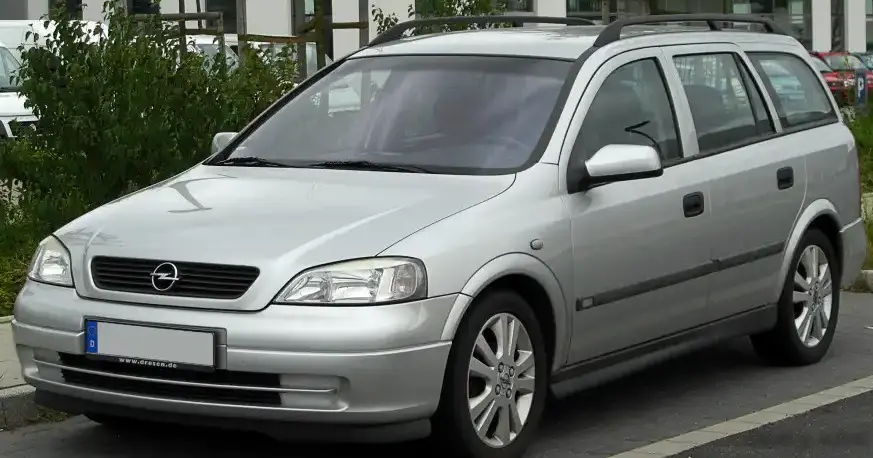
The Opel Astra G Caravan 1.7 DTI 16V, produced from February 2000 to 2002, was an entry-level diesel variant within the broader Astra G Caravan (estate) range. Positioned as a fuel-efficient and practical option, it appealed to buyers who prioritized economy and load-carrying capacity over outright performance. This variant utilized Opel’s Y17DT engine, a 1.7-liter common rail diesel, and was typically paired with a five-speed manual transmission, although automatic options were available in some markets. The Astra G generation (1998-2004) was a significant model for Opel, building upon the success of its predecessor and introducing improved safety features and a more refined driving experience.
Powertrain & Engine Architecture
The heart of the Astra G Caravan 1.7 DTI 16V is the Y17DT engine, a 1.7-liter inline-four cylinder diesel. This engine utilizes direct fuel injection and a turbocharger with an intercooler to enhance power and efficiency. The direct injection system, a key feature of this engine, allows for precise fuel delivery directly into the combustion chamber, improving combustion efficiency and reducing emissions. The 16-valve DOHC (Double Overhead Camshaft) valvetrain further optimizes airflow into and out of the cylinders. The Y17DT engine is known for its relatively robust construction, though it can be susceptible to turbocharger issues with age and high mileage. The five-speed manual transmission was the most common pairing, offering a reasonable balance between fuel economy and drivability. An automatic transmission was available, but it generally detracted from the engine’s already modest performance.
Driving Characteristics
The 1.7 DTI 16V, with its 75 horsepower and 165 Nm (121.7 lb-ft) of torque, provided adequate, but not exhilarating, performance. Acceleration from 0-60 mph took around 14.3 seconds, and top speed was limited to 165 km/h (102.53 mph). The engine’s torque peak at 1800 rpm meant that it felt relatively responsive in everyday driving situations, particularly when overtaking at lower speeds. However, the engine could feel strained when fully loaded or climbing steep hills. Compared to the more powerful 1.8-liter gasoline engines or the 2.0-liter DTI, the 1.7 DTI offered significantly less performance. The manual transmission allowed for greater control and efficiency, while the automatic version, though convenient, resulted in noticeable power loss and slower acceleration.
Equipment & Trim Levels
The 1.7 DTI 16V typically came with a fairly basic level of equipment, reflecting its position as an entry-level model. Standard features generally included power steering, ABS brakes, central locking, and an adjustable steering column. Interior upholstery was typically cloth, and the dashboard featured a simple, functional design. Optional extras included air conditioning, electric windows, and an upgraded audio system. Higher trim levels, such as the Elegance or Sport, offered additional features like alloy wheels, upgraded interior trim, and fog lights, but were usually paired with more powerful engines.
Chassis & Braking
The Astra G Caravan’s chassis featured an independent McPherson strut suspension at the front and a semi-independent coil spring suspension at the rear. This setup provided a reasonable balance between ride comfort and handling. The front brakes were ventilated discs, offering good stopping power, while the rear brakes were drums, which were adequate for the vehicle’s weight and performance. Stabilizer bars were fitted to both the front and rear axles to reduce body roll during cornering. The suspension tuning was generally geared towards comfort rather than sporty handling.
Market Reception & Comparison
The Astra G Caravan 1.7 DTI 16V was generally well-received as a practical and economical estate car. Critics praised its fuel efficiency and spacious interior, but noted its lack of performance. Compared to the gasoline-powered Astra G models, the 1.7 DTI offered significantly better fuel economy, but at the expense of acceleration and refinement. Against competitors like the Ford Focus Estate and Volkswagen Golf Estate, the Astra G Caravan 1.7 DTI offered a competitive package in terms of price and practicality. However, some rivals offered more refined engines or a more premium interior.
Legacy
The Y17DT engine, while generally reliable, is known to be susceptible to issues with the turbocharger and fuel injectors as it ages. Regular maintenance, including oil changes and filter replacements, is crucial for ensuring long-term reliability. Today, the Astra G Caravan 1.7 DTI 16V can be found as an affordable used car, appealing to buyers seeking a practical and economical estate. Its simple mechanical design makes it relatively easy to maintain and repair, and parts availability is generally good. While not a performance icon, the 1.7 DTI variant remains a testament to Opel’s commitment to providing affordable and functional transportation.