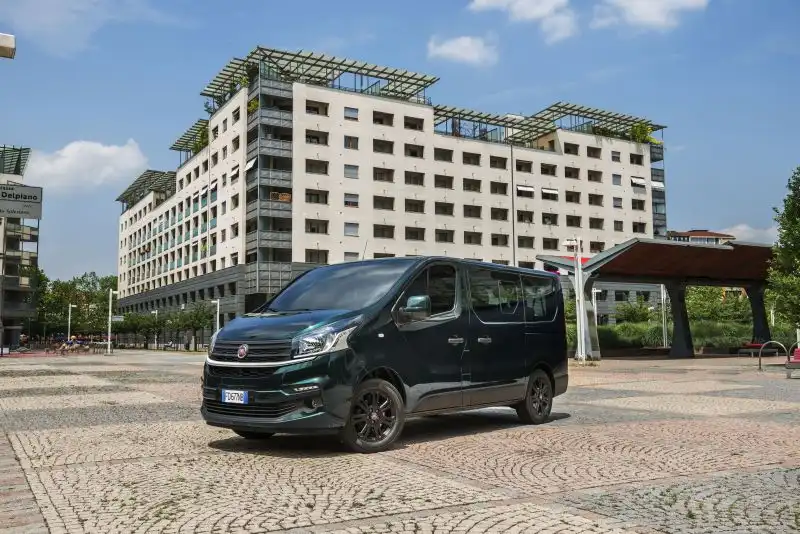
The Fiat Talento Crew Cab 1.6 Ecojet (125 hp) L2H1 is a commercial vehicle produced by Fiat Professional from 2016 to 2021. Part of the second generation Talento range, this variant offered a balance between cargo capacity, passenger space, and fuel efficiency, aimed at businesses requiring a versatile van for both transport and crew needs. The “L2H1” designation refers to the vehicle’s length and roof height – Long wheelbase and standard roof – positioning it as a mid-size option within the Talento lineup. It was primarily marketed in Europe, where light commercial vehicles of this type are highly popular.
Technical Specifications
| Brand | Fiat |
| Model | Talento |
| Generation | Talento Crew Cab |
| Type (Engine) | 1.6 Ecojet (125 Hp) L2H1 |
| Start of production | 2016 |
| End of production | 2021 |
| Powertrain Architecture | Internal Combustion engine |
| Body type | Minivan |
| Seats | 6 |
| Doors | 5 |
| Fuel consumption (urban) | 7 l/100 km (33.6 US mpg, 40.4 UK mpg, 14.3 km/l) |
| Fuel consumption (extra urban) | 5.6 l/100 km (42 US mpg, 50.4 UK mpg, 17.9 km/l) |
| Fuel consumption (combined) | 6.1 l/100 km (38.6 US mpg, 46.3 UK mpg, 16.4 km/l) |
| CO2 emissions | 159 g/km |
| Fuel Type | Diesel |
| Maximum speed | 174 km/h (108.12 mph) |
| Emission standard | Euro 6 |
| Weight-to-power ratio | 15.3 kg/Hp, 65.2 Hp/tonne |
| Weight-to-torque ratio | 6 kg/Nm, 167 Nm/tonne |
| Power | 125 Hp @ 3500 rpm |
| Power per litre | 78.2 Hp/l |
| Torque | 320 Nm @ 1500 rpm (236.02 lb.-ft. @ 1500 rpm) |
| Engine layout | Front, Transverse |
| Engine Model/Code | R9M 452 |
| Engine displacement | 1598 cm3 (97.52 cu. in.) |
| Number of cylinders | 4 |
| Engine configuration | Inline |
| Cylinder Bore | 80 mm (3.15 in.) |
| Piston Stroke | 79.5 mm (3.13 in.) |
| Compression ratio | 15.45:1 |
| Number of valves per cylinder | 4 |
| Fuel injection system | Diesel Commonrail |
| Engine aspiration | Twin-Turbo, Intercooler |
| Engine oil capacity | 7.4 l (7.82 US qt | 6.51 UK qt) |
| Coolant | 9.5 l (10.04 US qt | 8.36 UK qt) |
| Kerb Weight | 1916 kg (4224.06 lbs.) |
| Max. weight | 2940 kg (6481.59 lbs.) |
| Max load | 1024 kg (2257.53 lbs.) |
| Trunk (boot) space – maximum | 4000 l (141.26 cu. ft.) |
| Fuel tank capacity | 80 l (21.13 US gal | 17.6 UK gal) |
| Permitted trailer load with brakes (12%) | 2000 kg (4409.25 lbs.) |
| Permitted trailer load without brakes | 750 kg (1653.47 lbs.) |
| Length | 5399 mm (212.56 in.) |
| Width | 1956 mm (77.01 in.) |
| Width including mirrors | 2283 mm (89.88 in.) |
| Height | 1971 mm (77.6 in.) |
| Wheelbase | 3498 mm (137.72 in.) |
| Front track | 1615 mm (63.58 in.) |
| Rear (Back) track | 1628 mm (64.09 in.) |
| Front overhang | 933 mm (36.73 in.) |
| Rear overhang | 968 mm (38.11 in.) |
| Minimum turning circle (turning diameter) | 13.73 m (45.05 ft.) |
| Drivetrain Architecture | The Internal combustion engine (ICE) drives the front wheels of the vehicle. |
| Drive wheel | Front wheel drive |
| Number of gears and type of gearbox | 6 gears, manual transmission |
| Front suspension | Independent, type McPherson with coil spring and anti-roll bar |
| Rear suspension | Semi-independent, coil spring |
| Front brakes | Ventilated discs |
| Rear brakes | Disc |
| Assisting systems | ABS (Anti-lock braking system) |
| Steering type | Steering rack and pinion |
| Power steering | Hydraulic Steering |
| Tires size | 205/65 R16; 215/60 R17 |
| Wheel rims size | 16; 17 |
INTRODUCTION
The Fiat Talento Crew Cab 1.6 Ecojet (125 hp) L2H1, launched in 2016, represented Fiat Professional’s entry into the increasingly competitive mid-size van segment. Built in collaboration with Renault (sharing a platform with the Renault Trafic and Opel Vivaro), the Talento aimed to provide a practical and efficient solution for businesses needing a van capable of carrying both passengers and cargo. The Crew Cab configuration, with its second row of seats, specifically targeted tradespeople and service industries. The 1.6 Ecojet engine, paired with a six-speed manual transmission, was positioned as a workhorse option, prioritizing fuel economy and reliability over outright performance.
Powertrain & Engine Architecture
The heart of the Talento Crew Cab 1.6 Ecojet is the R9M 452 engine, a 1.6-liter inline-four cylinder diesel engine. This engine utilizes a common rail direct injection system, delivering fuel at extremely high pressure for optimized combustion. A key feature is its twin-turbocharger setup, incorporating a small, low-inertia turbo for rapid response and a larger turbo for sustained power delivery. An intercooler further enhances performance by cooling the intake air. The engine produces 125 horsepower at 3500 rpm and 320 Nm (236 lb-ft) of torque at a low 1500 rpm, providing good pulling power for hauling loads. The six-speed manual transmission was the standard offering for this variant, chosen for its efficiency and driver control. The engine meets Euro 6 emission standards, incorporating a diesel particulate filter (DPF) to reduce harmful emissions.
Driving Characteristics
The 1.6 Ecojet engine, while not exceptionally powerful, provides adequate performance for typical commercial van duties. Acceleration is modest, but the readily available 320 Nm of torque ensures strong pulling power, making it suitable for carrying heavy loads. The six-speed manual transmission allows for efficient cruising on highways, while the relatively low-revving nature of the engine contributes to good fuel economy. Compared to higher-powered Talento variants (such as those with the 150 hp version of the 1.6 Ecojet or the 2.3-liter engine), the 125 hp model feels less responsive, particularly when fully loaded. However, this trade-off is offset by improved fuel efficiency and potentially lower maintenance costs. The gear ratios are well-chosen for maximizing torque and minimizing engine strain.
Equipment & Trim Levels
The Talento Crew Cab 1.6 Ecojet L2H1 typically came with a functional, rather than luxurious, equipment level. Standard features included air conditioning, a basic audio system with USB connectivity, electric front windows, and a driver’s airbag. The Crew Cab configuration featured a second row of seats, usually with a 60/40 split-folding arrangement for flexible cargo space. Optional extras included rear parking sensors, a touchscreen infotainment system with navigation, cruise control, and upgraded interior trim. The interior was generally constructed from durable, hard-wearing materials designed to withstand the rigors of commercial use. The dashboard layout was straightforward and functional, prioritizing ease of use.
Chassis & Braking
The Talento utilizes a front-wheel-drive layout, contributing to its relatively low weight and good fuel efficiency. The front suspension employs an independent McPherson strut setup with coil springs and an anti-roll bar, providing a comfortable ride and stable handling. The rear suspension is a semi-independent coil spring arrangement. Braking is handled by ventilated discs at the front and solid discs at the rear, equipped with an Anti-lock Braking System (ABS) as standard. The hydraulic power steering provides light and precise steering control. Tire sizes typically ranged from 205/65 R16 to 215/60 R17, depending on the trim level and optional equipment.
Market Reception & Comparison
The Fiat Talento Crew Cab 1.6 Ecojet (125 hp) L2H1 was generally well-received by critics as a practical and economical work van. It was praised for its spacious interior, good fuel economy, and competitive pricing. However, some reviewers noted that the 125 hp engine could feel underpowered when fully loaded, particularly on hilly terrain. Compared to other vans in its class, such as the Renault Trafic and Opel Vivaro (with which it shares a platform), the Talento offered a similar level of performance and practicality. The 1.6 Ecojet engine offered a good balance between fuel efficiency and cost, making it an attractive option for businesses prioritizing running costs. Higher-powered Talento variants offered more performance but came at a higher price and with potentially lower fuel economy.
Legacy
The Fiat Talento Crew Cab 1.6 Ecojet (125 hp) L2H1 has proven to be a relatively reliable workhorse in the used car market. The 1.6 Ecojet engine, while not without its potential issues (such as DPF clogging if not properly maintained), is generally considered durable and long-lasting. Regular servicing and adherence to recommended maintenance schedules are crucial for ensuring the longevity of the engine and other components. Today, these vans represent a cost-effective option for businesses needing a versatile and practical commercial vehicle. Their relatively simple mechanical design and readily available parts contribute to their affordability and ease of maintenance.