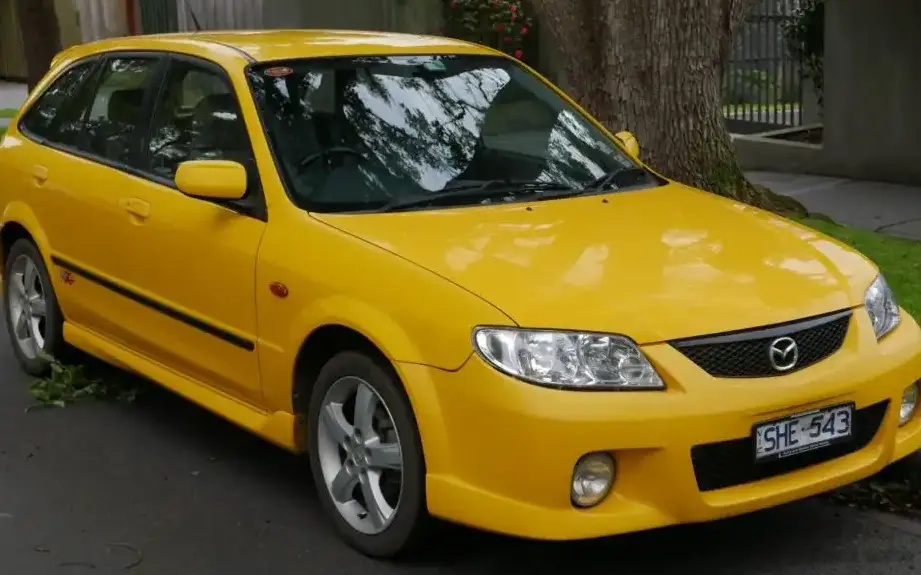
The Mazda 323 F VI (BJ) 2.0 DiTD, produced from 2000 to 2003, represented a significant offering in Mazda’s compact hatchback lineup. Positioned as a diesel-powered variant within the sixth generation (BJ platform) of the 323F, it aimed to provide a balance of fuel efficiency and reasonable performance for European and other international markets. This model served as a practical and economical choice for buyers seeking a versatile, five-door hatchback. The 2.0 DiTD trim occupied a middle ground in the 323F range, offering a step up in performance from the lower-displacement gasoline engines while remaining more affordable than the higher-output petrol versions.
Technical Specifications
| Brand | Mazda |
| Model | 323 |
| Generation | 323 F VI (BJ) |
| Type (Engine) | 2.0 DiTD (101 Hp) |
| Start of production | 2000 |
| End of production | 2003 |
| Powertrain Architecture | Internal Combustion engine |
| Body type | Hatchback |
| Seats | 5 |
| Doors | 5 |
| Fuel consumption (urban) | 7.4 l/100 km (31.8 US mpg) |
| Fuel consumption (extra urban) | 4.9 l/100 km (48 US mpg) |
| Fuel consumption (combined) | 5.8 l/100 km (40.6 US mpg) |
| Fuel Type | Diesel |
| Acceleration 0 – 100 km/h | 12.2 sec |
| Acceleration 0 – 62 mph | 12.2 sec |
| Acceleration 0 – 60 mph | 11.6 sec |
| Maximum speed | 187 km/h (116.2 mph) |
| Weight-to-power ratio | 11.8 kg/Hp |
| Weight-to-torque ratio | 5.2 kg/Nm |
| Power | 101 Hp @ 4000 rpm |
| Torque | 230 Nm @ 2000 rpm (169.64 lb.-ft. @ 2000 rpm) |
| Engine layout | Front, Transverse |
| Engine Model/Code | RF4F |
| Engine displacement | 1998 cm3 (121.93 cu. in.) |
| Number of cylinders | 4 |
| Engine configuration | Inline |
| Cylinder Bore | 86 mm (3.39 in.) |
| Piston Stroke | 86 mm (3.39 in.) |
| Compression ratio | 18.8:1 |
| Number of valves per cylinder | 4 |
| Fuel injection system | Direct injection |
| Engine aspiration | Turbocharger |
| Valvetrain | DOHC |
| Engine oil capacity | 4.7 l (4.97 US qt | 4.14 UK qt) |
| Coolant capacity | 9 l (9.51 US qt | 7.92 UK qt) |
| Kerb Weight | 1195 kg (2634.52 lbs.) |
| Max. weight | 1650 kg (3637.63 lbs.) |
| Max load | 455 kg (1003.1 lbs.) |
| Trunk (boot) space – minimum | 355 l (12.54 cu. ft.) |
| Trunk (boot) space – maximum | 1000 l (35.31 cu. ft.) |
| Fuel tank capacity | 55 l (14.53 US gal | 12.1 UK gal) |
| Length | 4290 mm (168.9 in.) |
| Width | 1705 mm (67.13 in.) |
| Height | 1420 mm (55.91 in.) |
| Wheelbase | 2610 mm (102.76 in.) |
| Front track | 1470 mm (57.87 in.) |
| Rear track | 1470 mm (57.87 in.) |
| Drivetrain Architecture | Front wheel drive |
| Number of gears | 5 |
| Gearbox type | Manual transmission |
| Front suspension | Coil spring |
| Rear suspension | Coil spring |
| Front brakes | Ventilated discs |
| Rear brakes | Disc |
| Assisting systems | ABS (Anti-lock braking system) |
| Steering type | Steering rack and pinion |
| Power steering | Hydraulic |
| Tires size | 195/55 R15 |
| Wheel rims size | 15 |
Powertrain & Engine Architecture
The heart of the 323 F VI 2.0 DiTD is the RF4F engine, a 1.998-liter inline-four cylinder diesel. This engine utilized direct fuel injection and a turbocharger to achieve its 101 horsepower output at 4000 rpm and 230 Nm (169.64 lb.-ft.) of torque at 2000 rpm. The direct injection system, a key feature of this engine, allowed for precise fuel delivery, contributing to improved fuel efficiency and reduced emissions. The turbocharger provided a boost in power, mitigating some of the inherent torque deficit often associated with smaller displacement diesel engines. The engine featured a double overhead camshaft (DOHC) valvetrain, optimizing airflow into and out of the cylinders. The 323 F VI 2.0 DiTD was equipped with a five-speed manual transmission, chosen for its efficiency and driver engagement.
Driving Characteristics
The 2.0 DiTD offered a noticeably different driving experience compared to the gasoline-powered 323F models. While not a performance-oriented variant, the diesel engine provided ample torque for everyday driving situations. Acceleration to 60 mph took approximately 11.6 seconds, and the top speed was around 116.2 mph. The turbocharger did introduce a degree of turbo lag, meaning there was a slight delay between pressing the accelerator and feeling the full power delivery. However, once the turbo spooled up, the engine provided a strong and consistent pull. The five-speed manual transmission allowed drivers to effectively manage the engine’s powerband, and the gear ratios were well-suited for both city and highway driving. Compared to the higher-output gasoline engines, the 2.0 DiTD prioritized fuel economy and low-end torque over outright speed.
Equipment & Trim Levels
The 323 F VI 2.0 DiTD typically came with a reasonable level of standard equipment. This included power steering, ABS brakes, central locking, and electric front windows. Interior upholstery was generally cloth, with a functional and durable design. Optional extras could include air conditioning, alloy wheels, and a CD player. The trim level was generally positioned as a mid-range offering, providing a good balance of features and affordability. The dashboard layout was typical of early 2000s Mazda designs, with a focus on practicality and ease of use.
Chassis & Braking
The 323 F VI utilized a relatively simple chassis design, featuring coil spring suspension at both the front and rear. The front suspension employed MacPherson struts, while the rear used a torsion beam setup. This configuration provided a comfortable ride quality, although it wasn’t particularly sporty. The braking system consisted of ventilated discs at the front and solid discs at the rear, providing adequate stopping power for the vehicle’s weight and performance. The hydraulic power steering offered a light and responsive feel, making it easy to maneuver in tight spaces.
Market Reception & Comparison
The Mazda 323 F VI 2.0 DiTD was generally well-received in European markets as a practical and economical hatchback. Critics praised its fuel efficiency and low running costs, making it an attractive option for budget-conscious buyers. However, some reviewers noted that the engine could be somewhat noisy and that the acceleration wasn’t particularly brisk. Compared to the gasoline-powered 323F models, the 2.0 DiTD offered significantly better fuel economy but less overall performance. It also provided a more refined driving experience than some of its competitors in the same price range.
Legacy
The RF4F engine, while not known for being exceptionally durable, proved to be reasonably reliable with proper maintenance. Common issues included turbocharger wear and potential problems with the fuel injection system. Today, the Mazda 323 F VI 2.0 DiTD can be found on the used car market at relatively affordable prices. It remains a viable option for buyers seeking a practical and economical hatchback, but potential buyers should be aware of the potential maintenance costs associated with a diesel engine of this age. The 323 F VI 2.0 DiTD represents a snapshot of early 2000s automotive technology, offering a blend of fuel efficiency, practicality, and affordability.