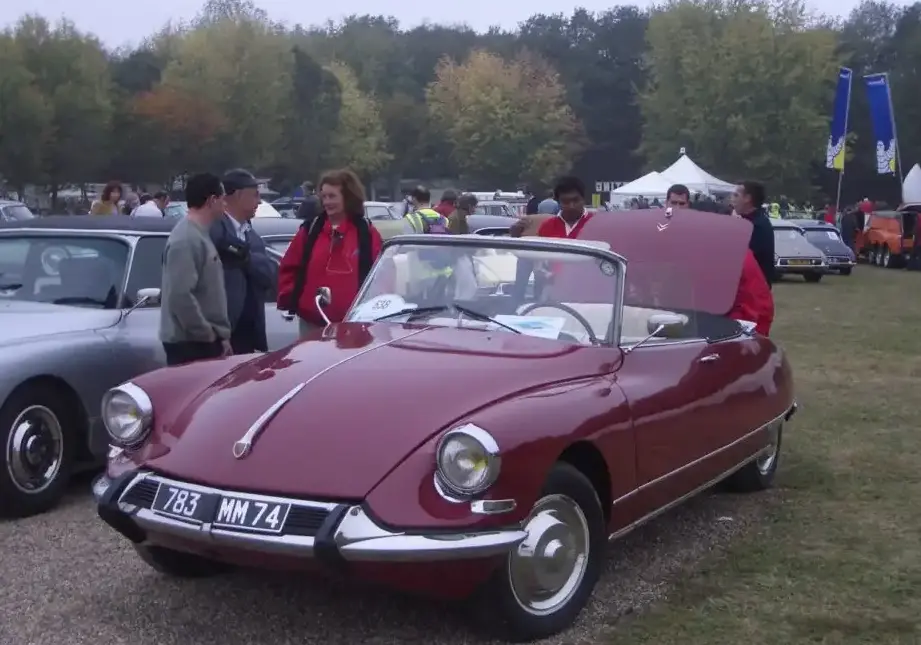
The Citroën DS I Cabriolet Chapron 19, produced between 1960 and 1961, represents a unique and luxurious iteration of the groundbreaking Citroën DS. This variant, distinguished by its coachbuilt convertible body crafted by Chapron, combined the innovative technology of the DS with open-air motoring. It occupied a niche position within the DS range, being the most exclusive and expensive version available. The “19” designation refers to the engine displacement, and the “78 Hp” indicates the power output of the 1.9-liter inline-four engine. The DS, launched in 1955, revolutionized automotive engineering with its hydropneumatic suspension and power-assisted features, and the Chapron-bodied Cabriolet further elevated its status as a symbol of French automotive excellence.
Technical Specifications
| Brand | Citroen |
| Model | DS |
| Generation | DS I Cabriolet Chapron |
| Type (Engine) | 19 (78 Hp) |
| Start of production | 1960 year |
| End of production | 1961 year |
| Powertrain Architecture | Internal Combustion engine |
| Body type | Cabriolet |
| Seats | 2 |
| Doors | 2 |
| Fuel Type | Petrol (Gasoline) |
| Weight-to-power ratio | 16.6 kg/Hp, 60.2 Hp/tonne |
| Weight-to-torque ratio | 9.3 kg/Nm, 107.3 Nm/tonne |
| Power | 78 Hp @ 4500 rpm |
| Power per litre | 40.8 Hp/l |
| Torque | 139 Nm @ 3000 rpm, 102.52 lb.-ft. @ 3000 rpm |
| Engine layout | Front, Longitudinal |
| Engine displacement | 1911 cm3, 116.62 cu. in. |
| Number of cylinders | 4 |
| Engine configuration | Inline |
| Cylinder Bore | 78 mm, 3.07 in. |
| Piston Stroke | 100 mm, 3.94 in. |
| Compression ratio | 7.5:1 |
| Number of valves per cylinder | 2 |
| Fuel injection system | Carburettor |
| Engine aspiration | Naturally aspirated engine |
| Engine oil capacity | 4 l, 4.23 US qt | 3.52 UK qt |
| Coolant | 10 l, 10.57 US qt | 8.8 UK qt |
| Kerb Weight | 1295 kg, 2854.99 lbs |
| Fuel tank capacity | 65 l, 17.17 US gal | 14.3 UK gal |
| Length | 4820 mm, 189.76 in |
| Width | 1790 mm, 70.47 in |
| Height | 1450 mm, 57.09 in |
| Wheelbase | 3125 mm, 123.03 in |
| Front track | 1500 mm, 59.06 in |
| Rear (Back) track | 1300 mm, 51.18 in |
| Minimum turning circle (turning diameter) | 11 m, 36.09 ft |
| Drivetrain Architecture | The Internal combustion engine (ICE) drives the front wheels of the vehicle. |
| Drive wheel | Front wheel drive |
| Number of gears and type of gearbox | 4 gears, manual transmission |
| Front suspension | Hydro-pneumatic element |
| Rear suspension | Hydro-pneumatic element |
| Front brakes | Disc |
| Rear brakes | Drum |
| Steering type | Steering rack and pinion |
| Power steering | Hydraulic Steering |
Powertrain & Engine Architecture
The Citroën DS I Cabriolet Chapron 19 was powered by a 1.9-liter (1911 cc) inline-four cylinder engine. This engine, designated as the engine code, produced 78 horsepower at 4500 rpm and 139 Nm (102.52 lb-ft) of torque at 3000 rpm. The engine featured a relatively high compression ratio of 7.5:1 for the era and utilized a single or dual Solex carburetor, depending on the specific configuration. The valvetrain employed two valves per cylinder, operated by a single overhead camshaft. The engine was mounted longitudinally in the front of the vehicle, driving the front wheels. The four-speed manual transmission was a standard feature, providing a relatively direct connection between the engine and the wheels. This configuration, while not particularly powerful by modern standards, was considered adequate for the DS’s weight and intended cruising role.
Driving Characteristics
The driving experience of the DS I Cabriolet Chapron 19 was defined by its exceptional ride quality, thanks to the innovative hydropneumatic suspension system. This system, a hallmark of the DS, provided a remarkably smooth and comfortable ride, even on uneven road surfaces. The 78 hp engine, coupled with the four-speed manual transmission, offered reasonable performance, but it wasn’t designed for rapid acceleration. The car was best suited for relaxed cruising, where the suspension could truly shine. Compared to later DS models with larger engines (like the 2.1-liter or 2.3-liter variants), the 1.9-liter version felt less powerful, particularly when fully loaded or tackling steep inclines. The manual transmission allowed for greater driver control, but the gear ratios were optimized for fuel efficiency and comfortable cruising rather than outright performance.
Equipment & Trim Levels
As the most luxurious variant of the DS, the Cabriolet Chapron 19 came standard with a high level of equipment. The interior was typically trimmed in high-quality leather, and featured elegant wood trim. Power-assisted steering was standard, making the car relatively easy to maneuver. Other standard features included comfortable seating for two, a comprehensive instrument panel, and a sophisticated heating and ventilation system. Optional extras included a radio, upgraded upholstery, and various cosmetic enhancements. The Chapron coachwork itself was a significant feature, with its elegant lines and meticulous attention to detail. The convertible top was manually operated, adding to the sense of occasion when lowering it for open-air driving.
Chassis & Braking
The DS I Cabriolet Chapron 19 utilized a monocoque chassis construction, providing a strong and rigid platform. The hydropneumatic suspension system, with its self-leveling and ride-height adjustment capabilities, was a key component of the chassis design. The front suspension featured independent hydropneumatic elements, while the rear suspension also employed hydropneumatic elements. Braking was provided by disc brakes at the front and drum brakes at the rear. The hydraulic braking system, also assisted by the hydropneumatic system, offered good stopping power for the era. The steering system was a rack-and-pinion type, providing precise and responsive steering feel.
Market Reception & Comparison
The Citroën DS I Cabriolet Chapron 19 was highly regarded by critics for its innovative technology, luxurious appointments, and elegant styling. However, its high price tag limited its appeal to a relatively small segment of the market. Compared to other DS variants, the 1.9-liter version was seen as a more affordable entry point into the DS range, but it lacked the performance of the larger-engined models. Fuel economy was reasonable for the time, but not exceptional. Reliability was generally good, but the complex hydropneumatic system required specialized maintenance. The Cabriolet Chapron, being a coachbuilt model, was even more expensive to maintain than the standard DS.
Legacy
The Citroën DS I Cabriolet Chapron 19 remains a highly sought-after classic car today. Its innovative technology, elegant styling, and rarity have made it a favorite among collectors. The 1.9-liter engine, while not the most powerful DS powerplant, is generally considered to be reliable and relatively easy to maintain. However, the hydropneumatic suspension system still requires specialized knowledge and care. Well-maintained examples of the DS I Cabriolet Chapron 19 command high prices in the used car market, reflecting their historical significance and enduring appeal. The DS, in all its variants, left an indelible mark on automotive history, and the Chapron-bodied Cabriolet represents the pinnacle of its design and engineering.