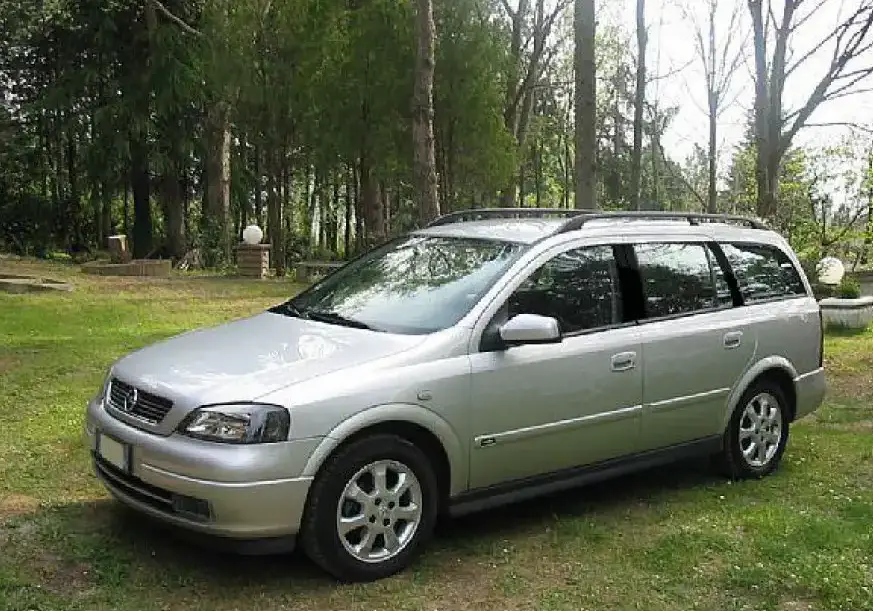
The Opel Astra G Caravan (facelift, produced 2002-2004) 1.2 16V, delivering 75 horsepower, represented an entry-level offering within the broader Astra G range. This variant, a practical five-door station wagon (estate), was primarily marketed in Europe as an affordable and fuel-efficient family vehicle. It occupied the lower end of the spectrum, positioned below more powerful engine options like the 1.6L and 1.8L variants, and the diesel offerings. The facelift introduced in 2002 brought subtle styling revisions and minor mechanical updates to the Astra G, enhancing its appeal in a competitive segment.
Technical Specifications
| Brand | Opel |
| Model | Astra |
| Generation | Astra G Caravan (facelift 2002) |
| Type (Engine) | 1.2 16V (75 Hp) |
| Start of production | 2002 |
| End of production | May, 2004 |
| Powertrain Architecture | Internal Combustion engine |
| Body type | Station wagon (estate) |
| Seats | 5 |
| Doors | 5 |
| Fuel Type | Petrol (Gasoline) |
| Weight-to-power ratio | 14 kg/Hp, 71.4 Hp/tonne |
| Weight-to-torque ratio | 9.5 kg/Nm, 104.8 Nm/tonne |
| Power | 75 Hp @ 5600 rpm |
| Power per litre | 62.6 Hp/l |
| Torque | 110 Nm @ 4000 rpm (81.13 lb.-ft. @ 4000 rpm) |
| Engine layout | Front, Transverse |
| Engine Model/Code | Z12XE |
| Engine displacement | 1199 cm3 (73.17 cu. in.) |
| Number of cylinders | 4 |
| Engine configuration | Inline |
| Cylinder Bore | 72.5 mm (2.85 in.) |
| Piston Stroke | 72.6 mm (2.86 in.) |
| Compression ratio | 10.1:1 |
| Number of valves per cylinder | 4 |
| Fuel injection system | Multi-port manifold injection |
| Engine aspiration | Naturally aspirated engine |
| Valvetrain | DOHC |
| Engine oil capacity | 3.5 l (3.7 US qt | 3.08 UK qt) |
| Coolant | 5.2 l (5.49 US qt | 4.58 UK qt) |
| Kerb Weight | 1050 kg (2314.85 lbs.) |
| Max. weight | 1570 kg (3461.26 lbs.) |
| Max load | 520 kg (1146.4 lbs.) |
| Trunk (boot) space – minimum | 460 l (16.24 cu. ft.) |
| Trunk (boot) space – maximum | 1500 l (52.97 cu. ft.) |
| Fuel tank capacity | 52 l (13.74 US gal | 11.44 UK gal) |
| Length | 4288 mm (168.82 in.) |
| Width | 1709 mm (67.28 in.) |
| Width including mirrors | 1967 mm (77.44 in.) |
| Height | 1510 mm (59.45 in.) |
| Wheelbase | 2611 mm (102.8 in.) |
| Front track | 1464 mm (57.64 in.) |
| Rear (Back) track | 1452 mm (57.17 in.) |
| Ride height (ground clearance) | 130 mm (5.12 in.) |
| Drag coefficient (Cd) | 0.32 |
| Drivetrain Architecture | The Internal combustion engine (ICE) drives the front wheels of the vehicle. |
| Drive wheel | Front wheel drive |
| Number of gears and type of gearbox | 5 gears, manual transmission |
| Front suspension | Independent, type McPherson with coil spring and anti-roll bar |
| Rear suspension | Suspension with traction connecting levers |
| Front brakes | Ventilated discs |
| Rear brakes | Disc |
| Assisting systems | ABS (Anti-lock braking system) |
| Steering type | Steering rack and pinion |
| Power steering | Hydraulic Steering |
| Tires size | 175/70 R14 |
| Wheel rims size | 14 |
Introduction
The Opel Astra G Caravan 1.2 16V (75 hp) was a key component of Opel’s strategy to offer a versatile and affordable station wagon to European families. Produced from 2002 to 2004 as part of the facelifted G generation (1998-2004), it built upon the success of the original Astra G, addressing the growing demand for practical, yet economical vehicles. The Caravan body style, known as a station wagon or estate in the US, provided significantly increased cargo capacity compared to the hatchback version, making it ideal for families and those requiring ample space for luggage or work equipment. This particular variant, with its smaller engine and manual transmission, was aimed at buyers prioritizing fuel efficiency and lower running costs.
Powertrain & Engine Architecture
At the heart of the Astra G Caravan 1.2 16V lies the Z12XE engine, a 1.2-liter (1199cc) inline-four cylinder petrol engine. This engine is characterized by its relatively simple design, featuring a multi-port fuel injection system and a double overhead camshaft (DOHC) valvetrain with four valves per cylinder. The Z12XE was known for its reliability, though it wasn’t a powerhouse. The 16-valve configuration helped to improve breathing and, consequently, power output compared to earlier 8-valve designs. The engine’s compression ratio of 10.1:1 contributed to its efficiency. The standard transmission was a five-speed manual gearbox, optimized for maximizing fuel economy and providing adequate acceleration for everyday driving. The engine’s transverse mounting and front-wheel drive configuration were typical for vehicles in this class.
Driving Characteristics
The 75 horsepower and 81 lb-ft of torque produced by the 1.2-liter engine translated to modest, but adequate, performance. Acceleration was not brisk, and overtaking required careful planning. The five-speed manual transmission allowed drivers to keep the engine in its optimal power band, but it wasn’t a sporty experience. The gear ratios were geared towards fuel efficiency rather than outright speed. Compared to the 1.6L or 1.8L Astra G Caravan models, the 1.2 16V felt noticeably slower, especially when fully loaded. However, its lighter weight and efficient engine contributed to better fuel economy, making it a sensible choice for urban commuting and longer journeys where outright performance wasn’t a priority.
Equipment & Trim Levels
The Astra G Caravan 1.2 16V typically came with a fairly basic level of equipment, reflecting its position as an entry-level model. Standard features generally included power steering, central locking, electric front windows, and an adjustable steering column. Interior upholstery was typically cloth, and the dashboard featured a functional, if somewhat utilitarian, design. Optional extras, such as air conditioning, alloy wheels, and a CD player, were available, allowing buyers to customize their vehicle to some extent. Safety features included ABS (Anti-lock Braking System) and driver and passenger airbags.
Chassis & Braking
The Astra G Caravan’s chassis featured an independent McPherson strut suspension at the front, providing a comfortable ride and reasonable handling. The rear suspension utilized a torsion beam setup, which was cost-effective and space-efficient. The front brakes were ventilated discs, offering good stopping power, while the rear brakes were solid discs. The steering was rack and pinion, providing precise control. The 175/70 R14 tires offered a good balance of grip and ride comfort. The suspension setup was tuned for comfort rather than sporty handling, prioritizing a smooth ride over sharp cornering.
Market Reception & Comparison
The Astra G Caravan 1.2 16V was generally well-received by critics as a practical and affordable family vehicle. Its fuel efficiency was a major selling point, and its spacious interior and large cargo area were also praised. However, its lack of power was often noted, and some reviewers found the driving experience to be somewhat uninspiring. Compared to the 1.6L and 1.8L variants, the 1.2 16V offered significantly lower performance but also lower running costs. The diesel models provided even better fuel economy but came with a higher purchase price. The 1.2 16V appealed to buyers who prioritized economy and practicality over performance.
Legacy
The Opel Astra G Caravan 1.2 16V, while not a performance icon, remains a relatively reliable and affordable used car option today. The Z12XE engine is known for its durability, and parts availability is generally good. However, potential buyers should be aware of the engine’s limited power output and the possibility of age-related wear and tear. These vehicles are often found with high mileage, so a thorough inspection is recommended before purchase. The Astra G Caravan 1.2 16V represents a practical and economical choice for those seeking a spacious and reliable station wagon.