Technical Specifications
| Brand | Volkswagen |
| Model | Golf |
| Generation | Golf VII (3-door) |
| Type (Engine) | GTI Performance 2.0 TSI (230 Hp) DSG |
| Start of production | March, 2013 |
| End of production | December, 2016 |
| Powertrain Architecture | Internal Combustion engine |
| Body type | Hatchback |
| Seats | 5 |
| Doors | 3 |
| Fuel consumption (economy) – urban (NEDC) | 8.1 l/100 km (29 US mpg, 34.9 UK mpg, 12.3 km/l) |
| Fuel consumption (economy) – extra urban (NEDC) | 5.4 l/100 km (43.6 US mpg, 52.3 UK mpg, 18.5 km/l) |
| Fuel consumption (economy) – combined (NEDC) | 6.4 l/100 km (36.8 US mpg, 44.1 UK mpg, 15.6 km/l) |
| CO2 emissions (NEDC) | 149 g/km |
| Fuel Type | Petrol (Gasoline) |
| Acceleration 0 – 100 km/h | 6.4 sec |
| Acceleration 0 – 62 mph | 6.4 sec |
| Acceleration 0 – 60 mph | 6.1 sec |
| Maximum speed | 248 km/h (154.1 mph) |
| Emission standard | Euro 6 |
| Weight-to-power ratio | 5.8 kg/Hp, 173.3 Hp/tonne |
| Weight-to-torque ratio | 3.8 kg/Nm, 263.8 Nm/tonne |
| Power | 230 Hp @ 4700-6200 rpm |
| Power per litre | 115.9 Hp/l |
| Torque | 350 Nm @ 1500-4600 rpm (258.15 lb.-ft. @ 1500-4600 rpm) |
| Engine layout | Front, Transverse |
| Engine Model/Code | EA888 / CHHA |
| Engine displacement | 1984 cm3 (121.07 cu. in.) |
| Number of cylinders | 4 |
| Engine configuration | Inline |
| Cylinder Bore | 82.5 mm (3.25 in.) |
| Piston Stroke | 92.8 mm (3.65 in.) |
| Compression ratio | 9.6:1 |
| Number of valves per cylinder | 4 |
| Fuel injection system | Direct injection and Multi-port manifold injection |
| Engine aspiration | Turbocharger, Intercooler |
| Valvetrain | DOHC |
| Engine oil capacity | 5.7 l (6.02 US qt | 5.02 UK qt) |
| Kerb Weight | 1327 kg (2925.53 lbs.) |
| Max. weight | 1870 kg (4122.64 lbs.) |
| Max load | 543 kg (1197.11 lbs.) |
| Trunk (boot) space – minimum | 380 l (13.42 cu. ft.) |
| Trunk (boot) space – maximum | 1270 l (44.85 cu. ft.) |
| Fuel tank capacity | 50 l (13.21 US gal | 11 UK gal) |
| Max. roof load | 75 kg (165.35 lbs.) |
| Permitted trailer load with brakes (12%) | 1600 kg (3527.4 lbs.) |
| Permitted trailer load without brakes | 700 kg (1543.24 lbs.) |
| Permitted towbar download | 80 kg (176.37 lbs.) |
| Length | 4268 mm (168.03 in.) |
| Width | 1799 mm (70.83 in.) |
| Width including mirrors | 2027 mm (79.8 in.) |
| Height | 1442 mm (56.77 in.) |
| Wheelbase | 2631 mm (103.58 in.) |
| Front track | 1538 mm (60.55 in.) |
| Rear (Back) track | 1516 mm (59.69 in.) |
| Ride height (ground clearance) | 133 mm (5.24 in.) |
| Minimum turning circle (turning diameter) | 10.9 m (35.76 ft.) |
| Front suspension | Independent, type McPherson with coil spring and anti-roll bar |
| Rear suspension | Independent multi-link spring suspension with stabilizer |
| Front brakes | Ventilated discs, 340 mm |
| Rear brakes | Ventilated discs, 310 mm |
| Number of gears and type of gearbox | 6 gears, automatic transmission DSG |
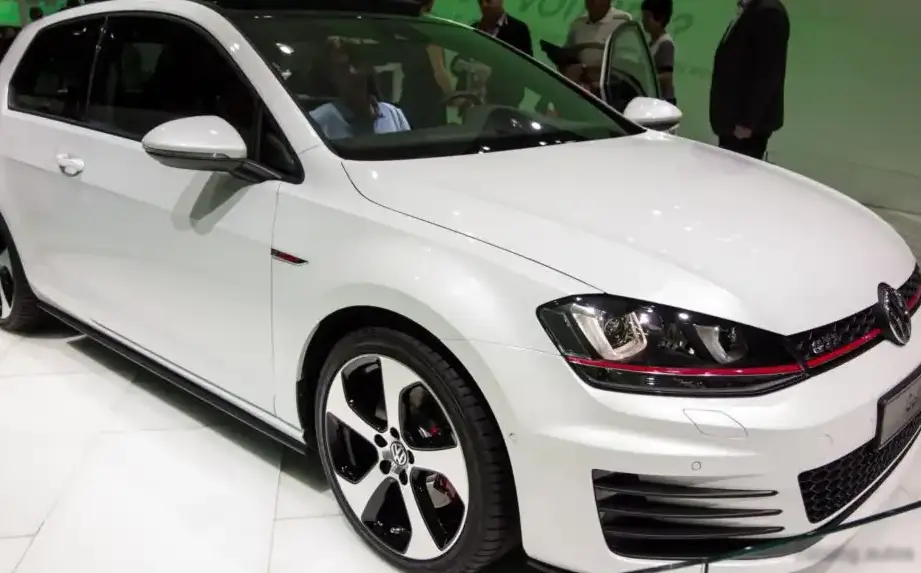
The Golf VII GTI Performance, introduced as a mid-life update to the already successful GTI, aimed to deliver a more focused driving experience. Production spanned from 2013 to 2016, and it was a key model within the Golf VII range, which utilized the versatile MQB platform. The “Performance” designation signified upgrades to both the engine and braking system compared to the standard GTI, making it a more capable performer on both the road and the track. The three-door body style, while less common than the five-door, offered a slightly lighter weight and a more sporty aesthetic.
Powertrain & Engine Architecture
At the heart of the GTI Performance lies the EA888 2.0-liter turbocharged four-cylinder engine, specifically the CHHA engine code. This engine featured direct fuel injection combined with multi-point injection, optimizing both power delivery and fuel efficiency. The turbocharger, an integral part of the engine’s design, provided significant boost, allowing the engine to produce 230 horsepower at 4700-6200 rpm and 350 Nm (258 lb-ft) of torque between 1500-4600 rpm. The engine also incorporated variable valve timing on both the intake and exhaust sides (DOHC) for improved responsiveness. The power is transferred to the front wheels via a six-speed dual-clutch transmission (DSG), known for its quick and seamless gear changes. This DSG unit was specifically tuned for faster shift times in the Performance model. The engine also featured a start/stop system to further enhance fuel economy.
Driving Characteristics
The 230 hp and 350 Nm of torque, coupled with the DSG transmission, resulted in a 0-60 mph time of around 6.1 seconds and a top speed of 154 mph. While not as brutally fast as the Golf R, the GTI Performance offered a very engaging driving experience. The DSG transmission provided rapid gear changes, keeping the engine within its optimal power band. The gear ratios were tuned to provide strong acceleration in all gears, making it a versatile performer for both city driving and highway cruising. Compared to the standard GTI, the Performance model felt noticeably more responsive, and the increased torque provided a more muscular feel. The automatic transmission, while convenient, didn’t offer the same level of driver engagement as a manual gearbox, but its speed and efficiency were undeniable.
Equipment & Trim Levels
The GTI Performance came standard with a comprehensive list of features, including sport seats upholstered in the classic GTI plaid fabric, a leather-wrapped steering wheel, and a touchscreen infotainment system. Additional standard equipment included automatic climate control, alloy wheels (typically 18-inch), and a sport-tuned suspension. Optional extras included adaptive dampers (DCC), a panoramic sunroof, and upgraded audio systems. Interior trim was typically dark, with red accents to emphasize the GTI’s sporty character. The dashboard layout was typical of the Golf VII, with a clean and functional design.
Chassis & Braking
The GTI Performance benefited from a revised chassis and upgraded braking system. The front suspension featured a McPherson strut design with a stabilizer bar, while the rear utilized a multi-link setup, also with a stabilizer bar. The suspension was tuned for a balance between comfort and handling. Crucially, the Performance model received larger brakes than the standard GTI – ventilated discs measuring 340mm at the front and 310mm at the rear – providing improved stopping power and fade resistance. ABS (Anti-lock Braking System) was standard, enhancing safety and control.
Market Reception & Comparison
The Golf VII GTI Performance was generally well-received by automotive critics. It was praised for its strong performance, engaging handling, and refined interior. Compared to the standard GTI, the Performance model offered a noticeable step up in driving dynamics and braking capability. Fuel economy was respectable, averaging around 36.8 US mpg in combined driving. Reliability was generally good, although, like any turbocharged engine, preventative maintenance was crucial. Compared to the Golf R, the GTI Performance offered a similar level of performance at a lower price point, making it an attractive option for buyers who didn’t need all-wheel drive.
Legacy
The Volkswagen Golf VII GTI Performance remains a popular choice in the used car market. Its combination of performance, practicality, and refinement has ensured its enduring appeal. The EA888 engine, while requiring regular maintenance, is generally considered to be robust and reliable. The DSG transmission, if properly maintained (fluid changes are critical), can provide years of trouble-free operation. Today, these cars represent a sweet spot for enthusiasts seeking a capable and enjoyable hot hatch without the higher price tag of newer models or the all-in complexity of the Golf R.