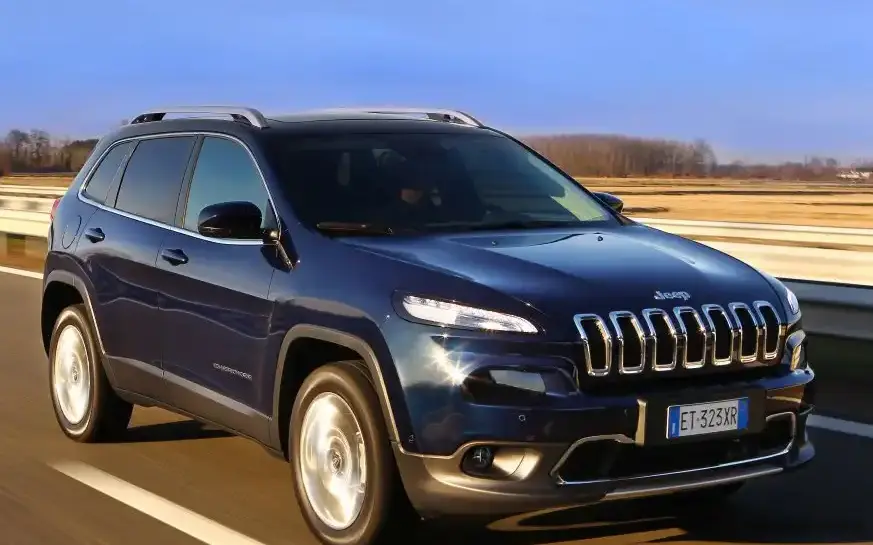
The Jeep Cherokee (KL) 2.0 4WD, produced from 2013 to 2017, represented a significant shift for the iconic American brand. This variant, powered by a 2.0-liter turbocharged diesel engine producing 140 horsepower, was primarily aimed at the European market where fuel efficiency and lower running costs were highly valued. It occupied a mid-range position within the KL Cherokee lineup, slotting below the more powerful gasoline options and above base-level trims. The KL generation itself was the first Cherokee to utilize a unibody construction, moving away from the traditional body-on-frame design, and aimed to blend off-road capability with on-road comfort and refinement.
Technical Specifications
| Brand | Jeep |
| Model | Cherokee |
| Generation | Cherokee V (KL) |
| Type (Engine) | 2.0 (140 Hp) 4WD |
| Start of production | 2013 |
| End of production | 2017 |
| Powertrain Architecture | Internal Combustion engine |
| Body type | SUV |
| Seats | 5 |
| Doors | 5 |
| Fuel consumption (urban) | 6.8 l/100 km (34.6 US mpg, 41.5 UK mpg, 14.7 km/l) |
| Fuel consumption (extra urban) | 4.9 l/100 km (48 US mpg, 57.6 UK mpg, 20.4 km/l) |
| Fuel consumption (combined) | 5.6 l/100 km (42 US mpg, 50.4 UK mpg, 17.9 km/l) |
| CO2 emissions | 147 g/km |
| Fuel Type | Diesel |
| Acceleration 0 – 100 km/h | 12 sec |
| Acceleration 0 – 62 mph | 12 sec |
| Acceleration 0 – 60 mph | 11.4 sec |
| Maximum speed | 189 km/h (117.44 mph) |
| Emission standard | Euro 5 |
| Weight-to-power ratio | 13.7 kg/Hp, 72.9 Hp/tonne |
| Weight-to-torque ratio | 5.5 kg/Nm, 182.2 Nm/tonne |
| Power | 140 Hp @ 3750 rpm |
| Power per litre | 71.6 Hp/l |
| Torque | 350 Nm @ 1500 rpm (258.15 lb.-ft. @ 1500 rpm) |
| Engine layout | Front, Longitudinal |
| Engine Model/Code | EBT |
| Engine displacement | 1956 cm3 (119.36 cu. in.) |
| Number of cylinders | 4 |
| Engine configuration | Inline |
| Cylinder Bore | 83 mm (3.27 in.) |
| Piston Stroke | 90.4 mm (3.56 in.) |
| Compression ratio | 16.5:1 |
| Number of valves per cylinder | 4 |
| Fuel injection system | Diesel Commonrail |
| Engine aspiration | Turbocharger, Intercooler |
| Valvetrain | DOHC |
| Engine oil capacity | 4.1 l (4.33 US qt | 3.61 UK qt) |
| Coolant | 6.8 l (7.19 US qt | 5.98 UK qt) |
| Kerb Weight | 1921-1947 kg (4235.08 – 4292.4 lbs.) |
| Trunk (boot) space – minimum | 591 l (20.87 cu. ft.) |
| Trunk (boot) space – maximum | 1267 l (44.74 cu. ft.) |
| Fuel tank capacity | 60 l (15.85 US gal | 13.2 UK gal) |
| Permitted trailer load with brakes (12%) | 1600 kg (3527.4 lbs.) |
| Length | 4624 mm (182.05 in.) |
| Width | 1859 mm (73.19 in.) |
| Height | 1670 mm (65.75 in.) |
| Wheelbase | 2700 mm (106.3 in.) |
| Front track | 1586 mm (62.44 in.) |
| Rear (Back) track | 1584 mm (62.36 in.) |
| Ride height (ground clearance) | 157-168 mm (6.18 – 6.61 in.) |
| Minimum turning circle (turning diameter) | 11.6 m (38.06 ft.) |
| Approach angle | 18.2° |
| Departure angle | 24.0° |
| Drive wheel | All wheel drive (4×4) |
| Number of gears and type of gearbox | 6 gears, manual transmission |
| Front suspension | Independent type McPherson |
| Rear suspension | Independent multi-link suspension |
| Front brakes | Ventilated discs |
| Rear brakes | Disc |
| Assisting systems | ABS (Anti-lock braking system) |
| Steering type | Steering rack and pinion |
| Tires size | 225/60 R17; 225/55 R18 |
| Wheel rims size | 7J x 17; 7J x 18 |
Powertrain & Engine Architecture
The heart of this Cherokee variant is the 1.956-liter (119.36 cubic inches) inline-four cylinder diesel engine, designated the EBT. This engine utilizes a common rail direct injection system, delivering fuel at extremely high pressure for optimized combustion. A turbocharger with an intercooler is employed to boost power output and improve torque across a wider rev range. The engine features a double overhead camshaft (DOHC) valvetrain with four valves per cylinder, contributing to its efficiency and responsiveness. The 16.5:1 compression ratio is typical for a diesel engine, maximizing energy extraction from the fuel. The 6-speed manual transmission was standard, chosen for its efficiency and driver engagement, although an automatic transmission was available as an option in some markets.
Driving Characteristics
The 140 horsepower and 350 Nm (258 lb-ft) of torque provided by the 2.0-liter diesel offered a balance between fuel economy and usability. Acceleration from 0-60 mph took around 11.4 seconds, which was adequate for everyday driving but noticeably slower than the gasoline-powered Cherokee models. The engine’s peak torque, available from 1500 rpm, provided good low-end grunt, making it suitable for towing and navigating varied terrain. The manual transmission’s gear ratios were tuned for fuel efficiency, with taller gearing in higher gears. Compared to the more powerful 3.2-liter V6, this 2.0-liter diesel prioritized fuel economy and lower emissions over outright performance. The 4WD system provided enhanced traction in slippery conditions, making it a capable all-weather vehicle.
Equipment & Trim Levels
The 2.0 4WD Cherokee typically came with a reasonable level of standard equipment. This included air conditioning, power windows and locks, a basic audio system, and steel wheels with wheel covers. Higher trim levels, such as the Limited or Trailhawk, added features like leather upholstery, a touchscreen infotainment system, navigation, heated seats, and more sophisticated 4×4 systems. Optional extras included a panoramic sunroof, premium audio systems, and various driver-assistance technologies. Interior upholstery was generally cloth on the base models, with leather available on higher trims. The dashboard layout was functional and modern, with a focus on ease of use.
Chassis & Braking
The Cherokee KL utilized a unibody construction, providing a good balance of strength and weight. The front suspension featured independent McPherson struts, while the rear employed an independent multi-link setup. This configuration delivered a comfortable ride and predictable handling. Braking duties were handled by ventilated discs at the front and solid discs at the rear. Anti-lock brakes (ABS) were standard. The suspension was tuned to provide a comfortable ride on paved roads while still offering sufficient off-road capability. Stabilizer bars were fitted to both the front and rear axles to reduce body roll during cornering.
Market Reception & Comparison
The 2.0-liter diesel Cherokee was well-received in Europe, where its fuel efficiency and relatively low running costs were attractive to buyers. Critics praised its comfortable ride and capable 4×4 system. However, some noted its relatively modest performance compared to the gasoline-powered models. Fuel economy figures of around 42 US mpg combined were competitive for its class. Reliability was generally good, although some owners reported issues with the diesel particulate filter (DPF) system, a common concern with modern diesel engines. Compared to the 3.2-liter V6, the 2.0-liter diesel offered significantly better fuel economy but less power and acceleration.
Legacy
The Jeep Cherokee KL 2.0 4WD remains a popular choice in the used car market, particularly for buyers seeking a fuel-efficient and capable SUV. The 2.0-liter diesel engine, while not known for blistering performance, has proven to be relatively reliable when properly maintained. Regular servicing, including DPF regeneration, is crucial to ensure long-term reliability. The KL Cherokee’s unibody construction and independent suspension provide a comfortable and refined driving experience, making it a versatile vehicle for both on-road and off-road adventures. Its blend of practicality, capability, and fuel efficiency continues to appeal to a wide range of buyers.