Technical Specifications
| Brand | Hyundai |
| Model | IONIQ 6 |
| Generation | IONIQ 6 |
| Type (Engine) | LongRange 77.4 kWh (229 Hp) BEV |
| Start of production | July, 2022 |
| End of production | January, 2026 |
| Powertrain Architecture | BEV (Electric Vehicle) |
| Body type | Sedan, Fastback |
| Seats | 5 |
| Doors | 4 |
| Fuel Type | Electricity |
| Acceleration 0 – 100 km/h | 7.4 sec |
| Acceleration 0 – 62 mph | 7.4 sec |
| Acceleration 0 – 60 mph | 7 sec |
| Maximum speed | 185 km/h (114.95 mph) |
| Weight-to-power ratio | 8.4 kg/Hp, 118.7 Hp/tonne |
| Weight-to-torque ratio | 5.5 kg/Nm, 181.3 Nm/tonne |
| Gross battery capacity | 77.4 kWh |
| Battery voltage | 697 V |
| Battery technology | Lithium-polymer (LiPo) |
| Battery location | Below the floor |
| All-electric range (WLTP) | 545-614 km (338.65 – 381.52 mi) |
| All-electric range (EPA) | 452-524 km (280.86 – 325.6 mi) |
| Average Energy consumption (WLTP) | 14.3-16 kWh/100 km (23.01 – 25.75 kWh/100 mi) (146 – 131 MPGe) (7 – 6.3 km/kWh) (4.3 – 3.9 mi/kWh) |
| Average Energy consumption (EPA) | 16.6-19.6 kWh/100 km (26.72 – 31.54 kWh/100 mi) (126 – 107 MPGe) (6 – 5.1 km/kWh) (3.7 – 3.2 mi/kWh) |
| Electric motor power | 229 Hp |
| Electric motor Torque | 350 Nm (258.15 lb.-ft.) |
| Electric motor location | Rear axle, Transverse |
| Electric motor type | Synchronous |
| System power | 229 Hp |
| System torque | 350 Nm (258.15 lb.-ft.) |
| Kerb Weight | 1930-1950 kg (4254.92 – 4299.01 lbs.) |
| Max. weight | 2410 kg (5313.14 lbs.) |
| Max load | 460-480 kg (1014.13 – 1058.22 lbs.) |
| Trunk (boot) space – minimum | 401 l (14.16 cu. ft.) |
| Max. roof load | 80 kg (176.37 lbs.) |
| Permitted trailer load with brakes (12%) | 1500 kg (3306.93 lbs.) |
| Permitted trailer load without brakes | 750 kg (1653.47 lbs.) |
| Permitted towbar download | 100 kg (220.46 lbs.) |
| Length | 4855 mm (191.14 in.) |
| Width | 1880 mm (74.02 in.) |
| Height | 1495 mm (58.86 in.) |
| Wheelbase | 2950 mm (116.14 in.) |
| Front track | 1630-1635 mm (64.17 – 64.37 in.) |
| Rear (Back) track | 1639-1644 mm (64.53 – 64.72 in.) |
| Front overhang | 850 mm (33.46 in.) |
| Rear overhang | 1055 mm (41.54 in.) |
| Ride height (ground clearance) | 141 mm (5.55 in.) |
| Drag coefficient (Cd) | 0.21 |
| Drivetrain Architecture | One electric motor drives the rear wheels. |
| Drive wheel | Rear wheel drive |
| Number of gears and type of gearbox | 1 gears, automatic transmission |
| Front suspension | Independent, type McPherson with coil spring and anti-roll bar |
| Rear suspension | Independent multi-link spring suspension with stabilizer |
| Front brakes | Ventilated discs |
| Rear brakes | Ventilated discs |
| Assisting systems | ABS (Anti-lock braking system) |
| Steering type | Steering rack and pinion |
| Power steering | Electric Steering |
| Tires size | 225/55 R18; 245/40 R20 |
| Wheel rims size | 7.5J x 18; 8.5J x 20 |
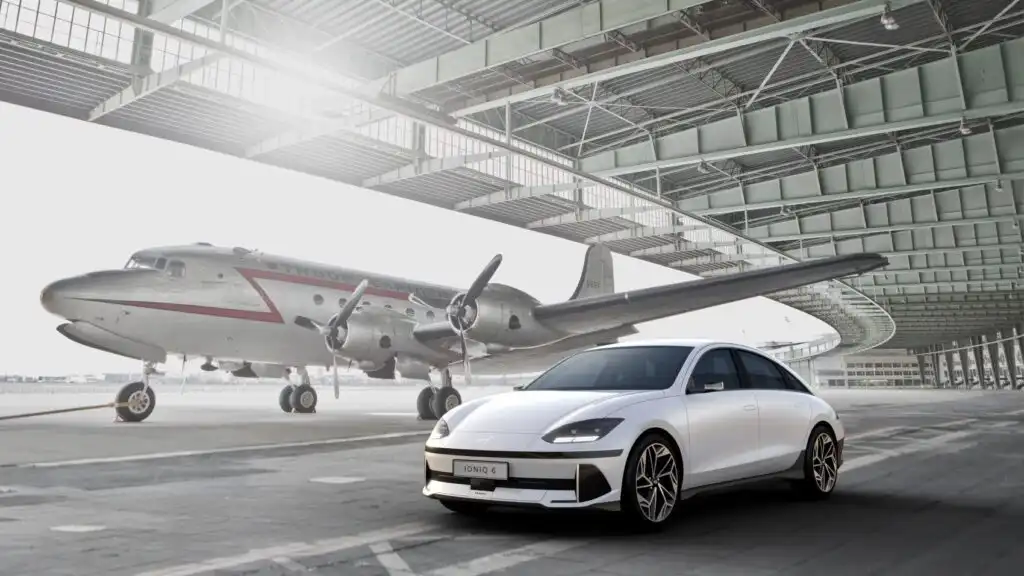
The Hyundai IONIQ 6 Long Range, introduced in July 2022 and slated for production through January 2026, is Hyundai’s second dedicated electric vehicle, building upon the success of the IONIQ 5. This streamlined, aerodynamic sedan – often described as a fastback – is designed to maximize range and efficiency. It’s built on Hyundai’s Electric Global Modular Platform (E-GMP), shared with the IONIQ 5 and Kia EV6, enabling fast charging and a spacious interior despite its sleek profile. The Long Range variant represents the top tier of the IONIQ 6 lineup, offering the greatest driving range and performance compared to the Standard Range models.
Powertrain & Engine Architecture
The IONIQ 6 Long Range utilizes a permanent magnet synchronous motor (PMSM) driving the rear wheels. This motor produces 229 horsepower and 350 Nm (258 lb-ft) of torque. The 77.4 kWh lithium-polymer battery pack, positioned low in the vehicle’s floor, contributes to a low center of gravity and improved handling. Hyundai’s 800V charging architecture allows for exceptionally fast DC fast charging, capable of adding approximately 220 miles of range in just 18 minutes under ideal conditions. The single-speed automatic transmission is a standard feature, optimized for efficiency and smooth acceleration. The motor’s power delivery is characterized by instant torque, typical of electric vehicles, providing brisk acceleration.
Driving Characteristics
The rear-wheel-drive configuration of the IONIQ 6 Long Range contributes to a balanced driving experience. Acceleration from 0 to 60 mph takes approximately 7 seconds. While not a performance-oriented vehicle, the instant torque provides ample power for everyday driving and highway merging. The single-speed transmission offers seamless acceleration, and the regenerative braking system allows for one-pedal driving, enhancing efficiency and driver control. Compared to the Standard Range models, the Long Range variant offers significantly improved acceleration and a substantially greater driving range. The aerodynamic design minimizes wind noise and contributes to a quiet and comfortable ride.
Equipment & Trim Levels
The IONIQ 6 Long Range typically comes standard with features such as a 12.3-inch touchscreen infotainment system, a 12.3-inch digital instrument cluster, Hyundai SmartSense suite of advanced driver-assistance systems (including adaptive cruise control, lane keeping assist, and blind-spot monitoring), and LED lighting. Higher trim levels add features like a premium Bose sound system, ventilated and heated front seats, a panoramic sunroof, and leather upholstery. Available options include a head-up display and various exterior color choices. Interior upholstery options range from cloth to leatherette and genuine leather, depending on the trim level.
Chassis & Braking
The IONIQ 6 features an independent McPherson strut front suspension and a multi-link rear suspension, tuned for a comfortable ride and responsive handling. Ventilated disc brakes are used on all four wheels, providing ample stopping power. The electronic stability control (ESC) system and anti-lock braking system (ABS) enhance safety and control. The vehicle’s relatively low weight, thanks to the battery pack’s placement and the use of lightweight materials, contributes to its agility. Steering is provided by an electric power steering system, offering precise and responsive control.
Market Reception & Comparison
The Hyundai IONIQ 6 has been generally well-received by automotive critics, praised for its striking design, long range, fast charging capabilities, and spacious interior. It competes with other electric sedans such as the Tesla Model 3, Polestar 2, and BMW i4. Compared to the Tesla Model 3, the IONIQ 6 offers a more comfortable ride and a more conventional interior layout. The Polestar 2 provides a similar level of performance and technology but at a higher price point. The IONIQ 6’s efficiency is a key selling point, with its energy consumption figures often exceeding those of its competitors.
Legacy
The IONIQ 6 represents a significant step forward for Hyundai in the electric vehicle market. Its advanced technology, long range, and stylish design have established it as a compelling alternative to established EV players. The E-GMP platform, upon which it is built, is expected to underpin future Hyundai and Kia electric vehicles. While long-term reliability data is still emerging, Hyundai’s reputation for building durable and reliable vehicles suggests that the IONIQ 6 powertrain should prove to be dependable. On the used car market, the IONIQ 6 Long Range is expected to hold its value well due to its desirable features and growing demand for electric vehicles.