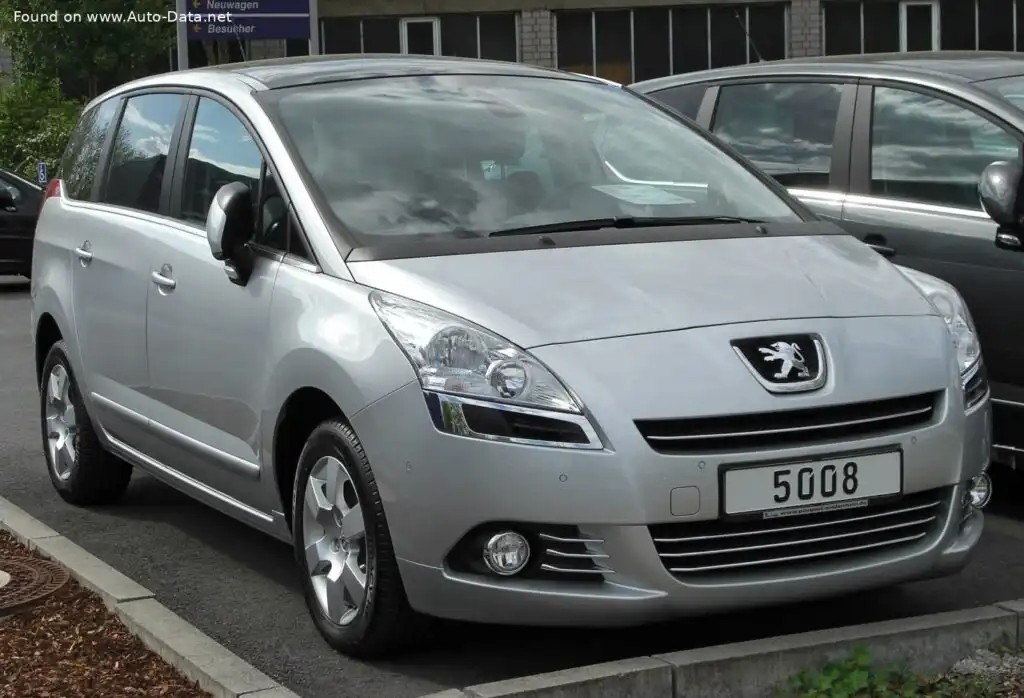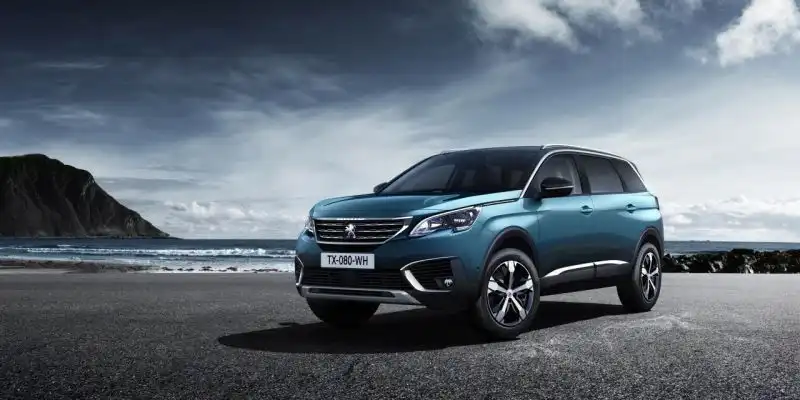
The Peugeot 5008 II, launched in 2017, represented a significant evolution for Peugeot’s mid-size SUV offering. The 1.6 PureTech 180 horsepower automatic variant, produced from 2018 to 2020, occupied a key position in the lineup, bridging the gap between more economical engine options and the range-topping diesel models. This version aimed to provide a balance of performance, fuel efficiency, and comfort for families seeking a versatile seven-seater SUV. It was primarily marketed in Europe, where the 5008 competed with vehicles like the Nissan X-Trail, Hyundai Santa Fe, and Volkswagen Tiguan Allspace.
Technical Specifications
| Brand | Peugeot |
| Model | 5008 |
| Generation | 5008 II (Phase I, 2017) |
| Type (Engine) | 1.6 PureTech (180 Hp) Automatic |
| Start of production | 2018 |
| End of production | 2020 |
| Powertrain Architecture | Internal Combustion engine |
| Body type | SUV |
| Seats | 7 |
| Doors | 5 |
| Fuel consumption (urban) | 7.2 l/100 km (32.7 US mpg, 39.2 UK mpg, 13.9 km/l) |
| Fuel consumption (extra urban) | 4.9 l/100 km (48 US mpg, 57.6 UK mpg, 20.4 km/l) |
| Fuel consumption (combined) | 5.7 l/100 km (41.3 US mpg, 49.6 UK mpg, 17.5 km/l) |
| CO2 emissions | 131 g/km |
| Fuel Type | Petrol (Gasoline) |
| Acceleration 0 – 100 km/h | 8.3 sec |
| Acceleration 0 – 62 mph | 8.3 sec |
| Acceleration 0 – 60 mph | 7.9 sec |
| Maximum speed | 220 km/h (136.7 mph) |
| Emission standard | Euro 6 d |
| Weight-to-power ratio | 7.6 kg/Hp, 131.9 Hp/tonne |
| Weight-to-torque ratio | 5.5 kg/Nm, 183.2 Nm/tonne |
| Power | 180 Hp @ 5500 rpm |
| Power per litre | 112.6 Hp/l |
| Torque | 250 Nm @ 1650 rpm (184.39 lb.-ft. @ 1650 rpm) |
| Maximum engine speed | 6500 rpm |
| Engine layout | Front, Transverse |
| Engine Model/Code | 5GF EP6FADTXD |
| Engine displacement | 1598 cm3 (97.52 cu. in.) |
| Number of cylinders | 4 |
| Engine configuration | Inline |
| Cylinder Bore | 77 mm (3.03 in.) |
| Piston Stroke | 85.8 mm (3.38 in.) |
| Compression ratio | 10.2:1 |
| Number of valves per cylinder | 4 |
| Fuel injection system | Direct injection |
| Engine aspiration | Turbocharger, Intercooler |
| Engine oil capacity | 4.25 l (4.49 US qt | 3.74 UK qt) |
| Kerb Weight | 1365-1606 kg (3009.31 – 3540.62 lbs.) |
| Max. weight | 2160 kg (4761.98 lbs.) |
| Max load | 554-795 kg (1221.36 – 1752.67 lbs.) |
| Trunk (boot) space – minimum | 780 l (27.55 cu. ft.) |
| Trunk (boot) space – maximum | 1940 l (68.51 cu. ft.) |
| Fuel tank capacity | 56 l (14.79 US gal | 12.32 UK gal) |
| Max. roof load | 80 kg (176.37 lbs.) |
| Permitted trailer load with brakes (12%) | 1350 kg (2976.24 lbs.) |
| Permitted trailer load without brakes | 720 kg (1587.33 lbs.) |
| Permitted towbar download | 72 kg (158.73 lbs.) |
| Length | 4641 mm (182.72 in.) |
| Width | 1844 mm (72.6 in.) |
| Width with mirrors folded | 1906 mm (75.04 in.) |
| Width including mirrors | 2098 mm (82.6 in.) |
| Height | 1646 mm (64.8 in.) |
| Wheelbase | 2840 mm (111.81 in.) |
| Front track | 1593-1601 mm (62.72 – 63.03 in.) |
| Rear (Back) track | 1587-1610 mm (62.48 – 63.39 in.) |
| Front overhang | 926 mm (36.46 in.) |
| Rear overhang | 875 mm (34.45 in.) |
| Ride height (ground clearance) | 236 mm (9.29 in.) |
| Minimum turning circle (turning diameter) | 11.2 m (36.75 ft.) |
| Approach angle | 19° |
| Departure angle | 28° |
| Drivetrain Architecture | The Internal combustion engine (ICE) drives the front wheels of the vehicle. |
| Drive wheel | Front wheel drive |
| Number of gears and type of gearbox | 8 gears, automatic transmission |
| Front suspension | Coil spring, Independent type McPherson |
| Rear suspension | Semi-independent, coil spring |
| Front brakes | Ventilated discs |
| Rear brakes | Disc |
| Assisting systems | ABS (Anti-lock braking system) |
| Steering type | Steering rack and pinion |
| Power steering | Electric Steering |
| Tires size | 225/55 R18 90H |
| Wheel rims size | 18 |
INTRODUCTION
The Peugeot 5008 II, introduced in 2017, marked a shift for the 5008 from a multi-purpose vehicle (MPV) to a more contemporary SUV. The 1.6 PureTech 180 hp automatic variant, available from 2018, was a key component of the Phase I models. Built on the EMP2 platform (also used by the Peugeot 3008 and other Stellantis vehicles), this version aimed to offer a compelling blend of practicality, style, and performance. The 5008 II was designed to appeal to families needing space and versatility, while also providing a more premium driving experience than its predecessor. This particular engine and transmission combination was positioned as a mid-range offering, providing more power than the base 1.2 PureTech engine but remaining more accessible than the diesel options.
Powertrain & Engine Architecture
At the heart of this 5008 variant lies the 1.6-liter PureTech engine, specifically the EP6FADTXD code. This is a turbocharged, direct-injection four-cylinder engine. The engine utilizes a twin-scroll turbocharger and high-pressure direct fuel injection to optimize performance and efficiency. The engine’s design incorporates variable valve timing on both intake and exhaust valves, contributing to its broad torque curve. Paired with this engine is an Aisin-sourced eight-speed automatic transmission. This transmission was chosen for its smooth shifting characteristics and efficiency. It features a torque converter and offers both automatic and manual shift modes. The transmission’s gear ratios are tuned to provide a balance between acceleration and fuel economy, with a relatively long final drive ratio to aid in highway cruising.
Driving Characteristics
The 1.6 PureTech 180 hp automatic 5008 delivers a respectable driving experience. Acceleration from 0-60 mph takes around 7.9 seconds, making it feel adequately powered for everyday driving and overtaking maneuvers. The eight-speed automatic transmission generally shifts smoothly, although some drivers have noted occasional hesitation at lower speeds. Compared to the 1.2 PureTech engine, the 1.6 offers significantly more torque, resulting in stronger acceleration, particularly when fully loaded. Compared to the diesel variants, the 1.6 PureTech provides a more responsive and engaging driving experience, albeit with slightly higher fuel consumption. The steering is light and precise, making it easy to maneuver in urban environments. The suspension is tuned for comfort, providing a reasonably smooth ride, although it can feel slightly firm on rougher road surfaces.
Equipment & Trim Levels
The 1.6 PureTech 180 hp automatic typically came equipped with a generous level of standard features. These included automatic climate control, a touchscreen infotainment system with Apple CarPlay and Android Auto compatibility, rear parking sensors, and cruise control. Higher trim levels added features such as a panoramic sunroof, leather upholstery, heated front seats, and a more advanced driver-assistance system including adaptive cruise control and lane-keeping assist. Interior upholstery was typically cloth on lower trims, with leather options available on higher-spec models. The dashboard layout featured a minimalist design with a focus on ergonomics. Optional extras included a premium sound system, a 360-degree parking camera, and a tow hitch.
Chassis & Braking
The 5008 II utilizes a McPherson strut front suspension and a semi-independent twist beam rear suspension. This setup provides a good balance between ride comfort and handling. The front brakes are ventilated discs, while the rear brakes are solid discs. ABS (Anti-lock Braking System) is standard, along with Electronic Stability Control (ESC). The steering system is an electric power-assisted rack and pinion system, providing light and precise steering feel. Stabilizer bars are fitted to both the front and rear axles to reduce body roll during cornering. The 5008’s weight, ranging from 1365 to 1606 kg depending on trim and options, influences its handling characteristics, requiring a slightly more conservative approach to cornering compared to lighter vehicles.
Market Reception & Comparison
The Peugeot 5008 II, and specifically the 1.6 PureTech 180 hp automatic variant, received generally positive reviews from automotive critics. Praise was given for its stylish design, spacious interior, and comfortable ride. However, some critics noted that the infotainment system could be occasionally slow to respond. Compared to the 1.2 PureTech engine, the 1.6 offered a noticeable improvement in performance, making it a more suitable choice for those who frequently carry passengers or travel long distances. Fuel economy was generally considered to be competitive for its class, although the diesel variants offered superior fuel efficiency. Reliability reports have been mixed, with some owners reporting issues with the engine’s timing chain, while others have experienced no significant problems.
Legacy
The 1.6 PureTech engine, while offering good performance, has been subject to some reliability concerns regarding the timing chain, particularly in earlier iterations. This has led to some owners experiencing premature engine wear. However, Peugeot issued updates to address these issues in later production years. In the used car market, the 5008 II 1.6 PureTech 180 hp automatic remains a popular choice, offering a good balance of practicality, style, and value. Its seven-seat configuration and spacious interior make it well-suited for families, while its relatively affordable price point makes it an attractive alternative to more expensive SUVs. Regular maintenance and adherence to Peugeot’s recommended service intervals are crucial to ensure the long-term reliability of this powertrain.