
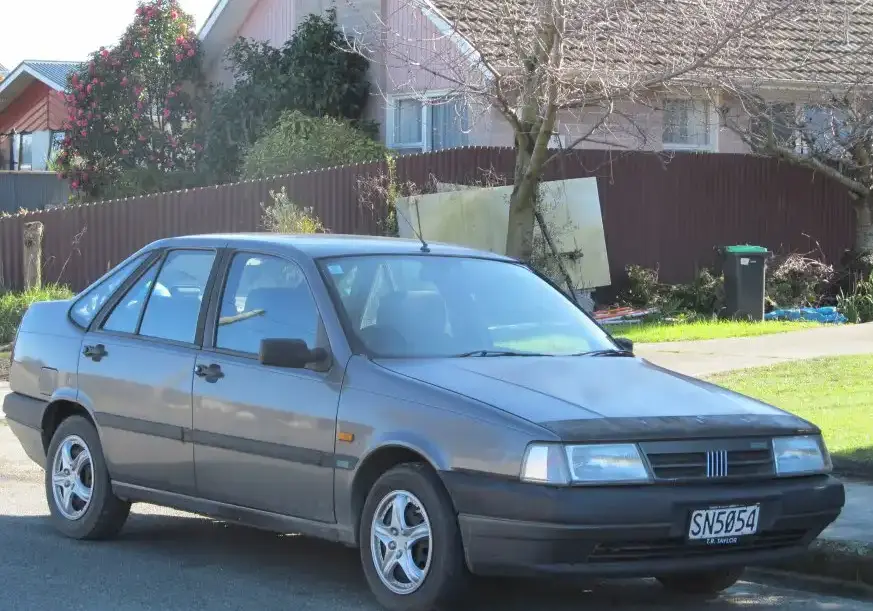
The Fiat Tempra 1.6 (86 hp) was a popular sedan produced between 1990 and 1993, representing a significant step forward for Fiat in the mid-size family car segment. Part of the 159 project, the Tempra aimed to replace the aging Fiat Regata and offered a more modern design, improved comfort, and a range of engines. The 1.6-liter variant, producing 86 horsepower, occupied an entry-level position within the Tempra lineup, appealing to buyers seeking affordable and practical transportation. It was a key model in several European and Latin American markets, offering a balance between economy and usability.
Technical Specifications
| Brand | Fiat |
| Model | Tempra |
| Generation | Tempra (159) |
| Type (Engine) | 1.6 (86 Hp) |
| Start of production | 1990 |
| End of production | 1993 |
| Powertrain Architecture | Internal Combustion engine |
| Body type | Sedan |
| Seats | 5 |
| Doors | 4 |
| Fuel consumption (urban) | 9.3 l/100 km (25.3 US mpg) |
| Fuel consumption (extra urban) | 5.5 l/100 km (42.8 US mpg) |
| Fuel consumption (combined) | 7.4 l/100 km (31.8 US mpg) |
| Fuel Type | Petrol (Gasoline) |
| Acceleration 0 – 100 km/h | 11.8 sec |
| Acceleration 0 – 62 mph | 11.8 sec |
| Acceleration 0 – 60 mph | 11.2 sec |
| Maximum speed | 175 km/h (108.74 mph) |
| Weight-to-power ratio | 11.6 kg/Hp |
| Weight-to-torque ratio | 7.6 kg/Nm |
| Power | 86 Hp @ 5800 rpm |
| Torque | 132 Nm @ 2900 rpm (97.36 lb.-ft. @ 2900 rpm) |
| Engine layout | Front, Transverse |
| Engine Model/Code | 159 A3.000 |
| Engine displacement | 1580 cm3 (96.42 cu. in.) |
| Number of cylinders | 4 |
| Engine configuration | Inline |
| Cylinder Bore | 86.4 mm (3.4 in.) |
| Piston Stroke | 67.4 mm (2.65 in.) |
| Compression ratio | 9.2:1 |
| Number of valves per cylinder | 2 |
| Fuel injection system | Carburettor |
| Engine aspiration | Naturally aspirated |
| Valvetrain | OHC |
| Engine oil capacity | 3.7 l (3.91 US qt | 3.26 UK qt) |
| Coolant capacity | 5.5 l (5.81 US qt | 4.84 UK qt) |
| Kerb Weight | 1000 kg (2204.62 lbs.) |
| Max. weight | 1565 kg (3450.23 lbs.) |
| Max load | 565 kg (1245.61 lbs.) |
| Trunk (boot) space – minimum | 500 l (17.66 cu. ft.) |
| Fuel tank capacity | 60 l (15.85 US gal | 13.2 UK gal) |
| Length | 4354 mm (171.42 in.) |
| Width | 1695 mm (66.73 in.) |
| Height | 1445 mm (56.89 in.) |
| Wheelbase | 2540 mm (100 in.) |
| Front track | 1435 mm (56.5 in.) |
| Rear track | 1415 mm (55.71 in.) |
| Front overhang | 918 mm (36.14 in.) |
| Rear overhang | 896 mm (35.28 in.) |
| Drivetrain Architecture | Front wheel drive |
| Number of gears | 5 gears, manual transmission |
| Front suspension | Wishbone |
| Rear suspension | Coil spring |
| Front brakes | Disc |
| Rear brakes | Disc |
| Assisting systems | ABS (Anti-lock braking system) |
| Steering type | Steering rack and pinion |
| Power steering | Hydraulic |
| Tires size | 165/70 R14 |
INTRODUCTION
The Fiat Tempra 1.6, launched in 1990, was a crucial model for Fiat, representing a move upmarket in terms of design and engineering. Built on the Type Two platform (159 series), it offered a more spacious and comfortable interior than its predecessor, the Regata. The 1.6-liter engine variant was positioned as the entry point to the Tempra range, aimed at buyers prioritizing fuel efficiency and affordability. It competed with other mainstream mid-size sedans like the Ford Escort, Opel/Vauxhall Astra, and Peugeot 305/405 in European markets, and similar offerings from local manufacturers in Latin America.
Powertrain & Engine Architecture
The Tempra 1.6 was powered by Fiat’s 159 A3.000 engine, a 1581cc inline-four cylinder unit. This engine utilized a single overhead camshaft (OHC) valvetrain with two valves per cylinder. Notably, this version of the engine employed a carburetor fuel system, a relatively outdated technology by the early 1990s, but one that helped keep production costs down. The carburetor provided adequate fuel delivery for the engine’s modest power output. The engine produced 86 horsepower at 5800 rpm and 132 Nm (97.36 lb-ft) of torque at 2900 rpm. The engine was transversely mounted in the front of the vehicle, driving the front wheels. The transmission was a standard five-speed manual gearbox, offering a reasonable spread of ratios for everyday driving.
Driving Characteristics
The Tempra 1.6, with its 86 horsepower and relatively lightweight construction (around 1000 kg or 2204 lbs), offered adequate performance for typical commuting and highway driving. Acceleration from 0 to 60 mph took around 11.2 seconds, and the top speed was approximately 108.74 mph. However, it wasn’t a particularly sporty vehicle. The carburetor-fed engine delivered power in a linear fashion, but lacked the responsiveness of fuel-injected engines. The five-speed manual transmission was well-matched to the engine’s characteristics, allowing drivers to keep the engine in its optimal power band. Compared to the more powerful 2.0-liter versions of the Tempra, the 1.6 felt noticeably slower, especially when fully loaded or climbing hills. The suspension provided a comfortable ride, prioritizing smoothness over sharp handling.
Equipment & Trim Levels
The Tempra 1.6 typically came with a fairly basic level of equipment, reflecting its position as the entry-level model. Standard features generally included power steering, central locking, and a basic stereo system. Interior upholstery was typically cloth, and the dashboard featured a functional but unadorned design. Optional extras included air conditioning, electric windows, and upgraded audio systems. Higher trim levels of the Tempra, such as the 2.0-liter versions, offered more luxurious features like leather upholstery, alloy wheels, and a more comprehensive instrument panel.
Chassis & Braking
The Tempra 1.6 featured a front-wheel-drive layout with independent wishbone suspension at the front and a coil spring rear suspension. This setup provided a comfortable ride quality, although it wasn’t particularly sporty. The braking system consisted of disc brakes on all four wheels, which were adequate for the vehicle’s weight and performance. An Anti-lock Braking System (ABS) was available as an option, enhancing safety by preventing wheel lockup during hard braking. The steering was a rack and pinion system with hydraulic power assistance, providing light and easy steering feel.
Market Reception & Comparison
The Fiat Tempra 1.6 was generally well-received by critics as a practical and affordable family sedan. It was praised for its spacious interior, comfortable ride, and reasonable fuel economy. However, the carburetor-fed engine was seen as a drawback compared to the fuel-injected engines offered in some competing models. The 1.6-liter version offered a significant fuel economy advantage over the 2.0-liter variants, achieving around 31.8 US mpg in combined driving. However, the 2.0-liter models provided considerably more performance. The Tempra 1.6 was a popular choice for budget-conscious buyers who prioritized practicality and reliability.
Legacy
The Fiat Tempra, including the 1.6-liter variant, enjoyed a reasonable reputation for reliability, although carburetor maintenance could be a factor for some owners. The engine itself was generally durable, but regular servicing was essential to ensure optimal performance. Today, the Tempra 1.6 is a relatively rare sight on the roads, but it remains a popular choice among classic Fiat enthusiasts. Parts availability can be a challenge, but the relatively simple mechanical design makes it a viable project for home mechanics. The Tempra 1.6 represents a significant chapter in Fiat’s history, marking a transition towards more modern and sophisticated family cars.
