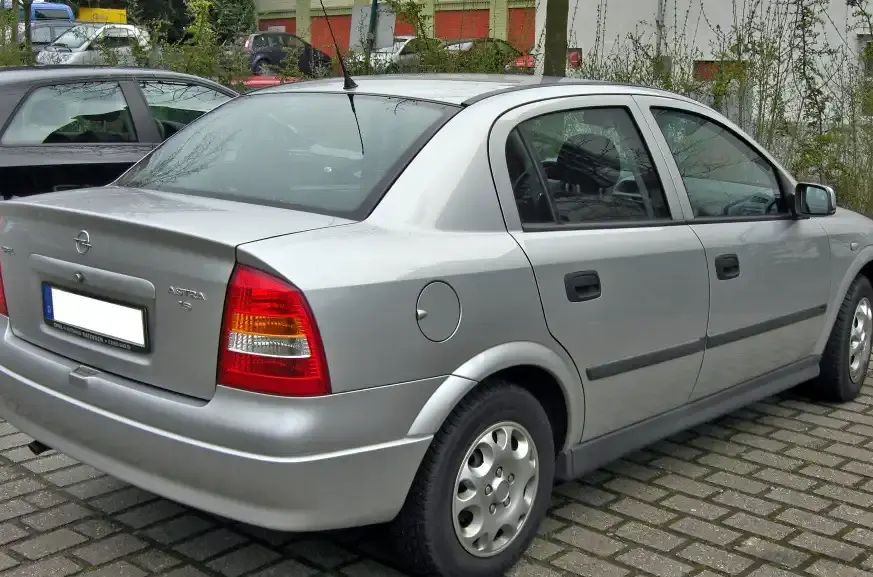
Technical Specifications
| Brand | Opel |
| Model | Astra |
| Generation | Astra G Classic |
| Type (Engine) | 1.6i (85 Hp) Automatic |
| Start of production | July, 2000 |
| End of production | February, 2004 |
| Powertrain Architecture | Internal Combustion engine |
| Body type | Sedan |
| Seats | 5 |
| Doors | 4 |
| Fuel consumption (urban) | 11.2 l/100 km (21 US mpg, 25.2 UK mpg, 8.9 km/l) |
| Fuel consumption (extra urban) | 6.3 l/100 km (37.3 US mpg, 44.8 UK mpg, 15.9 km/l) |
| Fuel consumption (combined) | 8.1 l/100 km (29 US mpg, 34.9 UK mpg, 12.3 km/l) |
| Fuel Type | Petrol (Gasoline) |
| Acceleration 0 – 100 km/h | 14.5 sec |
| Acceleration 0 – 62 mph | 14.5 sec |
| Acceleration 0 – 60 mph | 13.8 sec |
| Maximum speed | 170 km/h (105.63 mph) |
| Emission standard | Euro 3 |
| Weight-to-power ratio | 13 kg/Hp, 76.7 Hp/tonne |
| Weight-to-torque ratio | 8 kg/Nm, 124.5 Nm/tonne |
| Power | 85 Hp @ 5400 rpm |
| Power per litre | 53.2 Hp/l |
| Torque | 138 Nm @ 2600 rpm (101.78 lb.-ft. @ 2600 rpm) |
| Engine layout | Front, Transverse |
| Engine Model/Code | Z16SE |
| Engine displacement | 1598 cm3 (97.52 cu. in.) |
| Number of cylinders | 4 |
| Engine configuration | Inline |
| Cylinder Bore | 79 mm (3.11 in.) |
| Piston Stroke | 81.5 mm (3.21 in.) |
| Compression ratio | 9.6:1 |
| Number of valves per cylinder | 2 |
| Fuel injection system | Multi-port manifold injection |
| Engine aspiration | Naturally aspirated engine |
| Valvetrain | SOHC |
| Engine oil capacity | 3.5 l (3.7 US qt | 3.08 UK qt) |
| Coolant | 5.9 l (6.23 US qt | 5.19 UK qt) |
| Kerb Weight | 1108 kg (2442.72 lbs.) |
| Max. weight | 1660 kg (3659.67 lbs.) |
| Max load | 552 kg (1216.95 lbs.) |
| Trunk (boot) space – minimum | 460 l (16.24 cu. ft.) |
| Fuel tank capacity | 52 l (13.74 US gal | 11.44 UK gal) |
| Max. roof load | 100 kg (220.46 lbs.) |
| Permitted towbar download | 75 kg (165.35 lbs.) |
| Length | 4252 mm (167.4 in.) |
| Width | 1709 mm (67.28 in.) |
| Width including mirrors | 1967 mm (77.44 in.) |
| Height | 1425 mm (56.1 in.) |
| Wheelbase | 2606 mm (102.6 in.) |
| Front track | 1464 mm (57.64 in.) |
| Rear (Back) track | 1452 mm (57.17 in.) |
| Front overhang | 791 mm (31.14 in.) |
| Rear overhang | 855 mm (33.66 in.) |
| Ride height (ground clearance) | 130 mm (5.12 in.) |
| Drag coefficient (Cd) | 0.29 |
| Minimum turning circle | 10.8 m (35.43 ft.) |
| Drivetrain Architecture | The Internal combustion engine (ICE) drives the front wheels of the vehicle. |
| Drive wheel | Front wheel drive |
| Number of gears and type of gearbox | 4 gears, automatic transmission |
| Front suspension | Independent, type McPherson with coil spring and anti-roll bar |
| Rear suspension | Semi-independent, coil spring |
| Front brakes | Ventilated discs |
| Rear brakes | Disc |
| Assisting systems | ABS (Anti-lock braking system) |
| Steering type | Steering rack and pinion |
| Power steering | Hydraulic Steering |
| Tires size | 185/65 R15 |
| Wheel rims size | 6J x 15 |
The Opel Astra G Classic 1.6i (85 hp) Automatic, produced between July 2000 and February 2004, was an entry-level offering within the broader Astra G Classic range. Positioned as a practical and affordable sedan, it catered to buyers prioritizing economy and ease of use over outright performance. This variant was primarily sold in European markets, where the Astra G Classic continued production after the introduction of the more modern Astra G facelifted models elsewhere. It utilized the 1HX0 chassis code, shared with other vehicles within the General Motors J platform family.
Powertrain & Engine Architecture
The Astra G Classic 1.6i Automatic was powered by the Opel Z16SE engine, a 1.6-liter inline-four cylinder gasoline engine. This engine belonged to the Opel/Vauxhall Ecotec family, known for its relatively lightweight construction and focus on fuel efficiency. The Z16SE featured a single overhead camshaft (SOHC) valvetrain operating two valves per cylinder. Fuel delivery was handled by a multi-port fuel injection system. The engine produced 85 horsepower at 5400 rpm and 138 Nm (101.78 lb-ft) of torque at 2600 rpm. Paired with this engine was a four-speed automatic transmission, offering convenient operation but sacrificing some of the responsiveness found in manual transmission variants.
Driving Characteristics
The 1.6i Automatic offered a comfortable, if uninspiring, driving experience. Acceleration was modest, with a 0-60 mph time of around 13.8 seconds. The four-speed automatic transmission, while smooth, lacked the close gear ratios of more modern automatics or manual transmissions, resulting in noticeable engine drone during acceleration and a less engaging driving feel. The relatively low power output meant that overtaking maneuvers required careful planning. Compared to the more powerful 1.8-liter or diesel variants, the 1.6i Automatic prioritized fuel economy and ease of driving over performance.
Equipment & Trim Levels
The 1.6i Automatic typically came with a base level of equipment, focusing on essential comfort and safety features. Standard equipment generally included power steering, central locking, electric front windows, and an anti-lock braking system (ABS). Interior upholstery was typically cloth. Optional extras could include air conditioning, alloy wheels, and a radio/cassette player. Trim levels varied slightly depending on the specific market, but the 1.6i Automatic generally represented the entry point into the Astra G Classic range.
Chassis & Braking
The Astra G Classic featured an independent McPherson strut suspension at the front and a semi-independent coil spring suspension at the rear. This setup provided a reasonable balance between ride comfort and handling. The 1.6i Automatic variant was equipped with ventilated disc brakes at the front and solid disc brakes at the rear. The braking system, combined with ABS, provided adequate stopping power for everyday driving conditions. Stabilizer bars were fitted to both the front and rear axles to reduce body roll during cornering.
Market Reception & Comparison
The Astra G Classic 1.6i Automatic was generally well-received as a practical and affordable family car. Critics acknowledged its fuel efficiency and ease of use, but often noted its lack of performance compared to higher-powered variants. Compared to the 1.8-liter models, the 1.6i Automatic offered lower running costs but significantly less power. The diesel variants, such as the 1.7 DTi, provided even better fuel economy but were often noisier and less refined. The automatic transmission, while convenient, was often criticized for its lack of responsiveness.
Legacy
The Z16SE engine, while not known for being particularly groundbreaking, proved to be a relatively reliable unit when properly maintained. The four-speed automatic transmission, however, is a potential weak point, and examples with high mileage may exhibit signs of wear. Today, the Astra G Classic 1.6i Automatic represents an affordable entry point into classic Opel ownership. Its simplicity and relatively low maintenance costs make it an attractive option for budget-conscious buyers or those seeking a nostalgic driving experience. Parts availability is generally good, although some trim-specific components may be difficult to find.