
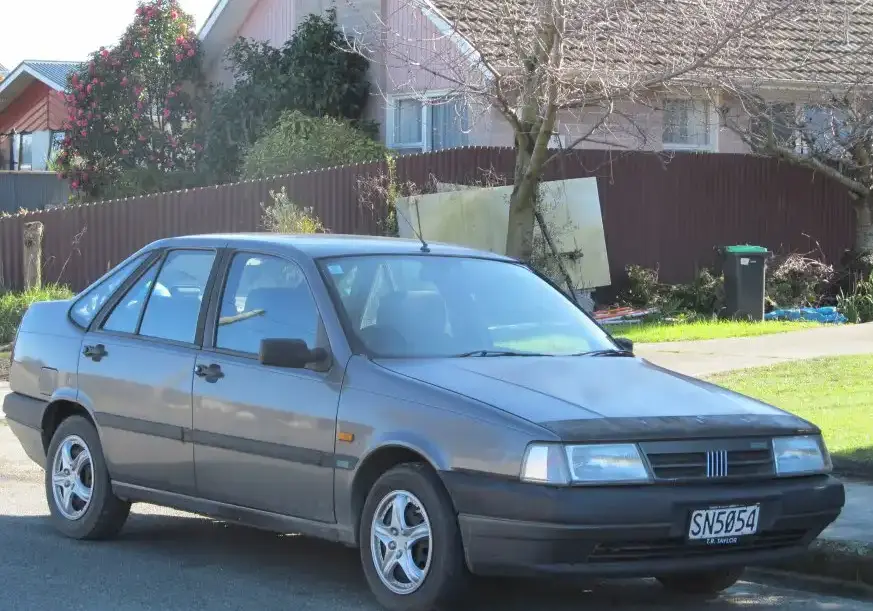
The Fiat Tempra 1.8 i.e., produced between March 1992 and April 1993, represented a mid-range offering within the 159 series of the Tempra. Positioned as a practical and relatively affordable family sedan, it aimed to bridge the gap between the base models and the more performance-oriented versions. The Tempra itself was Fiat’s replacement for the aging Tipo, designed to compete in the increasingly competitive mid-size segment of the European car market. The 1.8 i.e. variant, with its fuel injection system, offered a balance of performance and economy, making it a popular choice for buyers seeking a comfortable and reliable vehicle.
Technical Specifications
| Brand | Fiat |
| Model | Tempra |
| Generation | Tempra (159) |
| Type (Engine) | 1.8 i.e. (105 Hp) |
| Start of production | March, 1992 |
| End of production | April, 1993 |
| Powertrain Architecture | Internal Combustion engine |
| Body type | Sedan |
| Seats | 5 |
| Doors | 4 |
| Fuel consumption (urban) | 10.3 l/100 km (22.8 US mpg) |
| Fuel consumption (extra urban) | 6.7 l/100 km (35.1 US mpg) |
| Fuel Type | Petrol (Gasoline) |
| Acceleration 0 – 100 km/h | 11.4 sec |
| Acceleration 0 – 62 mph | 11.4 sec |
| Acceleration 0 – 60 mph | 10.8 sec |
| Maximum speed | 188 km/h (116.82 mph) |
| Weight-to-power ratio | 11.2 kg/Hp |
| Weight-to-torque ratio | 8.5 kg/Nm |
| Power | 105 Hp @ 6000 rpm |
| Torque | 137 Nm @ 3000 rpm (101.05 lb.-ft. @ 3000 rpm) |
| Engine layout | Front, Transverse |
| Engine Model/Code | 159A4.000 |
| Engine displacement | 1756 cm3 (107.16 cu. in.) |
| Number of cylinders | 4 |
| Engine configuration | Inline |
| Number of valves per cylinder | 2 |
| Fuel injection system | Multi-port manifold injection |
| Engine aspiration | Naturally aspirated engine |
| Valvetrain | SOHC |
| Engine oil capacity | 5.2 l (5.49 US qt | 4.58 UK qt) |
| Coolant capacity | 6.9 l (7.29 US qt | 6.07 UK qt) |
| Kerb Weight | 1171 kg (2581.61 lbs.) |
| Max. weight | 1300 kg (2866.01 lbs.) |
| Max load | 129 kg (284.4 lbs.) |
| Trunk (boot) space – minimum | 500 l (17.66 cu. ft.) |
| Fuel tank capacity | 63 l (16.64 US gal | 13.86 UK gal) |
| Length | 4354 mm (171.42 in.) |
| Width | 1695 mm (66.73 in.) |
| Height | 1445 mm (56.89 in.) |
| Wheelbase | 2540 mm (100 in.) |
| Front overhang | 918 mm (36.14 in.) |
| Rear overhang | 896 mm (35.28 in.) |
| Minimum turning circle | 10.3 m (33.79 ft.) |
| Drivetrain Architecture | Front wheel drive |
| Number of gears | 5 gears, manual transmission |
| Front suspension | Independent, type McPherson with coil spring and anti-roll bar |
| Rear suspension | Independent coil spring, Transverse stabilizer |
| Front brakes | Disc |
| Rear brakes | Drum |
| Steering type | Steering rack and pinion |
| Power steering | Hydraulic Steering |
| Tires size | 185/60 R14 |
Powertrain & Engine Architecture
The heart of the Tempra 1.8 i.e. was the 159A4.000 engine, a 1756 cc (1.8 liter) inline four-cylinder unit. This engine featured a single overhead camshaft (SOHC) valvetrain operating two valves per cylinder. Crucially, it employed multi-port fuel injection, a significant upgrade over the carbureted engines found in earlier Fiat models. This system, controlled by an electronic engine management system, allowed for more precise fuel delivery, resulting in improved efficiency and responsiveness. The engine produced 105 horsepower at 6000 rpm and 137 Nm (101 lb-ft) of torque at 3000 rpm. The five-speed manual transmission was the standard offering, providing a reasonable spread of gears for both city driving and highway cruising. The engine’s transverse mounting and front-wheel-drive configuration were typical for European family cars of the era.
Driving Characteristics
The Tempra 1.8 i.e. offered a comfortable, if not particularly sporty, driving experience. Acceleration from 0 to 60 mph took around 10.8 seconds, and it could reach a top speed of 116.82 mph. While not setting any performance records, this was adequate for everyday driving and overtaking maneuvers. The five-speed manual transmission allowed drivers to keep the engine in its optimal power band. Compared to the lower-powered 1.6-liter versions, the 1.8 i.e. provided noticeably more punch, especially when fully loaded. However, it lacked the more aggressive character of the later Tempra 2.0 i.e. models. The steering was light and easy, making it maneuverable in urban environments, but lacked significant feedback. The suspension provided a reasonably comfortable ride, absorbing most road imperfections without excessive body roll.
Equipment & Trim Levels
The Tempra 1.8 i.e. typically came equipped with features considered standard for a mid-range family sedan in the early 1990s. These included power steering, central locking, electric front windows, and a basic stereo system. Interior upholstery was typically cloth, with a relatively simple dashboard layout. Optional extras included air conditioning, a sunroof, and upgraded audio systems. The trim level often dictated the quality of the cloth upholstery and the availability of features like alloy wheels. The Tempra aimed for practicality and value, so luxury appointments were generally limited.
Chassis & Braking
The Tempra 1.8 i.e. utilized an independent McPherson strut suspension setup at the front, providing a good balance of ride comfort and handling. The rear suspension employed an independent coil spring arrangement with a transverse stabilizer bar, further enhancing stability. Braking duties were handled by disc brakes at the front and drum brakes at the rear. While adequate for normal driving conditions, the braking system wasn’t particularly powerful compared to some contemporary rivals. The car’s relatively light weight (around 2582 lbs) helped to mitigate the limitations of the braking system.
Market Reception & Comparison
The Fiat Tempra 1.8 i.e. was generally well-received by automotive critics as a competent and practical family car. It was praised for its comfortable ride, spacious interior, and relatively fuel-efficient engine. However, some reviewers noted that the styling was somewhat bland and that the interior lacked the sophistication of some competitors. Compared to the base 1.6-liter models, the 1.8 i.e. offered a significant performance improvement, making it a more appealing option for drivers who frequently carried passengers or drove on highways. Fuel economy was competitive for the time, averaging around 35 mpg on the highway. Reliability was generally good, although some owners reported issues with the electrical system.
Legacy
The Fiat Tempra, and specifically the 1.8 i.e. variant, remains a relatively common sight on European roads today, testament to its durability and practicality. The 159A4.000 engine, while not a high-performance unit, proved to be reasonably reliable and relatively easy to maintain. In the used car market, Tempra 1.8 i.e. models are often sought after by enthusiasts looking for a classic 1990s family car. Parts availability can be a challenge in some regions, but the engine’s simplicity makes it relatively straightforward to repair. The Tempra represented a significant step forward for Fiat in terms of design, technology, and overall quality, paving the way for future models like the Bravo and Brava.
