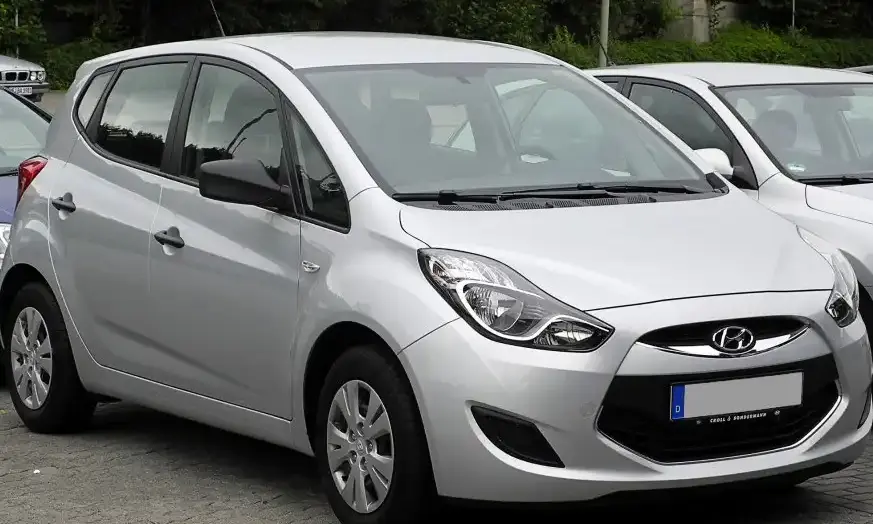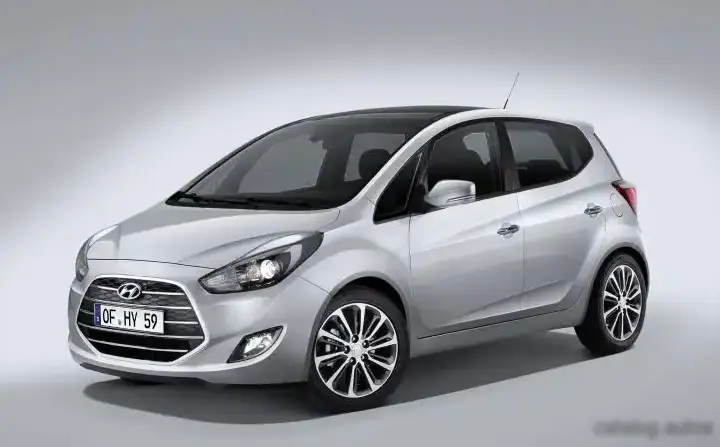
The Hyundai ix20 1.4d (90 hp) represents a significant entry point into the subcompact MPV (Multi-Purpose Vehicle) segment for the Hyundai brand, particularly within the European market. Produced from 2015 to 2018 as part of the facelifted first generation (internally designated as the ix20 facelift), this variant aimed to provide an affordable and practical family vehicle with reasonable fuel economy. It occupied the lower end of the ix20 lineup, positioned below the more powerful 1.6-liter gasoline and diesel options. This model was never officially sold in the United States, reflecting the differing preferences for vehicle types in the American automotive landscape.
Technical Specifications
| Brand | Hyundai |
| Model | ix20 |
| Generation | ix20 (facelift 2015) |
| Type (Engine) | 1.4d (90 Hp) |
| Start of production | 2015 |
| End of production | 2018 |
| Powertrain Architecture | Internal Combustion engine |
| Body type | Hatchback |
| Seats | 5 |
| Doors | 5 |
| Fuel Type | Diesel |
| Acceleration 0 – 100 km/h | 14.2 sec |
| Acceleration 0 – 62 mph | 14.2 sec |
| Acceleration 0 – 60 mph | 13.5 sec |
| Maximum speed | 167 km/h (103.77 mph) |
| Emission standard | Euro 6 |
| Weight-to-power ratio | 14.1 kg/Hp, 70.9 Hp/tonne |
| Weight-to-torque ratio | 5.3 kg/Nm, 189 Nm/tonne |
| Power | 90 Hp @ 4000 rpm |
| Power per litre | 64.5 Hp/l |
| Torque | 240 Nm @ 1500-2500 rpm (177.01 lb.-ft. @ 1500-2500 rpm) |
| Engine layout | Front, Transverse |
| Engine Model/Code | U / D4FC |
| Engine displacement | 1396 cm3 (85.19 cu. in.) |
| Number of cylinders | 4 |
| Engine configuration | Inline |
| Cylinder Bore | 75 mm (2.95 in.) |
| Piston Stroke | 79 mm (3.11 in.) |
| Compression ratio | 16:1 |
| Number of valves per cylinder | 4 |
| Fuel injection system | Diesel Commonrail |
| Engine aspiration | Turbocharger, Intercooler |
| Valvetrain | DOHC |
| Engine oil capacity | 5.3 l (5.6 US qt | 4.66 UK qt) |
| Coolant | 6.3 l (6.66 US qt | 5.54 UK qt) |
| Kerb Weight | 1270 kg (2799.87 lbs.) |
| Trunk (boot) space – minimum | 440 l (15.54 cu. ft.) |
| Trunk (boot) space – maximum | 1486 l (52.48 cu. ft.) |
| Fuel tank capacity | 50 l (13.21 US gal | 11 UK gal) |
| Length | 4115 mm (162.01 in.) |
| Width | 1765 mm (69.49 in.) |
| Height | 1600 mm (62.99 in.) |
| Wheelbase | 2615 mm (102.95 in.) |
| Drivetrain Architecture | The Internal combustion engine (ICE) drives the front wheels of the vehicle. |
| Drive wheel | Front wheel drive |
| Number of gears and type of gearbox | 6 gears, manual transmission |
| Front suspension | Independent, type McPherson with coil spring and anti-roll bar |
| Rear suspension | Semi-independent, coil spring |
| Front brakes | Ventilated discs |
| Rear brakes | Disc |
| Assisting systems | ABS (Anti-lock braking system) |
| Steering type | Steering rack and pinion |
| Power steering | Electric Steering |
| Tires size | 195/65 R15; 205/55 R16; 205/50 R17 |
| Wheel rims size | 15; 16; 17 |
INTRODUCTION
The Hyundai ix20, launched in 2010, was Hyundai’s first foray into the European-specific subcompact MPV market. The 2015 facelift brought revised styling, improved interior materials, and updated technology. The 1.4d (90 hp) variant, powered by the D4FC engine, was a key component of the range, offering a balance between affordability, fuel efficiency, and practicality. It was designed to appeal to buyers seeking a versatile vehicle for urban driving and family use. The ix20 competed with models like the Renault Modus, Opel Meriva, and Ford Fusion (in Europe).
Powertrain & Engine Architecture
The heart of the ix20 1.4d is the Hyundai D4FC engine, a 1.4-liter inline-four cylinder diesel. This engine utilizes a second-generation common rail direct injection system, delivering fuel at extremely high pressure for optimized combustion. The D4FC is a turbocharged engine, employing a variable geometry turbocharger (VGT) to enhance low-end torque and improve responsiveness. The engine also features an intercooler to reduce intake air temperature, further boosting performance. The engine produces 90 horsepower at 4000 rpm and 240 Nm (177 lb-ft) of torque between 1500 and 2500 rpm. This engine is known for its relatively simple construction, contributing to its reliability. The 6-speed manual transmission was the standard gearbox for this variant, offering a good balance between fuel economy and drivability. The transmission’s gear ratios were tuned to maximize the engine’s torque output, providing adequate acceleration for everyday driving.
Driving Characteristics
The ix20 1.4d (90 hp) delivers a driving experience focused on practicality and fuel economy rather than outright performance. Acceleration is modest, with a 0-62 mph (0-100 km/h) time of around 14.2 seconds. However, the engine’s strong low-end torque makes it feel more responsive in urban environments and during overtaking maneuvers. The 6-speed manual transmission allows drivers to keep the engine in its optimal power band. Compared to the 1.6-liter gasoline engine, the 1.4d offers significantly better fuel economy, but lacks the gasoline engine’s higher top-end power. The suspension is tuned for comfort, providing a reasonably smooth ride over uneven surfaces. Steering is light and easy, making it well-suited for city driving. The relatively low power output and front-wheel-drive configuration mean that the ix20 1.4d is not a particularly sporty vehicle.
Equipment & Trim Levels
The ix20 1.4d typically came with a reasonable level of standard equipment, though specific features varied depending on the market and optional packages. Standard features generally included air conditioning, power windows, central locking, a basic audio system with USB connectivity, and ABS brakes. Higher trim levels added features such as alloy wheels, a more advanced audio system, rear parking sensors, and a panoramic sunroof. Interior upholstery was typically cloth, with a focus on durability and practicality. The dashboard layout was functional and straightforward, with easy-to-use controls. Safety features included dual front airbags, side airbags, and curtain airbags.
Chassis & Braking
The ix20 utilizes a McPherson strut front suspension and a semi-independent torsion beam rear suspension. This setup provides a good balance between ride comfort and handling. The front suspension incorporates a stabilizer bar to reduce body roll during cornering. Braking duties are handled by ventilated discs at the front and solid discs at the rear. ABS (Anti-lock Braking System) is standard, enhancing braking performance and stability. The steering system is a rack and pinion type with electric power assistance, providing light and precise steering feel.
Market Reception & Comparison
The Hyundai ix20 1.4d was generally well-received by automotive critics as a practical and affordable MPV. It was praised for its spacious interior, good fuel economy, and comfortable ride. However, some critics noted its modest performance and relatively basic interior trim. Compared to the more powerful 1.6-liter gasoline and diesel variants, the 1.4d offered lower running costs but less performance. It was often seen as a sensible choice for buyers prioritizing fuel efficiency and practicality over driving excitement. The 1.4d’s fuel economy was a key selling point, typically achieving around 50-60 mpg (depending on driving conditions).
Legacy
The Hyundai ix20 1.4d has proven to be a relatively reliable vehicle, with the D4FC engine generally considered durable and long-lasting. Common issues are typically related to wear and tear on components such as the turbocharger and fuel injectors. On the used car market, the ix20 1.4d represents a good value proposition for buyers seeking an affordable and practical MPV. Its fuel efficiency and spacious interior make it a suitable choice for families and urban commuters. While it may not offer the most exciting driving experience, its reliability and low running costs make it a sensible and economical option.