
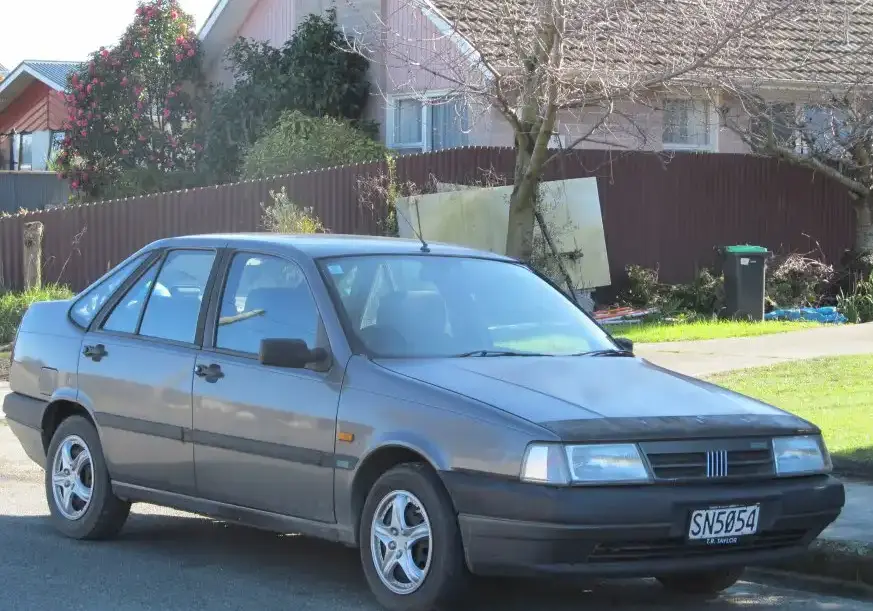
The Fiat Tempra 1.9 TD (90 hp) was a diesel-powered variant of the Tempra (Type 159) sedan, produced between 1990 and 1996. Positioned as a fuel-efficient and practical option within the Tempra range, it catered to drivers prioritizing economy over outright performance. The Tempra itself was Fiat’s replacement for the aging Tipo, representing a significant step up in terms of size, comfort, and technology for the Italian automaker. This 1.9 TD model found its primary market in Europe, where diesel engines were – and continue to be – popular due to favorable taxation and fuel costs. It served as a workhorse for families and businesses alike, offering a blend of space, reliability, and low running costs.
Technical Specifications
| Brand | Fiat |
| Model | Tempra |
| Generation | Tempra (159) |
| Type (Engine) | 1.9 TD (90 Hp) |
| Start of production | 1990 |
| End of production | 1996 |
| Powertrain Architecture | Internal Combustion engine |
| Body type | Sedan |
| Seats | 5 |
| Doors | 4 |
| Fuel consumption (combined) | 6.1 l/100 km (38.6 US mpg, 46.3 UK mpg, 16.4 km/l) |
| Fuel Type | Diesel |
| Acceleration 0 – 100 km/h | 13.9 sec |
| Acceleration 0 – 62 mph | 13.9 sec |
| Acceleration 0 – 60 mph | 13.2 sec |
| Maximum speed | 180 km/h (111.85 mph) |
| Weight-to-power ratio | 13.2 kg/Hp, 75.8 Hp/tonne |
| Weight-to-torque ratio | 6.4 kg/Nm, 156.6 Nm/tonne |
| Power | 90 Hp @ 4200 rpm |
| Power per litre | 46.7 Hp/l |
| Torque | 186 Nm @ 2800 rpm (137.19 lb.-ft. @ 2800 rpm) |
| Engine layout | Front, Transverse |
| Engine Model/Code | 160 A6.000 |
| Engine displacement | 1929 cm3 (117.71 cu. in.) |
| Number of cylinders | 4 |
| Engine configuration | Inline |
| Cylinder Bore | 82.6 mm (3.25 in.) |
| Piston Stroke | 90 mm (3.54 in.) |
| Compression ratio | 19.2:1 |
| Number of valves per cylinder | 2 |
| Fuel injection system | Precombustion chamber injection |
| Engine aspiration | Turbocharger |
| Valvetrain | OHC |
| Engine oil capacity | 5 l (5.28 US qt | 4.4 UK qt) |
| Coolant | 8.8 l (9.3 US qt | 7.74 UK qt) |
| Kerb Weight | 1188 kg (2619.09 lbs.) |
| Max. weight | 1710 kg (3769.9 lbs.) |
| Max load | 522 kg (1150.81 lbs.) |
| Trunk (boot) space – minimum | 500 l (17.66 cu. ft.) |
| Fuel tank capacity | 60 l (15.85 US gal | 13.2 UK gal) |
| Length | 4354 mm (171.42 in.) |
| Width | 1695 mm (66.73 in.) |
| Height | 1445 mm (56.89 in.) |
| Wheelbase | 2540 mm (100 in.) |
| Front track | 1435 mm (56.5 in.) |
| Rear (Back) track | 1415 mm (55.71 in.) |
| Front overhang | 918 mm (36.14 in.) |
| Rear overhang | 896 mm (35.28 in.) |
| Drivetrain Architecture | The Internal combustion engine (ICE) drives the front wheels of the vehicle. |
| Drive wheel | Front wheel drive |
| Number of gears and type of gearbox | 5 gears, manual transmission |
| Front suspension | Wishbone |
| Rear suspension | Coil spring |
| Front brakes | Disc |
| Rear brakes | Disc |
| Assisting systems | ABS (Anti-lock braking system) |
| Steering type | Steering rack and pinion |
| Power steering | Hydraulic Steering |
| Tires size | 175/65 R14 |
Powertrain & Engine Architecture
The heart of the Tempra 1.9 TD was the 160 A6.000 engine, a 1929cc inline-four cylinder diesel. This engine utilized a precombustion chamber injection system, a common technology for diesel engines of the era. This system involved injecting fuel into a small precombustion chamber within the cylinder head, where it would partially ignite before being fully combusted in the main cylinder. This design aided in smoother combustion and reduced engine noise compared to direct injection systems. The engine was turbocharged, boosting power output to 90 hp at 4200 rpm and 186 Nm (137.19 lb-ft) of torque at 2800 rpm. The five-speed manual transmission was the only gearbox option available with this engine, prioritizing fuel efficiency over rapid acceleration. The engine featured a single overhead camshaft (OHC) valvetrain with two valves per cylinder.
Driving Characteristics
The Tempra 1.9 TD, with its 90 hp and manual transmission, offered a decidedly unhurried driving experience. Acceleration to 100 km/h (62 mph) took around 13.9 seconds, and top speed was limited to 180 km/h (112 mph). However, the engine’s strong low-end torque made it well-suited for everyday driving and overtaking on highways. The gear ratios were optimized for fuel economy, meaning the engine wasn’t particularly rev-happy. Compared to the more powerful gasoline-powered Tempra variants, the 1.9 TD lacked the punch for spirited driving, but it excelled in providing a comfortable and economical ride. The manual transmission allowed for greater driver control, but the long throws and relatively heavy clutch action were typical of the period.
Equipment & Trim Levels
The Tempra 1.9 TD was generally offered in a fairly basic trim level, reflecting its positioning as the entry-level diesel option. Standard equipment typically included central locking, power steering, and a basic stereo system. Interior upholstery was usually cloth, and the dashboard featured a functional, if somewhat dated, design. Optional extras included air conditioning, electric windows, and upgraded audio systems. The Tempra wasn’t known for its luxurious appointments, but it provided a comfortable and practical interior for its price point.
Chassis & Braking
The Tempra 1.9 TD utilized a front-wheel-drive layout with independent wishbone suspension at the front and a coil spring rear suspension. This setup provided a reasonable balance between ride comfort and handling. Braking was handled by disc brakes on all four wheels, supplemented by an Anti-lock Braking System (ABS) which was becoming increasingly common on European cars of this era. The steering was rack and pinion, providing reasonably precise control. The tires were typically 175/65 R14, offering a good compromise between grip and rolling resistance.
Market Reception & Comparison
The Fiat Tempra 1.9 TD was generally well-received by critics as a practical and economical family car. Its fuel economy of around 6.1 l/100 km (38.6 US mpg) was a major selling point, particularly in Europe where diesel fuel was cheaper than gasoline. Compared to the gasoline-powered Tempra variants, the 1.9 TD offered significantly better fuel economy but lacked the same level of performance. It also proved to be more reliable than some of the more complex gasoline engines in the range. The Tempra 1.9 TD competed with other mid-size diesel sedans such as the Ford Mondeo TD and the Opel/Vauxhall Vectra CD.
Legacy
The Fiat Tempra 1.9 TD has proven to be a relatively durable and reliable vehicle, with many examples still on the road today. The 160 A6.000 engine, while not particularly powerful, is known for its longevity and relatively simple mechanical design. Parts availability can be a challenge, but the engine is generally easy to work on for experienced mechanics. In the used car market, the Tempra 1.9 TD is often sought after by those looking for a cheap and economical classic car. It represents a significant step forward for Fiat in terms of design, comfort, and technology, and remains a popular choice for those seeking a practical and affordable vehicle.
