
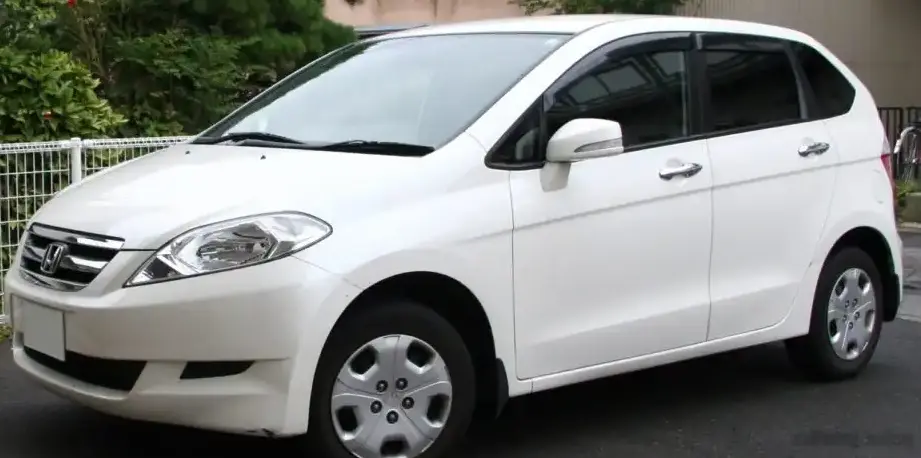
The Honda Edix 1.7, a six-seat minivan produced between 2004 and 2009, represented Honda’s attempt to cater to a niche market seeking a compact, versatile people carrier. Primarily sold in Japan and select Asian markets, the Edix (also known as the Honda Partner in some regions) offered a unique blend of minivan practicality and a relatively small footprint. The 1.7-liter, 130 horsepower, four-wheel-drive variant occupied a mid-range position within the Edix lineup, offering a balance between affordability, fuel efficiency, and all-weather capability. It was positioned below the more powerful 2.0-liter engine options, and aimed at families prioritizing practicality over outright performance.
Technical Specifications
| Brand | Honda |
| Model | Edix |
| Generation | Edix |
| Type (Engine) | 1.7 (130 Hp) 4WD |
| Start of production | 2004 |
| End of production | 2009 |
| Powertrain Architecture | Internal Combustion engine |
| Body type | Minivan |
| Seats | 6 |
| Doors | 4 |
| Fuel Type | Petrol (Gasoline) |
| Weight-to-power ratio | 11 kg/Hp, 90.9 Hp/tonne |
| Weight-to-torque ratio | 9.2 kg/Nm, 108.4 Nm/tonne |
| Power | 130 Hp @ 6300 rpm |
| Power per litre | 77.9 Hp/l |
| Torque | 155 Nm @ 4800 rpm (114.32 lb.-ft. @ 4800 rpm) |
| Engine layout | Front, Transverse |
| Engine displacement | 1668 cm3 (101.79 cu. in.) |
| Number of cylinders | 4 |
| Engine configuration | Inline |
| Number of valves per cylinder | 4 |
| Fuel injection system | Multi-port manifold injection |
| Engine aspiration | Naturally aspirated engine |
| Valvetrain | SOHC |
| Engine oil capacity | 3.5 l (3.7 US qt | 3.08 UK qt) |
| Coolant | 5.5 l (5.81 US qt | 4.84 UK qt) |
| Kerb Weight | 1430 kg (3152.61 lbs) |
| Fuel tank capacity | 50 l (13.21 US gal | 11 UK gal) |
| Length | 4285 mm (168.7 in) |
| Width | 1795 mm (70.67 in) |
| Height | 1635 mm (64.37 in) |
| Wheelbase | 2680 mm (105.51 in) |
| Front track | 1545 mm (60.83 in) |
| Rear (Back) track | 1550 mm (61.02 in) |
| Drive wheel | All wheel drive (4×4) |
| Number of gears and type of gearbox | 4 gears, automatic transmission |
| Front brakes | Ventilated discs |
| Rear brakes | Drum |
| Tires size | 195/65 R15 |
| Wheel rims size | 15 |
Powertrain & Engine Architecture
The Edix 1.7 utilized Honda’s D17A engine, a 1.7-liter inline-four cylinder powerplant. This engine featured a single overhead camshaft (SOHC) valvetrain and multi-point fuel injection. While not a particularly advanced engine design, the D17A was known for its reliability and reasonable fuel economy. The 130 horsepower output was achieved through a relatively conservative tuning of the engine, prioritizing durability over peak performance. The engine’s torque peak of 155 Nm (114.32 lb-ft) arrived at 4800 rpm, providing adequate, though not exhilarating, acceleration. The four-speed automatic transmission was a conventional torque converter type, chosen for its smoothness and ease of use. It wasn’t known for its sportiness, with relatively wide gear ratios geared towards fuel efficiency rather than rapid acceleration.
Driving Characteristics
The 1.7-liter engine and four-speed automatic combination in the Edix delivered a comfortable, if uninspiring, driving experience. Acceleration was adequate for everyday driving, but passing maneuvers required planning. The automatic transmission’s shift points were optimized for fuel economy, sometimes resulting in the engine feeling strained under heavy load. The all-wheel-drive system provided enhanced traction in slippery conditions, making the Edix a capable vehicle in inclement weather. Compared to the 2.0-liter Edix models, the 1.7 felt noticeably slower, particularly when fully loaded with passengers and cargo. However, the 1.7 offered a significant fuel economy advantage, making it a more practical choice for drivers prioritizing running costs.
Equipment & Trim Levels
The Edix 1.7 4WD typically came equipped with features such as air conditioning, power windows, power door locks, and a basic audio system. Higher trim levels added features like alloy wheels, a more sophisticated audio system, and optional navigation. Interior upholstery was typically cloth, with a focus on durability rather than luxury. The Edix’s interior was designed with practicality in mind, offering ample storage space and a flexible seating arrangement. The second-row seats could be folded flat or removed entirely, creating a large cargo area. The third-row seats, while suitable for children, were relatively cramped for adults.
Chassis & Braking
The Edix utilized a MacPherson strut front suspension and a torsion beam rear suspension. This setup provided a comfortable ride, but wasn’t particularly sporty. The front brakes were ventilated discs, providing adequate stopping power, while the rear brakes were drums, a cost-saving measure common in this class of vehicle. The all-wheel-drive system employed a viscous coupling to distribute torque between the front and rear axles, providing automatic all-wheel drive engagement when needed. The 15-inch wheels were fitted with 195/65 R15 tires, offering a good balance between ride comfort and handling.
Market Reception & Comparison
The Honda Edix 1.7 4WD was generally well-received for its practicality, fuel efficiency, and all-weather capability. Critics praised its spacious interior and flexible seating arrangement. However, some reviewers found the engine to be underpowered, particularly when the vehicle was fully loaded. Compared to other minivans in its class, the Edix offered a more compact footprint and a more affordable price point. It competed with vehicles like the Toyota Wish and the Nissan Serena, offering a similar blend of practicality and versatility. The 1.7-liter engine offered better fuel economy than the larger engine options, but at the expense of performance.
Legacy
The Honda Edix, while not a mainstream success in many markets, established a reputation for reliability and practicality. The D17A engine is known for its durability, and with proper maintenance, can provide many years of service. In the used car market, the Edix 1.7 4WD remains a relatively affordable and practical option for families seeking a versatile people carrier. Its all-wheel-drive system and reputation for reliability make it a particularly attractive choice in regions with harsh winters or challenging road conditions. While it may not offer the latest technology or the most exciting driving experience, the Edix 1.7 4WD continues to serve as a dependable and functional vehicle for those who prioritize practicality and value.
