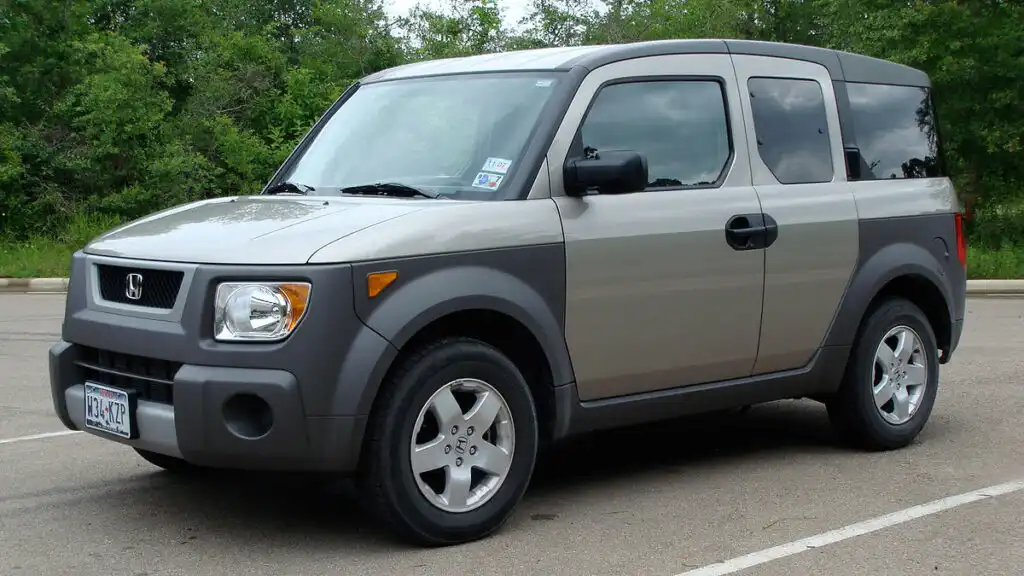
The Honda Element, produced from the 2003 to 2011 model years, was a distinctive offering in the compact SUV segment. The 2.4i 16V variant, generating 162 horsepower, served as the primary engine option from 2003 through 2006. Positioned as the entry-level engine choice, it aimed to provide a balance between affordability and sufficient performance for the vehicle’s intended role as a versatile, utilitarian carrier for both passengers and cargo. Built upon Honda’s compact platform – shared with the CR-V – the Element distinguished itself through its boxy design, durable interior materials, and emphasis on practicality. It was primarily marketed to active lifestyle consumers in North America, highlighting its adaptability for outdoor pursuits and everyday use.
Technical Specifications
| Brand | Honda |
| Model | Element |
| Generation | Element I |
| Type (Engine) | 2.4i 16V (162 Hp) |
| Start of production | 2003 |
| End of production | 2006 |
| Powertrain Architecture | Internal Combustion engine |
| Body type | SUV |
| Seats | 4 |
| Doors | 5 |
| Fuel consumption (urban) | 14 l/100 km (16.8 US mpg, 20.2 UK mpg, 7.1 km/l) |
| Fuel consumption (extra urban) | 10.2 l/100 km (23.1 US mpg, 27.7 UK mpg, 9.8 km/l) |
| Fuel Type | Petrol (Gasoline) |
| Acceleration 0 – 100 km/h | 9.5 sec |
| Acceleration 0 – 62 mph | 9.5 sec |
| Acceleration 0 – 60 mph | 9 sec |
| Maximum speed | 185 km/h (114.95 mph) |
| Weight-to-power ratio | 9.6 kg/Hp, 104.5 Hp/tonne |
| Weight-to-torque ratio | 7 kg/Nm, 141.9 Nm/tonne |
| Power | 162 Hp @ 5500 rpm |
| Power per litre | 68.8 Hp/l |
| Torque | 220 Nm @ 4500 rpm (162.26 lb.-ft. @ 4500 rpm) |
| Engine layout | Front, Transverse |
| Engine Model/Code | K24A4 |
| Engine displacement | 2354 cm3 (143.65 cu. in.) |
| Number of cylinders | 4 |
| Engine configuration | Inline |
| Cylinder Bore | 87 mm (3.43 in.) |
| Piston Stroke | 99 mm (3.9 in.) |
| Compression ratio | 9.7:1 |
| Number of valves per cylinder | 4 |
| Fuel injection system | Multi-port manifold injection |
| Engine aspiration | Naturally aspirated engine |
| Valvetrain | DOHC |
| Engine oil capacity | 4.2 l (4.44 US qt | 3.7 UK qt) |
| Coolant | 5.5 l (5.81 US qt | 4.84 UK qt) |
| Kerb Weight | 1550 kg (3417.17 lbs.) |
| Trunk (boot) space – minimum | 736 l (25.99 cu. ft.) |
| Trunk (boot) space – maximum | 2183 l (77.09 cu. ft.) |
| Fuel tank capacity | 60 l (15.85 US gal | 13.2 UK gal) |
| Length | 4229 mm (166.5 in.) |
| Width | 1788 mm (70.39 in.) |
| Height | 1816 mm (71.5 in.) |
| Wheelbase | 2575 mm (101.38 in.) |
| Front track | 1577 mm (62.09 in.) |
| Rear (Back) track | 1582 mm (62.28 in.) |
| Drivetrain Architecture | The Internal combustion engine (ICE) drives the front wheels of the vehicle. |
| Drive wheel | Front wheel drive |
| Number of gears and type of gearbox | 5 gears, manual transmission |
| Front suspension | Spring Strut |
| Rear suspension | Spring Strut |
| Front brakes | Ventilated discs |
| Rear brakes | Disc |
| Assisting systems | ABS (Anti-lock braking system) |
| Steering type | Steering rack and pinion |
| Tires size | 215/70 R16 |
| Wheel rims size | 16 |
Powertrain & Engine Architecture
The 2.4i Element’s powerplant was the Honda K24A4, a 2.4-liter inline-four cylinder engine. This engine belonged to Honda’s celebrated K-series family, renowned for its inherent reliability and relatively uncomplicated design. The K24A4 featured a cast iron engine block and an aluminum cylinder head, incorporating a double overhead camshaft (DOHC) valvetrain with four valves per cylinder. Fuel delivery was managed by a multi-point fuel injection system. The engine generated 162 horsepower at 5,500 rpm and 162 lb-ft of torque at 4,500 rpm. The standard transmission was a 5-speed manual, offering a direct and engaging driving experience. The engine’s design prioritized durability and low-end torque, making it well-suited to the Element’s intended purpose as a versatile vehicle capable of handling a variety of driving conditions.
Driving Characteristics
The 2.4i Element equipped with the 5-speed manual transmission delivered adequate, though not particularly sporty, performance. Acceleration from 0-60 mph was achieved in approximately 9 seconds. The engine’s torque curve was relatively flat, providing usable power across a broad range of engine speeds. The manual transmission allowed for precise control and maximized the engine’s potential. Compared to the later 2.4i automatic variants, the manual offered a more engaging driving experience and slightly improved fuel economy. While not a performance vehicle, the 2.4i Element was capable of comfortably maintaining highway speeds and navigating urban environments. The front-wheel-drive configuration provided predictable handling, though it lacked the all-weather capability of all-wheel-drive systems found in some competing SUVs.
Equipment & Trim Levels
The base Element trim level, powered by the 2.4i engine, included standard features such as air conditioning, power windows and locks, and an AM/FM stereo. The interior was characterized by its durable, water-resistant materials, designed to withstand the demands of an active lifestyle. The rear seats were foldable and removable, creating a highly configurable cargo area. Optional extras included a premium audio system, alloy wheels, and a sunroof. The Element’s interior was intentionally minimalist, prioritizing functionality and ease of cleaning. The unique “water-shedding” floor and seat materials were a significant selling point for those who frequently participated in outdoor activities.
Chassis & Braking
The Element employed a MacPherson strut front suspension and a multi-link rear suspension, providing a comfortable ride and predictable handling characteristics. The front brakes were ventilated discs, while the rear brakes were solid discs. An anti-lock braking system (ABS) was standard equipment. The Element’s relatively high ground clearance and short wheelbase contributed to its off-road capability, although it wasn’t designed for serious off-roading. The suspension was tuned to strike a balance between ride comfort and handling stability, making it suitable for both on-road and light off-road use.
Market Reception & Comparison
The Honda Element received generally favorable reviews from automotive critics. It was lauded for its unique design, spacious interior, and overall versatility. However, some reviewers noted its relatively modest performance and fuel economy. Compared to other compact SUVs of the era, such as the Toyota RAV4 and Honda CR-V, the Element offered a more utilitarian and adventurous character. The 2.4i manual transmission variant was often preferred by enthusiasts for its more engaging driving experience. Fuel economy was rated around 20 mpg in the city and 23 mpg on the highway, which was average for its class.
Legacy
The Honda Element cultivated a devoted following among outdoor enthusiasts and those seeking a practical and versatile vehicle. The K24A4 engine proved to be exceptionally reliable, with numerous examples exceeding 200,000 miles with routine maintenance. In the used car market, Elements are frequently sought after for their durability, spaciousness, and distinctive styling. Although production ceased in 2011, the Element remains a unique and well-regarded vehicle, representing a distinctive chapter in Honda’s history. Its focus on practicality and adaptability continues to appeal to buyers today, making it a popular choice for individuals seeking a vehicle that can accommodate their active lifestyles.