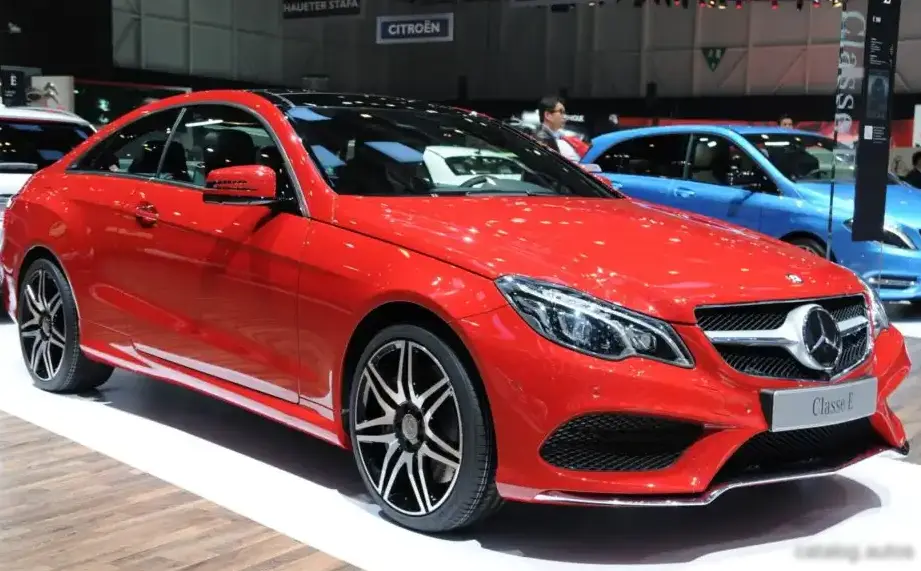
The Mercedes-Benz E-Class Coupe (C207) facelift, specifically the E 250 variant equipped with the 7G-TRONIC PLUS automatic transmission, was produced from June 2013 to December 2016. This model represented a mid-cycle refresh of the C207 coupe, building upon the foundation of the W207 E-Class sedan but offering a more sporting and style-focused alternative. Positioned as a mid-range offering within the coupe lineup, the E 250 aimed to balance performance, efficiency, and luxury features, appealing to buyers seeking a sophisticated grand tourer. It sat below the more powerful E 350 and E 550 models, and above any potential base-level trims offered in certain markets.
| Brand | Mercedes-Benz |
| Model | E-Class |
| Generation | E-Class Coupe (C207, facelift 2013) |
| Type | E 250 (211 Hp) 7G-TRONIC PLUS |
| Start of production | June, 2013 |
| End of production | December, 2016 |
| Powertrain Architecture | Internal Combustion engine |
| Body type | Coupe |
| Seats | 4 |
| Doors | 2 |
| Fuel consumption (urban) | 7.5-7.8 l/100 km (31.4 – 30.2 US mpg) |
| Fuel consumption (extra urban) | 4.6-5.1 l/100 km (51.1 – 46.1 US mpg) |
| Fuel consumption (combined) | 5.7-6.1 l/100 km (41.3 – 38.6 US mpg) |
| CO2 emissions | 132-142 g/km |
| Fuel Type | Petrol (Gasoline) |
| Acceleration 0 – 100 km/h | 7.1 sec |
| Acceleration 0 – 62 mph | 7.1 sec |
| Acceleration 0 – 60 mph | 6.7 sec |
| Maximum speed | 250 km/h (155.34 mph) – Electronically limited |
| Emission standard | Euro 6 |
| Weight-to-power ratio | 7.4 kg/Hp |
| Weight-to-torque ratio | 4.5 kg/Nm |
| Power | 211 Hp @ 5500 rpm |
| Torque | 350 Nm @ 1200-4000 rpm (258.15 lb.-ft. @ 1200-4000 rpm) |
| Engine layout | Front, Longitudinal |
| Engine Model/Code | M 274.920 |
| Engine displacement | 1991 cm3 (121.5 cu. in.) |
| Number of cylinders | 4 |
| Engine configuration | Inline |
| Cylinder Bore | 83 mm (3.27 in.) |
| Piston Stroke | 92 mm (3.62 in.) |
| Compression ratio | 9.8:1 |
| Number of valves per cylinder | 4 |
| Fuel injection system | Direct injection |
| Engine aspiration | Turbocharger, Intercooler |
| Valvetrain | DOHC |
| Engine oil capacity | 6.3 l (6.66 US qt | 5.54 UK qt) |
| Coolant capacity | 8.5 l (8.98 US qt | 7.48 UK qt) |
| Kerb Weight | 1560 kg (3439.21 lbs.) |
| Max. weight | 2105 kg (4640.73 lbs.) |
| Max load | 545 kg (1201.52 lbs.) |
| Trunk (boot) space (minimum) | 450 l (15.89 cu. ft.) |
| Fuel tank capacity | 66 l (17.44 US gal | 14.52 UK gal) |
| Max. roof load | 100 kg (220.46 lbs.) |
| Permitted trailer load (with brakes) | 1800 kg (3968.32 lbs.) |
| Permitted trailer load (without brakes) | 750 kg (1653.47 lbs.) |
| Permitted towbar download | 75 kg (165.35 lbs.) |
| Length | 4703 mm (185.16 in.) |
| Width | 1786 mm (70.31 in.) |
| Width including mirrors | 2016 mm (79.37 in.) |
| Height | 1397 mm (55 in.) |
| Wheelbase | 2760 mm (108.66 in.) |
| Front track | 1538 mm (60.55 in.) |
| Rear track | 1541 mm (60.67 in.) |
| Front overhang | 862 mm (33.94 in.) |
| Rear overhang | 1081 mm (42.56 in.) |
| Drag coefficient (Cd) | 0.25 |
| Minimum turning circle | 11.15 m (36.58 ft.) |
| Drivetrain | Rear wheel drive |
| Number of gears | 7 |
| Gearbox type | Automatic transmission G-TRONIC PLUS |
| Front suspension | Coil spring, Independent multi-link suspension, Transverse stabilizer |
| Rear suspension | Independent multi-link spring suspension with stabilizer |
| Front brakes | Ventilated discs |
| Rear brakes | Disc |
| Assisting systems | ABS (Anti-lock braking system) |
| Steering type | Steering rack and pinion |
| Power steering | Electric Steering |
| Front tire size | 235/45 R17; 235/40 R18; 235/35 R19 |
| Rear tire size | 235/45 R17; 255/35 R18; 255/30 R19 |
| Front wheel rim size | 7.5J x 17; 8J x 18; 8J x 19; 8.5J x 19 |
| Rear wheel rim size | 7.5J x 17; 8.5J x 18; 8.5J x 19 |
Powertrain & Engine Architecture
The E 250 Coupe utilized Mercedes-Benz’s M 274.920 2.0-liter inline-four cylinder engine. This engine was a key component of the company’s modular engine family, designed for both displacement and efficiency. It featured direct fuel injection, a single turbocharger with an intercooler, and a double overhead camshaft (DOHC) valvetrain with four valves per cylinder. The engine produced 211 horsepower at 5500 rpm and 350 Nm (258.15 lb.-ft.) of torque between 1200 and 4000 rpm. The 7G-TRONIC PLUS automatic transmission, a seven-speed unit, was standard. This transmission was known for its smooth shifting and efficiency, contributing to the E 250’s relatively good fuel economy. The transmission offered selectable driving modes, allowing drivers to prioritize comfort or performance.
Driving Characteristics
The E 250 Coupe with the 7G-TRONIC PLUS offered a comfortable and refined driving experience. While not overtly sporty, the engine provided adequate power for highway cruising and passing maneuvers. Acceleration from 0 to 60 mph took approximately 6.7 seconds. The 7G-TRONIC PLUS transmission was programmed for smooth, almost imperceptible gear changes in normal driving, but could also be shifted manually via steering wheel-mounted paddles. Compared to the E 350, the E 250 felt less urgent in its acceleration, but offered a noticeable improvement in fuel economy. The automatic transmission, while efficient, didn’t offer the same level of engagement as a manual gearbox, and some drivers found it to be slightly hesitant during quick downshifts.
Equipment & Trim Levels
The E 250 Coupe came standard with a generous array of features, including leather upholstery, automatic climate control, a power-adjustable driver’s seat, and a premium sound system. Optional extras included a panoramic sunroof, heated and ventilated front seats, a navigation system, and advanced driver-assistance systems such as lane keeping assist and blind spot monitoring. Interior trim options ranged from wood veneers to aluminum accents. The standard dashboard configuration featured analog gauges with a central display screen for infotainment and vehicle information. The E 250 typically included Mercedes-Benz’s COMAND system for controlling audio, navigation, and other vehicle functions.
Chassis & Braking
The C207 E-Class Coupe featured a sophisticated chassis design aimed at balancing comfort and handling. The front suspension utilized coil springs and an independent multi-link setup with a transverse stabilizer bar. The rear suspension employed an independent multi-link spring suspension, also with a stabilizer bar. The E 250 was equipped with ventilated disc brakes at the front and solid disc brakes at the rear. Anti-lock braking system (ABS) was standard. The steering system was a rack-and-pinion type with electric power steering, providing a responsive and precise feel.
Market Reception & Comparison
The E 250 Coupe was generally well-received by automotive critics. It was praised for its stylish design, comfortable ride, and fuel efficiency. However, some reviewers noted that the 2.0-liter engine lacked the punch of the larger engines offered in the E-Class lineup. Compared to the E 350, the E 250 offered a more affordable entry point into the E-Class Coupe range, but at the expense of performance. Fuel economy figures of 5.7-6.1 l/100 km (41.3 – 38.6 US mpg) were competitive for its class. Reliability reports generally indicated good dependability, although routine maintenance costs were typical for a luxury vehicle.
Legacy
The M 274 engine family, including the one used in the E 250 Coupe, has proven to be relatively reliable over the long term, provided that regular maintenance is performed. Common issues include oil leaks and occasional turbocharger problems, but these are not widespread. On the used car market, the E 250 Coupe represents a good value proposition for buyers seeking a stylish and comfortable grand tourer. Its combination of luxury features, reasonable running costs, and relatively strong build quality make it an attractive option compared to some of its competitors. The 7G-TRONIC PLUS transmission, while not the latest technology, has also proven to be durable and reliable.