
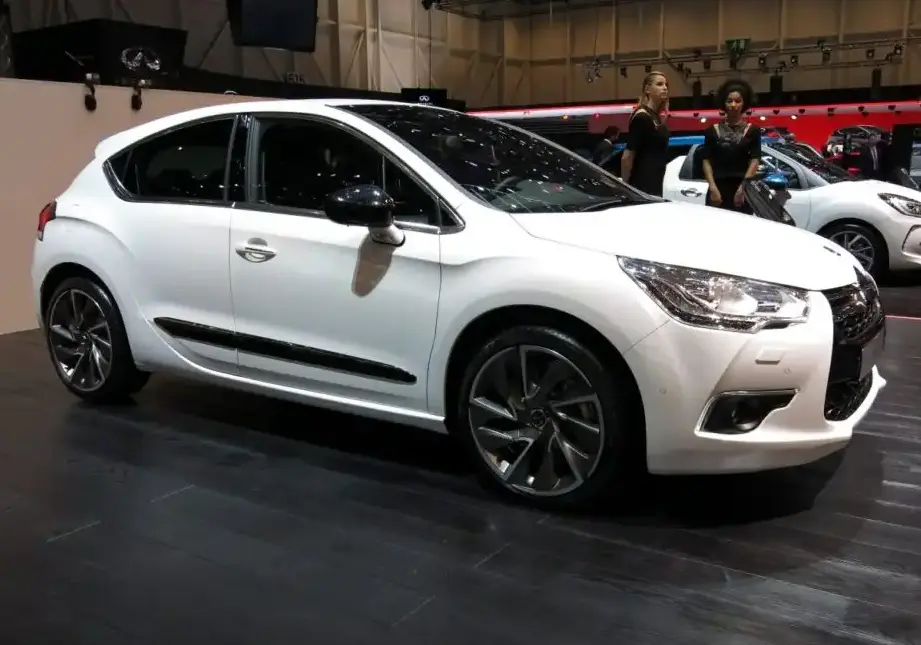
The Citroen DS4 2.0 BlueHDi 181 Stop&Start, produced for the 2015 model year, represents a sophisticated offering within the DS4 hatchback range. Positioned as a mid-to-high trim level, it combined a powerful diesel engine with the convenience of an automatic transmission and fuel-saving stop-start technology. This variant aimed to appeal to drivers seeking a blend of performance, efficiency, and comfort in a stylishly designed package. It was part of the first generation DS4 (2010-2015), which sought to elevate Citroen’s image with a more premium and distinctive design language.
Technical Specifications
| Brand | Citroen |
| Model | DS4 |
| Generation | DS4 |
| Type (Engine) | 2.0 BlueHDi (181 Hp) Automatic Stop&Start |
| Start of production | 2015 |
| End of production | 2015 |
| Powertrain Architecture | Internal Combustion engine |
| Body type | Hatchback |
| Seats | 5 |
| Doors | 5 |
| Fuel consumption (urban) | 5.2 l/100 km (45.2 US mpg, 54.3 UK mpg, 19.2 km/l) |
| Fuel consumption (extra urban) | 3.8 l/100 km (61.9 US mpg, 74.3 UK mpg, 26.3 km/l) |
| Fuel consumption (combined) | 4.3 l/100 km (54.7 US mpg, 65.7 UK mpg, 23.3 km/l) |
| CO2 emissions | 113 g/km |
| Fuel Type | Diesel |
| Acceleration 0 – 100 km/h | 9.3 sec |
| Acceleration 0 – 62 mph | 9.3 sec |
| Acceleration 0 – 60 mph | 8.8 sec |
| Maximum speed | 205 km/h (127.38 mph) |
| Emission standard | Euro 6 |
| Weight-to-power ratio | 8.3 kg/Hp, 121.1 Hp/tonne |
| Weight-to-torque ratio | 3.7 kg/Nm, 267.6 Nm/tonne |
| Power | 181 Hp @ 3750 rpm |
| Power per litre | 90.6 Hp/l |
| Torque | 400 Nm @ 2000 rpm (295.02 lb.-ft. @ 2000 rpm) |
| Engine layout | Front, Transverse |
| Engine Model/Code | AHW DW10FC |
| Engine displacement | 1997 cm3 (121.86 cu. in.) |
| Number of cylinders | 4 |
| Engine configuration | Inline |
| Cylinder Bore | 85 mm (3.35 in.) |
| Piston Stroke | 88 mm (3.46 in.) |
| Compression ratio | 16:1 |
| Number of valves per cylinder | 4 |
| Fuel injection system | Diesel Commonrail |
| Engine aspiration | Turbocharger, Intercooler |
| Valvetrain | DOHC |
| Engine oil capacity | 5.1 l (5.39 US qt | 4.49 UK qt) |
| Coolant | 6.5 l (6.87 US qt | 5.72 UK qt) |
| Kerb Weight | 1495 kg (3295.91 lbs.) |
| Max. weight | 1975 kg (4354.13 lbs.) |
| Max load | 480 kg (1058.22 lbs.) |
| Trunk (boot) space – minimum | 385 l (13.6 cu. ft.) |
| Trunk (boot) space – maximum | 1021 l (36.06 cu. ft.) |
| Fuel tank capacity | 60 l (15.85 US gal | 13.2 UK gal) |
| AdBlue tank | 17.0 l (4.49 US gal | 3.74 UK gal) |
| Permitted trailer load with brakes (12%) | 1550 kg (3417.17 lbs.) |
| Permitted trailer load without brakes | 745 kg (1642.44 lbs.) |
| Permitted towbar download | 75 kg (165.35 lbs.) |
| Length | 4275 mm (168.31 in.) |
| Width | 1810 mm (71.26 in.) |
| Height | 1533 mm (60.35 in.) |
| Wheelbase | 2612 mm (102.83 in.) |
| Front track | 1531 mm (60.28 in.) |
| Rear (Back) track | 1525 mm (60.04 in.) |
| Front overhang | 924 mm (36.38 in.) |
| Rear overhang | 739 mm (29.09 in.) |
| Minimum turning circle | 10.7 m (35.1 ft.) |
| Drivetrain Architecture | The Internal combustion engine (ICE) drives the front wheels of the vehicle. |
| Drive wheel | Front wheel drive |
| Number of gears and type of gearbox | 6 gears, automatic transmission |
| Front suspension | Independent type McPherson |
| Rear suspension | Semi-independent, coil spring |
| Front brakes | Ventilated discs |
| Rear brakes | Disc |
| Assisting systems | ABS (Anti-lock braking system) |
| Steering type | Steering rack and pinion |
| Tires size | 215/55 R17 |
| Wheel rims size | 17 |
Powertrain & Engine Architecture
At the heart of the DS4 2.0 BlueHDi 181 lies the DW10FC engine, a 2.0-liter inline-four cylinder diesel engine. This engine, often identified by the AHW engine code, is a member of the PSA Group’s (Peugeot Citroen) BlueHDi family, known for its focus on reducing particulate emissions and improving fuel efficiency. The engine utilizes a common rail direct injection system, delivering fuel at extremely high pressures for optimized combustion. A turbocharger with an intercooler further enhances performance by forcing more air into the cylinders. The engine also features a DOHC (Double Overhead Camshaft) valvetrain, contributing to efficient valve control. The Stop&Start system automatically shuts off the engine when the vehicle is stationary (at traffic lights, for example) to conserve fuel and reduce emissions, restarting it instantly when the driver releases the brake pedal. The engine is transversely mounted at the front of the vehicle. The six-speed automatic transmission is a conventional torque converter type, prioritizing smooth shifts and ease of use over outright performance.
Driving Characteristics
The 181 horsepower and 400 Nm (295 lb-ft) of torque provided by the 2.0 BlueHDi engine deliver respectable performance for a compact hatchback. Acceleration from 0-60 mph takes approximately 8.8 seconds, and the car reaches a top speed of 127.38 mph. While not a sports car, the DS4 2.0 BlueHDi offers ample power for everyday driving and confident overtaking. The automatic transmission, while smooth, isn’t particularly quick to shift, and lacks the responsiveness of a dual-clutch transmission. The gear ratios are tuned for fuel efficiency rather than outright acceleration. Compared to the lower-powered 1.6 BlueHDi variants, the 2.0-liter engine provides a noticeably more relaxed driving experience, particularly when fully loaded or on inclines. It also feels more refined and quieter than the smaller engine. Compared to a manual transmission equipped DS4, the automatic version sacrifices some driver engagement and fuel economy, but gains in convenience.
Equipment & Trim Levels
The DS4 2.0 BlueHDi 181 typically came well-equipped, reflecting its position as a mid-to-high trim level. Standard features often included alloy wheels, automatic climate control, a touchscreen infotainment system with Bluetooth connectivity, and rear parking sensors. Interior upholstery was typically a combination of cloth and leather. Optional extras could include a panoramic sunroof, navigation system, and upgraded audio system. The DS4’s interior design was distinctive, with a focus on creating a cockpit-like environment for the driver. The dashboard layout was somewhat complex, with many controls clustered around the steering wheel.
Chassis & Braking
The DS4 2.0 BlueHDi 181 utilizes an independent McPherson strut suspension at the front and a semi-independent coil spring suspension at the rear. This setup provides a good balance between ride comfort and handling. The front brakes are ventilated discs, while the rear brakes are solid discs. ABS (Anti-lock Braking System) is standard. The suspension is tuned for comfort, resulting in a relatively soft ride, but the car still feels stable and secure in corners. The steering is electrically assisted and provides adequate feedback.
Market Reception & Comparison
The Citroen DS4 2.0 BlueHDi 181 was generally well-received by automotive critics. It was praised for its stylish design, comfortable ride, and fuel-efficient engine. However, some critics noted the somewhat complex interior layout and the lack of a truly sporty driving experience. Compared to rivals like the Volkswagen Golf and Audi A3, the DS4 offered a more distinctive design and a more comfortable ride, but lacked the same level of refinement and brand prestige. Fuel economy was a strong point, with the DS4 achieving around 54.7 US mpg on the combined cycle. Reliability was generally good, although some owners reported minor issues with the infotainment system.
Legacy
The 2.0 BlueHDi engine has proven to be a durable and reliable unit, and well-maintained examples of the DS4 2.0 BlueHDi 181 continue to be sought after in the used car market. The Stop&Start system, while contributing to fuel savings, can be a potential source of issues if not properly maintained. Overall, the DS4 2.0 BlueHDi 181 represents a compelling option for buyers seeking a stylish, comfortable, and fuel-efficient hatchback with a touch of French flair. Its blend of performance and economy, combined with its distinctive design, ensures its place as a notable model within Citroen’s history.
