
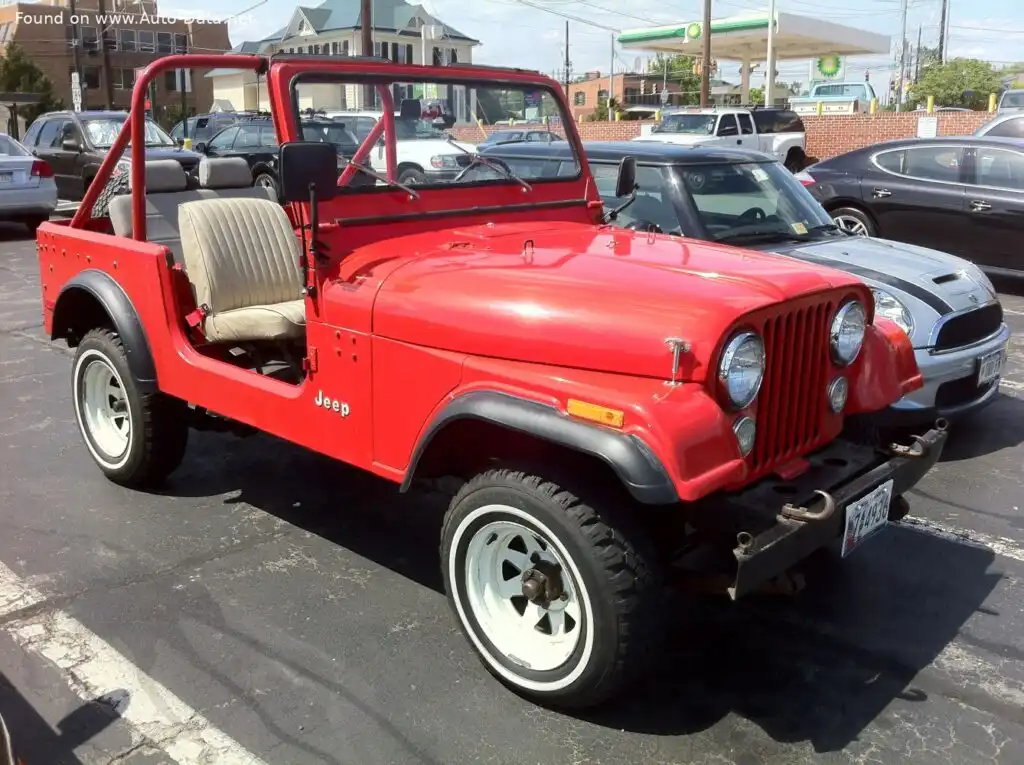
The Jeep CJ-7 3.8, produced from 1976 to 1978, represents a pivotal moment in the evolution of the iconic Jeep CJ (Civilian Jeep) line. Positioned as a more comfortable and refined alternative to the earlier CJ-5, the CJ-7 offered a longer wheelbase and a more modern interior while retaining the rugged off-road capability that defined the Jeep brand. The 3.8-liter (232 cubic inch) inline-six engine, producing 100 horsepower, was a common engine choice during these years, offering a balance of affordability and adequate power for both on-road driving and moderate off-road trails. This variant served as a popular entry point into the CJ-7 range, appealing to buyers seeking a versatile vehicle for both daily use and recreational adventures.
Technical Specifications
| Brand | Jeep |
| Model | CJ |
| Generation | CJ-7 |
| Type (Engine) | 3.8 (100 Hp) |
| Start of production | 1976 |
| End of production | 1978 |
| Powertrain Architecture | Internal Combustion engine |
| Body type | Off-road vehicle |
| Seats | 4 |
| Doors | 2 |
| Fuel Type | Petrol (Gasoline) |
| Power | 100 Hp @ 3600 rpm |
| Power per litre | 26.3 Hp/l |
| Torque | 251 Nm @ 1800 rpm / 185.13 lb.-ft. @ 1800 rpm |
| Engine layout | Front, Longitudinal |
| Engine Model/Code | AMC 232 |
| Engine displacement | 3802 cm3 / 232.01 cu. in. |
| Number of cylinders | 6 |
| Engine configuration | Inline |
| Cylinder Bore | 95.25 mm / 3.75 in. |
| Piston Stroke | 88.9 mm / 3.5 in. |
| Compression ratio | 8:1 |
| Number of valves per cylinder | 2 |
| Fuel injection system | Carburettor |
| Engine aspiration | Naturally aspirated engine |
| Valvetrain | OHV |
| Engine oil capacity | 5.7 l / 6.02 US qt | 5.02 UK qt |
| Coolant | 10 l / 10.57 US qt | 8.8 UK qt |
| Max. weight | 1701 kg / 3750.06 lbs |
| Trunk (boot) space – minimum | 385 l / 13.6 cu. ft |
| Fuel tank capacity | 59 l / 15.59 US gal | 12.98 UK gal |
| Length | 3757 mm / 147.91 in |
| Width | 1521 mm / 59.88 in |
| Height | 1717 mm / 67.6 in |
| Wheelbase | 2375 mm / 93.5 in |
| Front track | 1308 mm / 51.5 in |
| Rear (Back) track | 1270 mm / 50 in |
| Front overhang | 597 mm / 23.5 in |
| Rear overhang | 785 mm / 30.91 in |
| Ride height (ground clearance) | 175 mm / 6.89 in |
| Minimum turning circle (turning diameter) | 11.6 m / 38.06 ft |
| Drivetrain Architecture | The Internal combustion engine (ICE) drives the rear wheels permanently, and the front wheels are driven through an electrically or mechanically operated clutch if necessary. |
| Drive wheel | All wheel drive (4×4) |
| Number of gears and type of gearbox | 3 gears, manual transmission |
| Front suspension | Leaf spring |
| Rear suspension | Leaf spring |
| Front brakes | Drum |
| Rear brakes | Drum |
| Steering type | Cone worm with recirculation balls |
| Tires size | 205/75 R15 |
| Wheel rims size | 6J x 15 |
Powertrain & Engine Architecture
The heart of the CJ-7 3.8 was the AMC 232 inline-six engine. This 3.8-liter (232 cubic inch) engine was a workhorse, known for its durability and relatively simple design. It utilized a cast iron block and cylinder head, with a two-barrel carburetor handling fuel delivery. The overhead valve (OHV) configuration, while not the most modern, contributed to the engine’s reliability and ease of maintenance. The 8:1 compression ratio was a compromise between power and the ability to run on lower octane gasoline, common at the time. The 3-speed manual transmission was the standard offering, providing straightforward gear changes. While an automatic transmission was available as an option, the 3-speed manual was more common in this trim level, appealing to buyers who prioritized control and simplicity.
Driving Characteristics
The 100 horsepower and 185 lb-ft of torque produced by the 3.8-liter engine provided adequate, but not exhilarating, performance in the CJ-7. Acceleration was modest, and highway speeds required downshifting for passing. However, the engine’s torque curve was relatively flat, providing usable power across a wide RPM range. This made it well-suited for off-road driving, where low-end grunt was more important than outright speed. The 3-speed manual transmission offered a direct connection to the engine, allowing for precise control in challenging terrain. Compared to the more powerful V8 options available in the CJ-7, the 3.8-liter felt less refined, but it was also lighter, which improved handling and fuel economy. The gear ratios were optimized for off-road crawling, rather than high-speed cruising.
Equipment & Trim Levels
The CJ-7 3.8 typically came with a fairly basic level of equipment. Standard features included a vinyl interior, a simple dashboard with basic gauges, and high-back bucket seats. Optional extras included features like a heater, a radio, and upgraded upholstery. The CJ-7 was designed to be a customizable vehicle, and many owners added their own accessories, such as winches, roll bars, and lift kits. The 3.8-liter version often served as a base model, with buyers adding options to suit their individual needs and budgets. The interior was functional and durable, prioritizing practicality over luxury.
Chassis & Braking
The CJ-7’s chassis was a body-on-frame design, providing excellent strength and durability for off-road use. Both the front and rear suspension utilized leaf springs, a simple and robust design that could handle rough terrain. The braking system consisted of drum brakes on all four wheels, which were adequate for the vehicle’s weight and performance. Steering was handled by a cone worm and recirculating ball system, providing a solid, if somewhat imprecise, feel. The relatively short wheelbase and wide track contributed to the CJ-7’s stability on and off-road. The ride quality was firm, reflecting the vehicle’s off-road focus.
Market Reception & Comparison
The CJ-7 3.8 was generally well-received by buyers looking for a versatile and affordable off-road vehicle. Critics praised its ruggedness and simplicity, but noted its lack of refinement compared to more modern vehicles. Compared to the CJ-7 with the V8 engine, the 3.8-liter offered better fuel economy and lower maintenance costs, but at the expense of performance. The 3.8-liter was also a more attractive option than the smaller four-cylinder engines, offering a better balance of power and efficiency. The CJ-7 as a whole was a popular alternative to other off-road vehicles like the Ford Bronco and the International Scout.
Legacy
The AMC 232 engine, while not known for its high performance, proved to be remarkably durable and reliable. Many CJ-7s equipped with this engine are still on the road today, a testament to its longevity. The CJ-7 3.8 remains a popular choice among classic Jeep enthusiasts, offering a relatively affordable entry point into the world of vintage off-roading. Parts availability is generally good, and the engine is relatively easy to maintain. The CJ-7’s enduring popularity has cemented its place as an icon of American automotive history, and the 3.8-liter version continues to be appreciated for its simplicity, durability, and off-road capability.
