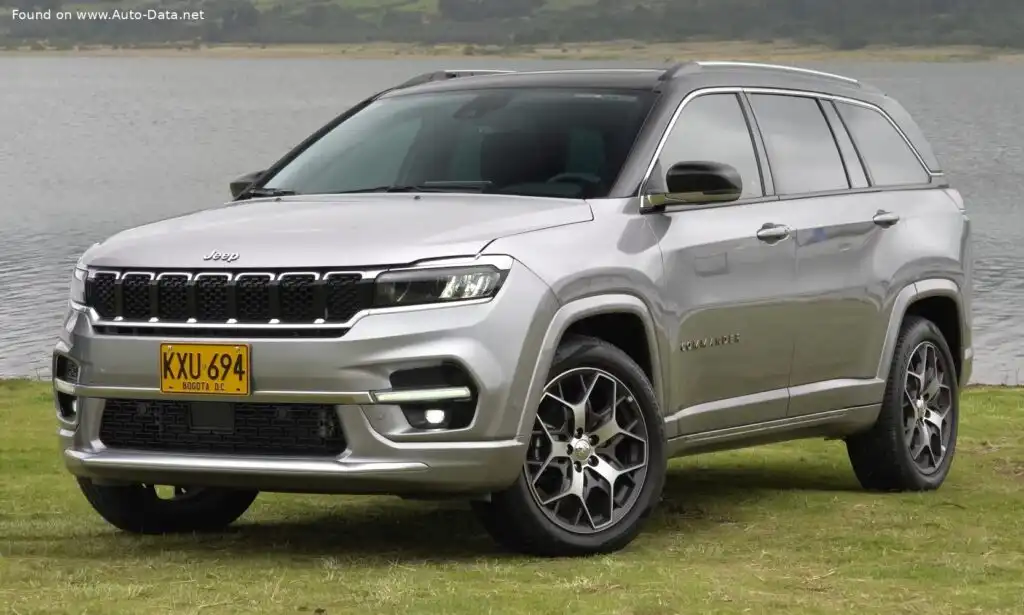
The Jeep Commander 2.0d (170 hp) AWD Automatic, launched in August 2021, represents a significant entry in the mid-size SUV segment, particularly for markets outside of North America where Jeep has expanded its offerings. This variant of the Commander, built primarily for South American and European markets, is positioned as a more fuel-efficient and accessible option within the Commander lineup, offering seven-passenger seating and all-wheel drive capability. It falls within the broader context of Jeep’s strategy to offer a wider range of SUVs catering to diverse consumer needs and preferences. The Commander utilizes a unibody construction and shares platform elements with other Stellantis vehicles.
Technical Specifications
| Brand | Jeep |
| Model | Commander |
| Generation | Commander (2022) |
| Type (Engine) | 2.0d (170 Hp) AWD Automatic |
| Start of production | August, 2021 |
| Powertrain Architecture | Internal Combustion engine |
| Body type | SUV, Crossover |
| Seats | 7 |
| Doors | 5 |
| Fuel consumption (economy) – urban (WLTC) | 9.4 l/100 km (25 US mpg, 30.1 UK mpg, 10.6 km/l) |
| Fuel consumption (economy) – extra urban (WLTC) | 6.2 l/100 km (37.9 US mpg, 45.6 UK mpg, 16.1 km/l) |
| Fuel consumption (economy) – combined (WLTC) | 7.2 l/100 km (32.7 US mpg, 39.2 UK mpg, 13.9 km/l) |
| Fuel Type | Diesel |
| Weight-to-power ratio | 11.1 kg/Hp, 89.9 Hp/tonne |
| Weight-to-torque ratio | 5.4 kg/Nm, 185.2 Nm/tonne |
| Power | 170 Hp @ 3750 rpm |
| Power per litre | 86.9 Hp/l |
| Torque | 350 Nm @ 1750-2500 rpm (258.15 lb.-ft. @ 1750-2500 rpm) |
| Engine layout | Front, Transverse |
| Engine Model/Code | 46344732 |
| Engine displacement | 1956 cm3 (119.36 cu. in.) |
| Number of cylinders | 4 |
| Engine configuration | Inline |
| Cylinder Bore | 83 mm (3.27 in.) |
| Piston Stroke | 90.4 mm (3.56 in.) |
| Number of valves per cylinder | 4 |
| Fuel injection system | Diesel Commonrail |
| Engine aspiration | Turbocharger, Intercooler |
| Valvetrain | DOHC |
| Engine oil capacity | 4.8 l (5.07 US qt | 4.22 UK qt) |
| Kerb Weight | 1890 kg (4166.74 lbs.) |
| Max. weight | 2275 kg (5015.52 lbs.) |
| Max load | 385 kg (848.78 lbs.) |
| Fuel tank capacity | 60 l (15.85 US gal | 13.2 UK gal) |
| Length | 4770 mm (187.8 in.) |
| Width | 1860 mm (73.23 in.) |
| Height | 1730 mm (68.11 in.) |
| Wheelbase | 2780 mm (109.45 in.) |
| Front track | 1580 mm (62.2 in.) |
| Rear (Back) track | 1590 mm (62.6 in.) |
| Minimum turning circle (turning diameter) | 11.6 m (38.06 ft.) |
| Drivetrain Architecture | All wheel drive (4×4). ICE drives front wheels, rear driven via clutch. |
| Number of gears and type of gearbox | 9 gears, automatic transmission |
| Front suspension | Independent type McPherson |
| Rear suspension | Independent multi-link suspension |
| Front brakes | Ventilated discs |
| Rear brakes | Disc |
| Assisting systems | ABS (Anti-lock braking system) |
| Steering type | Steering rack and pinion |
| Power steering | Electric Steering |
| Tires size | 235/55 R18 |
| Wheel rims size | 18 |
Powertrain & Engine Architecture
The Jeep Commander 2.0d utilizes a 1.956-liter inline-four cylinder diesel engine, designated with engine code 46344732. This engine is a turbocharged common-rail direct injection (CRDI) unit, designed for efficiency and reasonable power output. The turbocharger, coupled with an intercooler, helps to boost performance and reduce turbo lag. The engine employs a Double Overhead Camshaft (DOHC) valvetrain with four valves per cylinder, optimizing airflow for improved combustion. The 2.0d engine produces 170 horsepower at 3750 rpm and 350 Nm (258 lb-ft) of torque between 1750 and 2500 rpm. This torque band is particularly useful for everyday driving and towing. The engine is paired with a nine-speed automatic transmission, which contributes to both fuel efficiency and smooth gear changes. This transmission is a key component in managing the engine’s power delivery and optimizing fuel consumption.
Driving Characteristics
The 170 hp 2.0d Automatic Commander offers a comfortable and capable driving experience, though it’s not designed for outright performance. Acceleration is adequate for most driving situations, but it won’t provide the briskness of higher-powered variants. The nine-speed automatic transmission is generally smooth, but can sometimes exhibit slight hesitation during downshifts. The all-wheel-drive system provides enhanced traction in various conditions, making it suitable for light off-road use and inclement weather. Compared to potential gasoline engine options, the 2.0d prioritizes fuel economy and low-end torque, making it a good choice for drivers who prioritize practicality and efficiency over sporty performance. The gear ratios are tuned for fuel efficiency, with taller gearing in higher gears to reduce engine speed at highway speeds.
Equipment & Trim Levels
The Commander 2.0d Automatic typically comes with a respectable level of standard equipment. This generally includes features such as air conditioning, power windows and locks, a touchscreen infotainment system with smartphone integration (Apple CarPlay and Android Auto), and basic safety features like ABS, stability control, and multiple airbags. Higher trim levels add features like leather upholstery, a panoramic sunroof, upgraded audio systems, and advanced driver-assistance systems (ADAS) such as adaptive cruise control and lane departure warning. Interior upholstery is typically cloth on base models, with leather options available on higher trims. Dashboard configuration is modern and functional, with a focus on user-friendliness.
Chassis & Braking
The Jeep Commander features an independent suspension setup, with McPherson struts at the front and a multi-link suspension at the rear. This configuration provides a good balance of ride comfort and handling. The front brakes are ventilated discs, while the rear brakes are solid discs. The steering system is an electric power-assisted rack and pinion system, providing precise and responsive steering feel. The Commander’s chassis is designed to handle the vehicle’s weight and provide stability, particularly when fully loaded or towing. Stabilizer bars are included to reduce body roll during cornering.
Market Reception & Comparison
The Jeep Commander 2.0d Automatic has been generally well-received in markets where it’s offered, particularly as a more affordable and fuel-efficient alternative to larger SUVs. Critics have praised its spacious interior, comfortable ride, and capable all-wheel-drive system. However, some have noted that its performance is not as exciting as some of its competitors. Compared to other trims in the Commander lineup, the 2.0d offers the best fuel economy but sacrifices some performance. It’s positioned as an entry-level or mid-range option, appealing to families and drivers who prioritize practicality and value.
Legacy
The long-term reliability of the 2.0d engine and nine-speed automatic transmission remains to be fully assessed, as the Commander is a relatively new model. However, the engine architecture is based on proven technology used in other Stellantis vehicles, suggesting a reasonable level of durability. In the used car market, the 2.0d Automatic Commander is expected to hold its value reasonably well, particularly due to its fuel efficiency and practicality. Its appeal will likely be strongest among buyers seeking a spacious, capable, and affordable seven-passenger SUV.