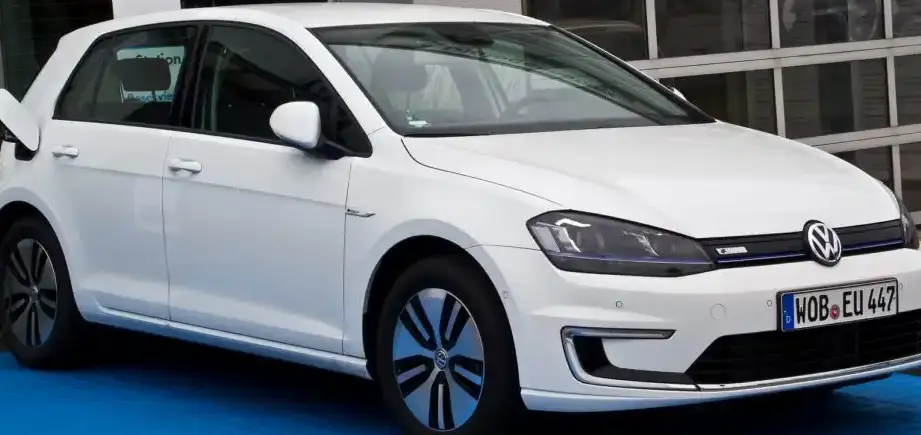
The Volkswagen e-Golf, specifically the 24.2 kWh variant producing 115 horsepower, represented Volkswagen’s initial foray into the mass-market all-electric vehicle segment. Introduced for the 2014 model year and continuing through 2016, this five-door hatchback was based on the seventh-generation Golf (Golf VII) platform – the 5G chassis – and aimed to provide a practical and accessible electric driving experience. Positioned as a direct competitor to the Nissan Leaf and other early EVs, the e-Golf sought to leverage the established reputation of the Golf nameplate while offering zero-emission motoring. It was primarily sold in markets with developing EV infrastructure, including the United States and Europe.
Technical Specifications
| Brand | Volkswagen |
| Model | Golf |
| Generation | Golf VII (5-door) |
| Type (Engine) | e-Golf 24.2 kWh (115 Hp) |
| Start of production | 2014 |
| End of production | 2016 |
| Powertrain Architecture | BEV (Electric Vehicle) |
| Body type | Hatchback |
| Seats | 5 |
| Doors | 5 |
| Fuel Type | Electricity |
| Acceleration 0 – 100 km/h | 10.4 sec |
| Acceleration 0 – 62 mph | 10.4 sec |
| Acceleration 0 – 60 mph | 9.9 sec |
| Maximum speed | 140 km/h (86.99 mph) |
| Weight-to-power ratio | 13.1 kg/Hp, 76.2 Hp/tonne |
| Weight-to-torque ratio | 5.6 kg/Nm, 178.8 Nm/tonne |
| Gross battery capacity | 24.2 kWh |
| Net (usable) battery capacity | 20.5 kWh |
| Battery voltage | 323 V |
| Battery technology | Lithium-ion (Li-Ion) |
| Battery weight | 318 kg (701.07 lbs) |
| Battery location | Below the floor, under the rear seats |
| All-electric range | 190 km (118.06 mi) |
| Average Energy consumption | 12.7 kWh/100 km (20.44 kWh/100 mi) |
| MPGe | 165 |
| km/kWh | 7.9 |
| mi/kWh | 4.9 |
| Electric motor power | 115 Hp @ 3000-12000 rpm |
| Electric motor Torque | 270 Nm @ 0-3000 rpm (199.14 lb.-ft. @ 0-3000 rpm) |
| Electric motor model/code | EAQ 270 |
| Electric motor location | Front axle, Transverse |
| System power | 115 Hp @ 3000-12000 rpm |
| System torque | 270 Nm @ 0-3000 rpm (199.14 lb.-ft. @ 0-3000 rpm) |
| Kerb Weight | 1510 kg (3328.98 lbs) |
| Max. weight | 1980 kg (4365.15 lbs) |
| Max load | 470 kg (1036.17 lbs) |
| Trunk (boot) space – minimum | 341 l (12.04 cu. ft.) |
| Trunk (boot) space – maximum | 1231 l (43.47 cu. ft.) |
| Max. roof load | 75 kg (165.35 lbs) |
| Length | 4270 mm (168.11 in) |
| Width | 1799 mm (70.83 in) |
| Width including mirrors | 2027 mm (79.8 in) |
| Height | 1473 mm (57.99 in) |
| Wheelbase | 2629 mm (103.5 in) |
| Front track | 1550 mm (61.02 in) |
| Rear (Back) track | 1522 mm (59.92 in) |
| Ride height (ground clearance) | 143 mm (5.63 in) |
| Drag coefficient (Cd) | 0.27 |
| Minimum turning circle | 10.9 m (35.76 ft) |
| Drivetrain Architecture | One electric motor drives the front wheels |
| Drive wheel | Front wheel drive |
| Number of gears and type of gearbox | 1 gears, automatic transmission |
| Front suspension | Independent, type McPherson with coil spring and anti-roll bar |
| Rear suspension | Independent multi-link spring suspension with stabilizer |
| Front brakes | Ventilated discs |
| Rear brakes | Disc |
| Assisting systems | ABS (Anti-lock braking system) |
| Steering type | Steering rack and pinion |
| Power steering | Electric Steering |
| Tires size | 205/55 R16 |
| Wheel rims size | 6.5J x 16 |
Powertrain & Engine Architecture
The e-Golf utilized a single electric motor, designated EAQ 270, producing 115 horsepower and 199 lb-ft of torque. This motor was mounted transversely at the front of the vehicle, driving the front wheels. Power was delivered through a single-speed automatic transmission, typical of electric vehicles. The heart of the system was the 24.2 kWh lithium-ion battery pack, providing a usable capacity of 20.5 kWh. This battery pack was positioned under the floor and extending under the rear seats, contributing to a lower center of gravity and improved handling. The e-Golf employed a 323V system. The charging port location varied by market, but generally supported both Level 1 (120V) and Level 2 (240V) charging, with DC fast charging capability available as an option, allowing for an 80% charge in approximately 30 minutes with a compatible charger.
Driving Characteristics
The 115 hp e-Golf offered brisk, though not particularly exhilarating, acceleration. The 0-60 mph sprint took around 9.9 seconds, making it comparable to a base-model gasoline-powered Golf with a smaller engine. The instant torque characteristic of electric motors provided responsive acceleration at lower speeds, making it well-suited for city driving. The single-speed transmission meant there were no gear changes, resulting in a smooth and linear power delivery. Compared to the gasoline-powered Golf models, the e-Golf felt quieter and more refined, with minimal engine noise. However, the added weight of the battery pack (approximately 318 kg / 701 lbs) did slightly impact handling, making it feel less nimble than its gasoline counterparts. Regenerative braking was a key feature, allowing drivers to recapture energy during deceleration and extend the vehicle’s range.
Equipment & Trim Levels
The e-Golf was generally well-equipped, even in its base trim. Standard features typically included air conditioning, a touchscreen infotainment system, Bluetooth connectivity, and a suite of safety features like ABS, stability control, and multiple airbags. Higher trim levels added features such as a larger touchscreen display, navigation, premium audio systems, and leather upholstery. Optional extras included a panoramic sunroof, adaptive cruise control, and parking assist systems. The interior design mirrored that of the standard Golf VII, with a focus on practicality and ergonomics. Upholstery options ranged from cloth to leatherette, and dashboard trim materials varied depending on the trim level.
Chassis & Braking
The e-Golf retained the Golf VII’s independent suspension setup, with a McPherson strut front suspension and a multi-link rear suspension. However, the suspension was tuned specifically to accommodate the added weight of the battery pack. The front brakes were ventilated discs, while the rear brakes were solid discs. ABS (Anti-lock Braking System) was standard. The e-Golf’s steering utilized an electric power steering system, providing a light and responsive feel. Tire size was typically 205/55 R16, mounted on 6.5J x 16 inch alloy wheels.
Market Reception & Comparison
The e-Golf was generally well-received by critics, who praised its practicality, refinement, and comfortable ride. However, its limited range (approximately 118 miles) was a common criticism, particularly compared to some of its competitors. Fuel economy, measured in MPGe, was rated at 165, which was competitive for the time. Compared to the gasoline-powered Golf models, the e-Golf offered significantly lower running costs, but its higher purchase price was a barrier for some buyers. Compared to the Golf VII’s other engine options (like the 1.8T or the 2.0 TDI), the e-Golf appealed to a different demographic – environmentally conscious buyers who prioritized zero-emission driving over outright performance.
Legacy
The e-Golf served as an important stepping stone for Volkswagen in its transition to electric mobility. While its range was limited by today’s standards, it demonstrated Volkswagen’s commitment to electric vehicles and paved the way for the ID. series of EVs. The e-Golf’s powertrain proved to be relatively reliable, with few widespread issues reported. On the used car market, the e-Golf remains a popular choice for buyers seeking an affordable and practical electric vehicle, particularly in urban areas. Battery degradation is a consideration for older models, but many e-Golfs continue to provide reliable service with proper maintenance.