
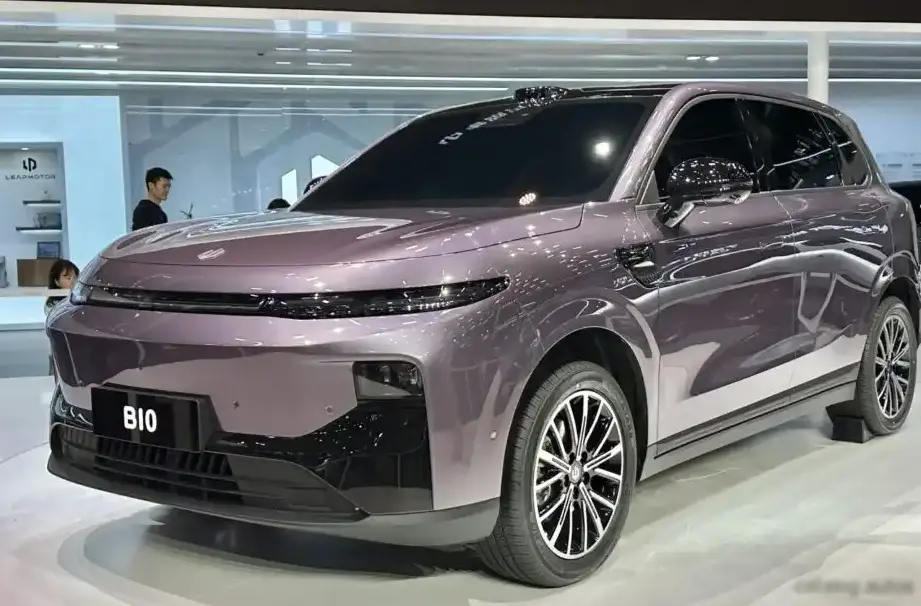
The Leapmotor B10 56.2 kWh is an all-electric compact SUV introduced in April 2025. Positioned as a mainstream offering within the Leapmotor lineup, it represents the brand’s entry into the competitive electric SUV market. The B10 is built on a dedicated electric vehicle platform and aims to provide a balance of range, performance, and affordability. It is primarily targeted at consumers seeking a practical and technologically advanced electric vehicle for urban and suburban driving.
Technical Specifications
| Brand | Leapmotor |
| Model | B10 |
| Generation | B10 |
| Type (Engine) | 56.2 kWh (218 Hp) Electric |
| Start of production | April, 2025 |
| Powertrain Architecture | BEV (Electric Vehicle) |
| Body type | SUV |
| Seats | 5 |
| Doors | 5 |
| Fuel Type | Electricity |
| Acceleration 0 – 100 km/h | 6.8 sec |
| Acceleration 0 – 62 mph | 6.8 sec |
| Acceleration 0 – 60 mph | 6.5 sec |
| Maximum speed | 170 km/h (105.63 mph) |
| Weight-to-power ratio | 7.8 kg/Hp, 127.9 Hp/tonne |
| Weight-to-torque ratio | 7.1 kg/Nm, 140.8 Nm/tonne |
| Gross battery capacity | 56.2 kWh |
| Battery technology | Lithium iron phosphate (LiFePO4) |
| Battery location | Below the floor |
| All-electric range (WLTP) | 361 km (224.32 mi) |
| All-electric range (CLTC) | 510 km (316.9 mi) |
| Average Energy consumption (CLTC) | 12.3 kWh/100 km (19.79 kWh/100 mi) |
| Average Energy consumption (CLTC) | 170 MPGe, 8.1 km/kWh (5.1 mi/kWh) |
| Electric motor power | 218 Hp |
| Electric motor Torque | 240 Nm (177.01 lb.-ft.) |
| Electric motor model/code | TZ180XY005 |
| Electric motor location | Rear axle, Transverse |
| Electric motor type | Synchronous |
| System power | 218 Hp |
| System torque | 240 Nm (177.01 lb.-ft.) |
| Kerb Weight | 1705 kg (3758.88 lbs.) |
| Max. weight | 2080 kg (4585.62 lbs.) |
| Max load | 375 kg (826.73 lbs.) |
| Trunk (boot) space – minimum | 420 l (14.83 cu. ft.) |
| Trunk (boot) space – maximum | 1415 l (49.97 cu. ft.) |
| Length | 4515 mm (177.76 in.) |
| Width | 1885 mm (74.21 in.) |
| Height | 1655 mm (65.16 in.) |
| Wheelbase | 2735 mm (107.68 in.) |
| Front track | 1615 mm (63.58 in.) |
| Rear (Back) track | 1605 mm (63.19 in.) |
| Ride height (ground clearance) | 170 mm (6.69 in.) |
| Minimum turning circle | 10.5 m (34.45 ft.) |
| Approach angle | 19° |
| Departure angle | 24° |
| Drivetrain Architecture | One electric motor drives the rear wheels. |
| Drive wheel | Rear wheel drive |
| Number of gears | 1 |
| Gearbox type | Automatic transmission |
| Front suspension | Independent, type McPherson with coil spring and anti-roll bar |
| Rear suspension | Independent multi-link spring suspension with stabilizer |
| Front brakes | Ventilated discs |
| Rear brakes | Disc |
| Assisting systems | ABS (Anti-lock braking system) |
| Steering type | Steering rack and pinion |
| Power steering | Electric Steering |
| Tires size | Front wheel tires: 225/50 R18, Rear wheel tires: 235/50 R18 |
| Wheel rims size | 18 |
Powertrain & Engine Architecture
The Leapmotor B10 utilizes a single rear-mounted electric motor producing 218 horsepower and 240 Nm (177 lb-ft) of torque. The motor, designated TZ180XY005, is a synchronous motor known for its efficiency and smooth power delivery. Power is drawn from a 56.2 kWh Lithium Iron Phosphate (LiFePO4) battery pack located under the vehicle floor, contributing to a low center of gravity and improved handling. The single-speed automatic transmission provides seamless acceleration. The LiFePO4 chemistry is chosen for its enhanced thermal stability and longer cycle life compared to traditional Nickel Manganese Cobalt (NMC) batteries, although it typically offers slightly lower energy density.
Driving Characteristics
The B10 56.2 kWh delivers brisk acceleration, achieving 0-60 mph in approximately 6.5 seconds. The rear-wheel-drive configuration provides a balanced feel, although it may require some adjustment for drivers accustomed to front-wheel-drive vehicles. The single-speed transmission offers linear power delivery, making it easy to modulate acceleration in various driving conditions. While not a performance-oriented vehicle, the B10 provides sufficient power for confident merging and overtaking. The relatively low weight of the vehicle, at 1705 kg (3759 lbs), contributes to its agility.
Equipment & Trim Levels
The B10 56.2 kWh comes standard with a comprehensive suite of features, including a large touchscreen infotainment system, digital instrument cluster, automatic climate control, and a range of advanced driver-assistance systems (ADAS). Standard safety features include ABS, electronic stability control, and multiple airbags. Interior upholstery is typically cloth, with options for leatherette available on higher trims. Optional extras may include a panoramic sunroof, upgraded sound system, and premium interior finishes. The B10 is designed to offer a modern and comfortable interior experience.
Chassis & Braking
The B10 features an independent suspension system at all four wheels. The front utilizes a McPherson strut setup with coil springs and an anti-roll bar, while the rear employs a multi-link suspension with a stabilizer bar. This configuration aims to provide a comfortable ride and responsive handling. The braking system consists of ventilated discs at the front and solid discs at the rear, providing adequate stopping power. The electric steering system offers precise and responsive control.
Market Reception & Comparison
The Leapmotor B10 has been generally well-received by automotive critics, who praise its value proposition, modern design, and efficient powertrain. Compared to other electric SUVs in its class, the B10 offers a competitive range and performance at a relatively affordable price point. Its LiFePO4 battery chemistry is seen as a positive attribute for long-term durability. However, some reviewers note that the interior materials could be of higher quality. Fuel economy, expressed as MPGe, is estimated at 170, and energy consumption is around 12.3 kWh per 100 kilometers.
Legacy
The Leapmotor B10 56.2 kWh represents a significant step forward for the brand, establishing it as a contender in the rapidly growing electric SUV market. The use of LiFePO4 battery technology suggests a focus on long-term reliability and cost-effectiveness. As the electric vehicle market matures, the B10 is expected to maintain its appeal as a practical and affordable option for consumers seeking a sustainable transportation solution. Its long-term reliability will depend on real-world usage and maintenance, but the inherent stability of the LiFePO4 battery pack suggests a promising outlook.
