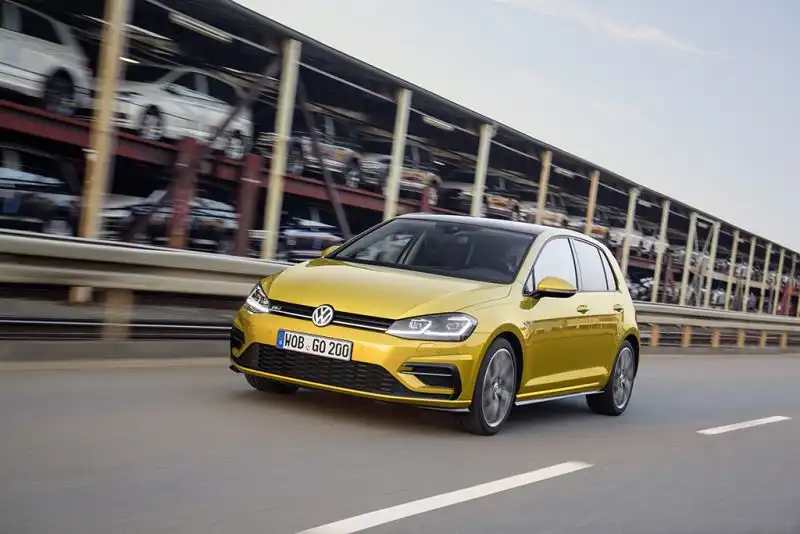
The Volkswagen Golf VII, specifically the 5-door hatchback produced from 2017 to 2019 with the 1.0 TSI 110 horsepower engine, represents a key iteration in the Golf’s long and successful history. This variant arrived as part of the facelift for the seventh-generation Golf (Mk7), introducing updated styling, enhanced technology, and a new engine lineup aimed at improving fuel efficiency and appealing to a broader customer base. Positioned as an entry-level to mid-range offering, the 1.0 TSI aimed to provide a balance of affordability, practicality, and modern features within the Golf range.
Technical Specifications
| Brand | Volkswagen |
| Model | Golf |
| Generation | Golf VII (5-door, facelift 2017) |
| Type (Engine) | 1.0 TSI (110 Hp) |
| Start of production | 2017 |
| End of production | 2019 |
| Powertrain Architecture | Internal Combustion engine |
| Body type | Hatchback |
| Seats | 5 |
| Doors | 5 |
| Fuel consumption (urban) | 5.9-6.0 l/100 km (39.9 – 39.2 US mpg, 47.9 – 47.1 UK mpg, 16.9 – 16.7 km/l) |
| Fuel consumption (extra urban) | 4.1-4.2 l/100 km (57.4 – 56 US mpg, 68.9 – 67.3 UK mpg, 24.4 – 23.8 km/l) |
| Fuel consumption (combined) | 4.8-4.9 l/100 km (49 – 48 US mpg, 58.9 – 57.6 UK mpg, 20.8 – 20.4 km/l) |
| CO2 emissions | 109-112 g/km |
| Fuel Type | Petrol (Gasoline) |
| Acceleration 0 – 100 km/h | 9.9 sec |
| Acceleration 0 – 62 mph | 9.9 sec |
| Acceleration 0 – 60 mph | 9.4 sec |
| Maximum speed | 196 km/h (121.79 mph) |
| Emission standard | Euro 6 |
| Weight-to-power ratio | 10.4 kg/Hp, 96.4 Hp/tonne |
| Weight-to-torque ratio | 5.7 kg/Nm, 175.3 Nm/tonne |
| Power | 110 Hp @ 5000-5500 rpm |
| Power per litre | 110.1 Hp/l |
| Torque | 200 Nm @ 2000-3500 rpm (147.51 lb.-ft. @ 2000-3500 rpm) |
| Engine layout | Front, Transverse |
| Engine Model/Code | CHZC |
| Engine displacement | 999 cm3 (60.96 cu. in.) |
| Number of cylinders | 3 |
| Engine configuration | Inline |
| Number of valves per cylinder | 4 |
| Fuel injection system | Direct injection |
| Engine aspiration | Turbocharger, Intercooler |
| Engine oil capacity | 4 l (4.23 US qt | 3.52 UK qt) |
| Kerb Weight | 1141 kg (2515.47 lbs.) |
| Max. weight | 1720 kg (3791.95 lbs.) |
| Max load | 579 kg (1276.48 lbs.) |
| Trunk (boot) space – minimum | 380 l (13.42 cu. ft.) |
| Trunk (boot) space – maximum | 1270 l (44.85 cu. ft.) |
| Fuel tank capacity | 50 l (13.21 US gal | 11 UK gal) |
| Max. roof load | 75 kg (165.35 lbs.) |
| Permitted trailer load with brakes (8%) | 1500 kg (3306.93 lbs.) |
| Permitted trailer load with brakes (12%) | 1300 kg (2866.01 lbs.) |
| Permitted trailer load without brakes | 600 kg (1322.77 lbs.) |
| Permitted towbar download | 80 kg (176.37 lbs.) |
| Length | 4258 mm (167.64 in.) |
| Width | 1799 mm (70.83 in.) |
| Height | 1492 mm (58.74 in.) |
| Wheelbase | 2620 mm (103.15 in.) |
| Front track | 1549 mm (60.98 in.) |
| Rear (Back) track | 1521 mm (59.88 in.) |
| Minimum turning circle | 10.9 m (35.76 ft.) |
| Drive wheel | Front wheel drive |
| Number of gears and type of gearbox | 6 gears, manual transmission |
| Front brakes | Ventilated discs |
| Rear brakes | Disc |
| Assisting systems | ABS (Anti-lock braking system) |
| Steering type | Steering rack and pinion |
| Power steering | Electric Steering |
| Tires size | 205/55 R16 |
| Wheel rims size | 6.5 J x 16 |
INTRODUCTION
The 1.0 TSI engine, introduced in the Mk7 Golf facelift, marked Volkswagen’s push towards smaller displacement, turbocharged engines designed to deliver improved fuel economy without significant compromises in performance. This three-cylinder engine, part of the EA211 family, was a relatively new addition to the Golf lineup, offering a more affordable and efficient alternative to the larger 1.4 and 2.0-liter TSI engines. The 110 horsepower version, paired with a six-speed manual transmission, was aimed at buyers prioritizing fuel efficiency and everyday usability over outright speed. It occupied a crucial position in the Golf range, appealing to those seeking a practical and economical hatchback.
Powertrain & Engine Architecture
The 1.0 TSI (CHZC) engine is a 999cc, inline three-cylinder petrol engine featuring direct fuel injection and a turbocharger with intercooler. This configuration allows for a compact engine design while delivering a respectable power output. The engine utilizes a Miller cycle combustion process, which improves thermal efficiency by reducing pumping losses. This is achieved through optimized valve timing, allowing for a longer expansion stroke than the compression stroke. Fuel is delivered via a high-pressure direct injection system, ensuring precise fuel metering and efficient combustion. The six-speed manual transmission provides a good balance between fuel economy and drivability, with gear ratios optimized for both urban and highway driving. The engine’s relatively lightweight construction contributes to the Golf’s overall balanced handling.
Driving Characteristics
The 1.0 TSI 110 hp Golf offers a surprisingly refined driving experience. While not as quick as its larger-engined siblings, it provides adequate performance for everyday driving situations. Acceleration from 0-60 mph takes around 9.4 seconds, and the top speed is 121.79 mph. The turbocharger provides a noticeable boost in power, particularly in the mid-range, making overtaking maneuvers manageable. The six-speed manual transmission is smooth and precise, allowing drivers to make the most of the engine’s power band. Compared to the more powerful TSI engines, the 1.0 TSI feels less stressed at higher speeds and offers better fuel economy. However, it may require more frequent gear changes when tackling steep hills or carrying a full load.
Equipment & Trim Levels
The 1.0 TSI 110 hp Golf typically came equipped with a reasonable level of standard features. These included air conditioning, a touchscreen infotainment system with Bluetooth connectivity, alloy wheels, and a suite of safety features such as ABS, ESC, and multiple airbags. Higher trim levels offered additional features such as automatic climate control, parking sensors, a rearview camera, and upgraded upholstery. Optional extras included a panoramic sunroof, adaptive cruise control, and a premium sound system. Interior upholstery was typically cloth, with the option of leather upgrades on higher trims. The dashboard layout was consistent across the Golf VII range, featuring a clean and modern design.
Chassis & Braking
The Golf VII chassis is well-regarded for its balance and composure. The 1.0 TSI variant utilizes a MacPherson strut front suspension and a multi-link rear suspension, providing a comfortable ride and precise handling. The braking system consists of ventilated discs at the front and solid discs at the rear, offering adequate stopping power for everyday driving. ABS (Anti-lock Braking System) is standard, enhancing safety in emergency braking situations. The suspension setup is tuned to provide a good balance between comfort and handling, making the Golf a pleasant car to drive on a variety of road surfaces.
Market Reception & Comparison
The 1.0 TSI 110 hp Golf was generally well-received by critics, who praised its fuel efficiency and surprisingly refined driving experience. It was seen as a sensible and practical choice for buyers prioritizing economy and usability. Compared to the 1.4 TSI and 2.0 TSI variants, the 1.0 TSI offered lower running costs but less outright performance. The 1.4 TSI provided a better balance between performance and economy, while the 2.0 TSI was aimed at drivers seeking a more engaging driving experience. In terms of reliability, the 1.0 TSI engine has proven to be generally robust, although some owners have reported issues with the turbocharger and fuel injectors.
Legacy
The 1.0 TSI engine has become a mainstay in Volkswagen’s lineup, powering a wide range of models. The Golf VII 1.0 TSI 110 hp variant remains a popular choice in the used car market, offering a compelling combination of affordability, fuel efficiency, and practicality. Its relatively simple engine design and readily available parts contribute to its long-term reliability. While not a performance icon, the 1.0 TSI Golf represents a significant step forward in terms of fuel efficiency and emissions reduction, making it a relevant and appealing option for environmentally conscious buyers.