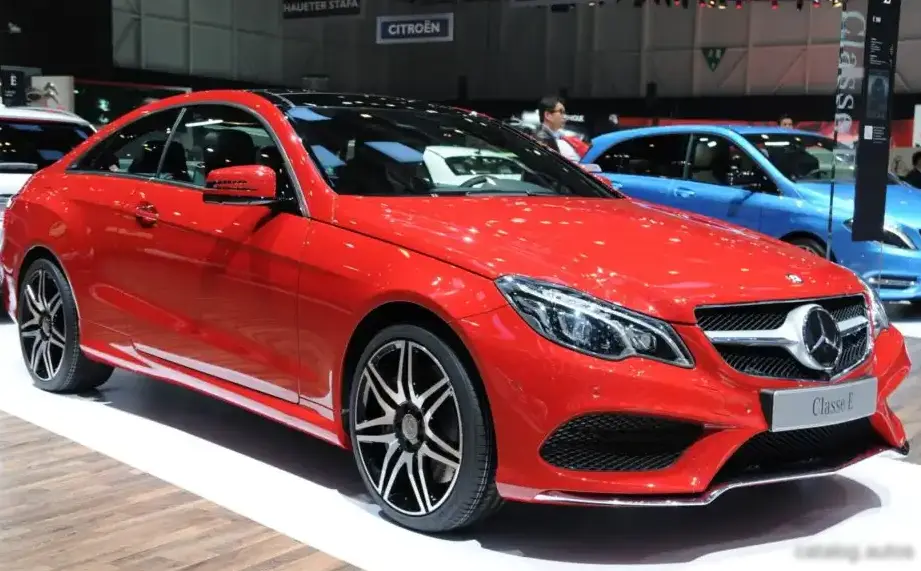
The Mercedes-Benz E-Class Coupe (C207) facelift, specifically the E 320 V6 variant equipped with the 7G-TRONIC PLUS automatic transmission, was produced from July 2014 to December 2016. This model represented a refined iteration of the C207 coupe, offering a blend of luxury, performance, and technology within the mid-size executive coupe segment. Positioned as a step up from the E 250 models, the E 320 aimed to provide a more engaging driving experience while maintaining the comfort expected of a Mercedes-Benz. It sat below the more potent E 400 and E 550 models in the coupe lineup.
Technical Specifications
| Brand | Mercedes-Benz |
| Model | E-Class |
| Generation | E-Class Coupe (C207, facelift 2013) |
| Type (Engine) | E 320 V6 (272 Hp) 7G-TRONIC PLUS |
| Start of production | July, 2014 |
| End of production | December, 2016 |
| Powertrain Architecture | Internal Combustion engine |
| Body type | Coupe |
| Seats | 4 |
| Doors | 2 |
| Fuel consumption (urban) | 10.5-10.6 l/100 km (22.4 – 22.2 US mpg) |
| Fuel consumption (extra urban) | 5.6-5.7 l/100 km (42 – 41.3 US mpg) |
| Fuel consumption (combined) | 7.4-7.5 l/100 km (31.8 – 31.4 US mpg) |
| CO2 emissions | 172-176 g/km |
| Fuel Type | Petrol (Gasoline) |
| Acceleration 0 – 100 km/h | 6.6 sec |
| Acceleration 0 – 62 mph | 6.6 sec |
| Acceleration 0 – 60 mph | 6.3 sec |
| Maximum speed | 250 km/h (155.34 mph) – Electronically limited |
| Emission standard | Euro 6 |
| Weight-to-power ratio | 6.1 kg/Hp |
| Weight-to-torque ratio | 4.1 kg/Nm |
| Power | 272 Hp @ 5000-6000 rpm |
| Torque | 400 Nm @ 1300-4500 rpm (295.02 lb.-ft. @ 1300-4500 rpm) |
| Engine layout | Front, Longitudinal |
| Engine Model/Code | M 276.820 |
| Engine displacement | 2996 cm3 (182.83 cu. in.) |
| Number of cylinders | 6 |
| Engine configuration | V-engine |
| Cylinder Bore | 88 mm (3.46 in.) |
| Piston Stroke | 82.1 mm (3.23 in.) |
| Number of valves per cylinder | 4 |
| Fuel injection system | Direct injection |
| Engine aspiration | BiTurbo, Intercooler |
| Valvetrain | DOHC |
| Engine oil capacity | 6.5 l (6.87 US qt | 5.72 UK qt) |
| Kerb Weight | 1650 kg (3637.63 lbs.) |
| Max. weight | 2195 kg (4839.15 lbs.) |
| Max load | 545 kg (1201.52 lbs.) |
| Trunk (boot) space (minimum) | 450 l (15.89 cu. ft.) |
| Fuel tank capacity | 66 l (17.44 US gal | 14.52 UK gal) |
| Permitted trailer load (with brakes) | 1800 kg (3968.32 lbs.) |
| Permitted trailer load (without brakes) | 750 kg (1653.47 lbs.) |
| Permitted towbar download | 75 kg (165.35 lbs.) |
| Length | 4703 mm (185.16 in.) |
| Width | 1786 mm (70.31 in.) |
| Width including mirrors | 2016 mm (79.37 in.) |
| Height | 1397 mm (55 in.) |
| Wheelbase | 2760 mm (108.66 in.) |
| Front track | 1538 mm (60.55 in.) |
| Rear track | 1541 mm (60.67 in.) |
| Front overhang | 862 mm (33.94 in.) |
| Rear overhang | 1081 mm (42.56 in.) |
| Minimum turning circle | 11.15 m (36.58 ft.) |
| Drive wheel | Rear wheel drive |
| Number of gears | 7 |
| Gearbox type | Automatic transmission G-TRONIC PLUS |
Powertrain & Engine Architecture
The heart of the E 320 Coupe was the M276.820 3.0-liter V6 engine. This engine featured direct injection and twin turbochargers, delivering a robust 272 horsepower and 400 Nm (295 lb-ft) of torque. The twin-turbo setup provided a broad torque curve, offering strong acceleration from low engine speeds. The engine utilized a DOHC (Dual Overhead Camshaft) valvetrain and a sophisticated engine management system to optimize performance and efficiency. The 7G-TRONIC PLUS automatic transmission, a seven-speed unit, was specifically tuned to complement the engine’s characteristics. It offered smooth and responsive gear changes, contributing to both performance and fuel economy. This transmission featured a torque converter lock-up clutch that engaged in most gears, improving efficiency.
Driving Characteristics
The E 320 Coupe with the 7G-TRONIC PLUS transmission offered a refined and comfortable driving experience. While not as overtly sporty as some of its rivals, it provided ample power for confident overtaking and highway cruising. The 7G-TRONIC PLUS transmission’s gear ratios were optimized for both acceleration and fuel efficiency. Compared to the base E 250 models, the E 320 offered a noticeable improvement in performance, with a 0-60 mph time of around 6.3 seconds. However, it lacked the sharper responsiveness of the manual transmission options available in other E-Class models. The rear-wheel-drive configuration contributed to a balanced feel, although it didn’t offer the all-weather confidence of all-wheel-drive variants.
Equipment & Trim Levels
The E 320 Coupe typically came well-equipped as standard. Features included leather upholstery, automatic climate control, a premium sound system, and a host of safety technologies such as ABS, stability control, and multiple airbags. Optional extras included a panoramic sunroof, upgraded navigation system, adaptive cruise control, and various driver assistance packages. Interior trim options ranged from wood veneers to aluminum accents, allowing buyers to personalize the cabin. The standard seats offered excellent support and comfort, and optional sport seats were available for a more aggressive driving position.
Chassis & Braking
The C207 E-Class Coupe featured a sophisticated suspension system designed to balance comfort and handling. The front suspension utilized a multi-link setup with coil springs and a transverse stabilizer bar, while the rear suspension employed an independent multi-link spring suspension, also with a stabilizer bar. The E 320 Coupe was equipped with ventilated disc brakes on all four wheels, providing ample stopping power. The ABS (Anti-lock Braking System) and Electronic Stability Program (ESP) further enhanced safety and control. Steering was via a power-assisted rack and pinion system, offering precise and responsive handling.
Market Reception & Comparison
The E 320 Coupe was generally well-received by automotive critics. It was praised for its refined engine, comfortable ride, and luxurious interior. However, some reviewers noted that it lacked the outright sportiness of some competitors, such as the BMW 4 Series. Fuel economy was considered respectable for a vehicle of its size and performance, with combined fuel consumption figures ranging from 7.4 to 7.5 l/100 km (31.8-31.4 US mpg). Compared to the E 250, the E 320 offered a significant performance upgrade, but at a higher price point. The E 400 and E 550 models provided even more power, but also came with a substantial premium.
Legacy
The M276 engine family, including the 3.0-liter V6 used in the E 320, has proven to be relatively reliable, although preventative maintenance is crucial. Common issues include potential oil leaks and occasional problems with the turbochargers. The 7G-TRONIC PLUS transmission is also generally durable, but regular fluid changes are essential to ensure smooth operation. Today, the C207 E 320 Coupe represents a compelling value in the used car market, offering a blend of luxury, performance, and technology at a relatively affordable price. Its elegant styling and comfortable interior continue to appeal to buyers seeking a sophisticated and refined coupe.