
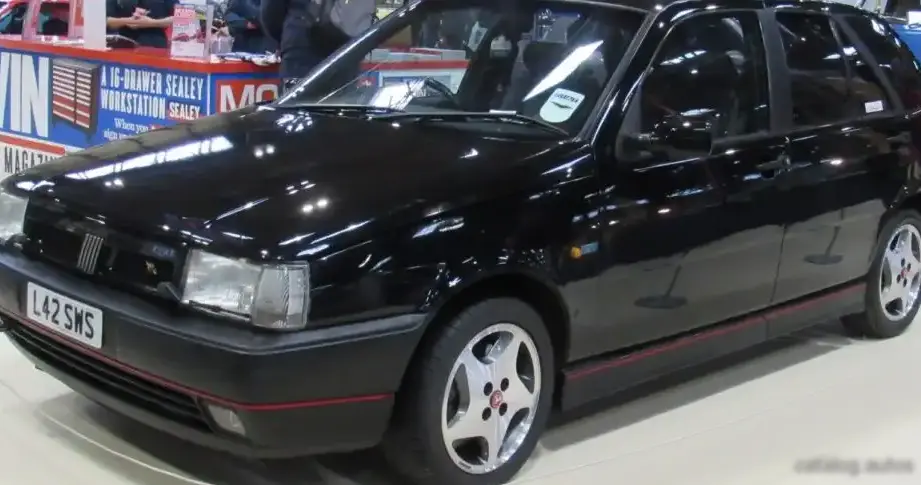
The Fiat Tipo (160) 1.4, producing 78 horsepower, was a mainstay of the Tipo range from its introduction in 1989 until production ended in 1995. Positioned as the entry-level model, it offered affordable family transportation within the broader Tipo lineup, which also included more powerful 1.6 and 2.0-liter variants, as well as diesel options. The Tipo (160) itself was a significant vehicle for Fiat, representing a move towards more modern design and engineering, and was a popular choice in European markets. This particular 1.4-liter version aimed for fuel efficiency and accessibility, making it a common sight on city streets and a practical choice for budget-conscious buyers.
Technical Specifications
| Brand | Fiat |
| Model | Tipo |
| Generation | Tipo (160) |
| Type (Engine) | 1.4 (78 Hp) |
| Start of production | 1989 |
| End of production | 1995 |
| Powertrain Architecture | Internal Combustion engine |
| Body type | Hatchback |
| Seats | 5 |
| Doors | 5 |
| Fuel consumption (urban) | 8.8 l/100 km (26.7 US mpg, 32.1 UK mpg, 11.4 km/l) |
| Fuel consumption (extra urban) | 5.4 l/100 km (43.6 US mpg, 52.3 UK mpg, 18.5 km/l) |
| Fuel consumption (combined) | 7.2 l/100 km (32.7 US mpg, 39.2 UK mpg, 13.9 km/l) |
| Fuel Type | Petrol (Gasoline) |
| Acceleration 0 – 100 km/h | 12.6 sec |
| Acceleration 0 – 62 mph | 12.6 sec |
| Acceleration 0 – 60 mph | 12 sec |
| Maximum speed | 167 km/h (103.77 mph) |
| Weight-to-power ratio | 12.1 kg/Hp, 82.5 Hp/tonne |
| Weight-to-torque ratio | 8.8 kg/Nm, 114.3 Nm/tonne |
| Power | 78 Hp @ 6000 rpm |
| Power per litre | 56.9 Hp/l |
| Torque | 108 Nm @ 2900 rpm (79.66 lb.-ft. @ 2900 rpm) |
| Engine layout | Front, Transverse |
| Engine Model/Code | 159 A2.000 |
| Engine displacement | 1372 cm3 (83.72 cu. in.) |
| Number of cylinders | 4 |
| Engine configuration | Inline |
| Cylinder Bore | 80.5 mm (3.17 in.) |
| Piston Stroke | 67.4 mm (2.65 in.) |
| Compression ratio | 9.2:1 |
| Number of valves per cylinder | 2 |
| Fuel injection system | Carburettor |
| Engine aspiration | Naturally aspirated engine |
| Valvetrain | OHC |
| Engine oil capacity | 3.7 l (3.91 US qt | 3.26 UK qt) |
| Coolant | 5.5 l (5.81 US qt | 4.84 UK qt) |
| Kerb Weight | 945 kg (2083.37 lbs.) |
| Max. weight | 1490 kg (3284.89 lbs.) |
| Max load | 545 kg (1201.52 lbs.) |
| Trunk (boot) space – minimum | 350 l (12.36 cu. ft.) |
| Trunk (boot) space – maximum | 1100 l (38.85 cu. ft.) |
| Fuel tank capacity | 55 l (14.53 US gal | 12.1 UK gal) |
| Length | 3958 mm (155.83 in.) |
| Width | 1700 mm (66.93 in.) |
| Height | 1450 mm (57.09 in.) |
| Wheelbase | 2540 mm (100 in.) |
| Front track | 1436 mm (56.54 in.) |
| Rear (Back) track | 1415 mm (55.71 in.) |
| Drivetrain Architecture | The Internal combustion engine (ICE) drives the front wheels of the vehicle. |
| Drive wheel | Front wheel drive |
| Number of gears and type of gearbox | 5 gears, manual transmission |
| Front suspension | Spring Strut |
| Rear suspension | Coil spring |
| Front brakes | Disc |
| Rear brakes | Drum |
| Steering type | Steering rack and pinion |
| Power steering | Hydraulic Steering |
| Tires size | 165/70 R13 |
| Wheel rims size | 13 |
Powertrain & Engine Architecture
The heart of the Tipo 1.4 was the 159 A2.000 engine, a 1.4-liter inline-four cylinder petrol engine. This engine utilized a single overhead camshaft (OHC) valvetrain with two valves per cylinder. Notably, this engine employed a carburetor for fuel delivery, a technology becoming less common in the late 1980s and early 1990s as fuel injection gained prominence. The carburetor system, while simpler and less expensive, offered less precise fuel metering compared to injection, impacting both performance and emissions. The engine produced 78 horsepower at 6000 rpm and 108 Nm (79.66 lb-ft) of torque at 2900 rpm. The engine was transversely mounted in the front of the vehicle, driving the front wheels. The transmission was a standard five-speed manual gearbox, optimized for fuel economy rather than outright performance.
Driving Characteristics
The Tipo 1.4 Automatic offered modest performance. Acceleration from 0 to 60 mph took around 12 seconds, and the top speed was approximately 103.77 mph. The carburetor and relatively low horsepower meant that the engine needed to be revved to extract the most performance. The five-speed manual transmission helped to keep the engine in its optimal power band, but the overall driving experience was geared towards practicality and economy. Compared to the 1.6 and 2.0-liter versions, the 1.4 felt noticeably slower, particularly when fully loaded or tackling inclines. However, the lighter weight of the 1.4 compared to its larger-engined siblings did offer some advantage in handling and fuel efficiency.
Equipment & Trim Levels
The 1.4-liter Tipo typically came with a fairly basic level of equipment, reflecting its position as the entry-level model. Standard features generally included cloth upholstery, a basic instrument cluster, and manual windows and door locks. Power steering was often included, but air conditioning and central locking were usually optional extras. Interior trim was functional and durable, prioritizing practicality over luxury. Optional extras could include upgraded stereo systems, alloy wheels, and a sunroof. The trim level often dictated the color of the interior plastics and the quality of the cloth upholstery.
Chassis & Braking
The Tipo 1.4 utilized a relatively simple chassis design. Front suspension consisted of MacPherson strut springs, while the rear employed a coil spring setup. Brakes were disc brakes on the front wheels and drum brakes on the rear, a common configuration for vehicles in this price range at the time. The steering was a rack and pinion system with hydraulic assistance. The suspension was tuned for comfort rather than sporty handling, providing a reasonably smooth ride on most road surfaces. The 165/70 R13 tires were chosen for a balance of grip and fuel efficiency.
Market Reception & Comparison
The Fiat Tipo 1.4 was generally well-received as an affordable and practical family car. Critics praised its spacious interior, comfortable ride, and reasonable fuel economy. However, the engine’s lack of power was often noted, and some reviewers found the carburetor system to be somewhat outdated. Compared to other cars in its class, such as the Volkswagen Golf and Ford Escort, the Tipo 1.4 offered a competitive price point but lacked the refinement and performance of some of its rivals. Fuel economy was a strong point, consistently achieving around 32.7 US mpg in combined driving conditions.
Legacy
The Fiat Tipo 1.4, while not known for its blistering performance, proved to be a reliable and durable vehicle. The 159 A2.000 engine, despite its carburetor-based fuel system, was generally robust and capable of high mileage with proper maintenance. Today, the Tipo 1.4 is a relatively affordable classic car, appealing to enthusiasts looking for a simple and practical vehicle. Parts availability can be a challenge, but many components are still available through specialist suppliers. The Tipo 1.4 represents a significant chapter in Fiat’s history, showcasing the company’s commitment to providing affordable and accessible transportation to a wide range of customers.
