
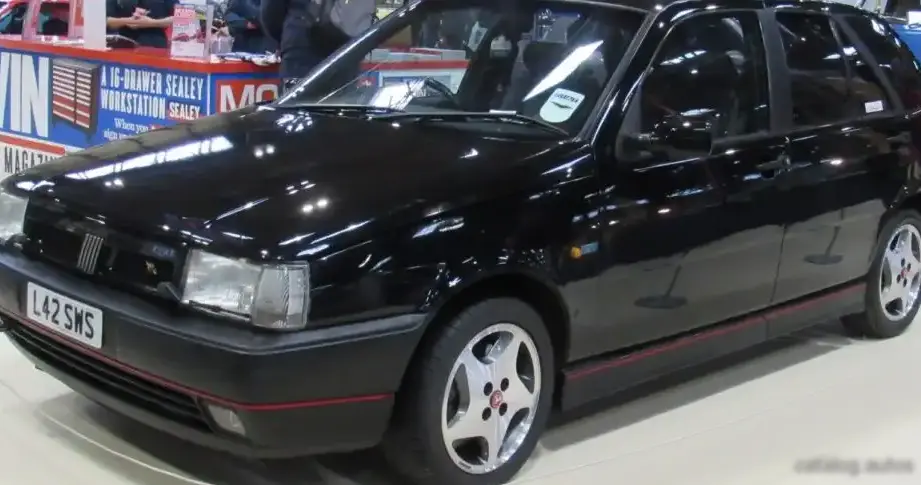
The Fiat Tipo (160) 1.4 i.e. represents the entry-level engine option within the second-generation Tipo range, produced from 1989 to 1995. Positioned as an affordable and practical family car, the 1.4 i.e. aimed to provide economical transportation for a broad customer base. It was a key component of Fiat’s strategy to offer a modern, spacious, and reliable vehicle in the competitive European small family car segment. The Tipo (160) itself was a significant departure from its predecessor, the Strada, offering a more contemporary design and improved mechanicals. This particular variant, with its 70 horsepower engine and typically a five-speed manual transmission, served as the foundation for the Tipo lineup, offering a balance between cost and usability.
Technical Specifications
| Brand | Fiat |
| Model | Tipo |
| Generation | Tipo (160) |
| Type (Engine) | 1.4 i.e. (70 Hp) |
| Start of production | 1989 |
| End of production | 1995 |
| Powertrain Architecture | Internal Combustion engine |
| Body type | Hatchback |
| Seats | 5 |
| Doors | 3-5 |
| Fuel consumption (urban) | 10 l/100 km (23.5 US mpg) |
| Fuel consumption (extra urban) | 6.4 l/100 km (36.8 US mpg) |
| Fuel consumption (combined) | 7.2 l/100 km (32.7 US mpg) |
| Fuel Type | Petrol (Gasoline) |
| Acceleration 0 – 100 km/h | 15.5 sec |
| Acceleration 0 – 62 mph | 15.5 sec |
| Acceleration 0 – 60 mph | 14.7 sec |
| Maximum speed | 161 km/h (100.04 mph) |
| Weight-to-power ratio | 14.7 kg/Hp |
| Weight-to-torque ratio | 9.7 kg/Nm |
| Power | 70 Hp @ 6000 rpm |
| Power per litre | 51 Hp/l |
| Torque | 106 Nm @ 3000 rpm (78.18 lb.-ft. @ 3000 rpm) |
| Engine layout | Front, Transverse |
| Engine Model/Code | 836 A4.000 |
| Engine displacement | 1372 cm3 (83.72 cu. in.) |
| Number of cylinders | 4 |
| Engine configuration | Inline |
| Cylinder Bore | 80.5 mm (3.17 in.) |
| Piston Stroke | 67.4 mm (2.65 in.) |
| Compression ratio | 9.2:1 |
| Number of valves per cylinder | 2 |
| Fuel injection system | Single-point injection |
| Engine aspiration | Naturally aspirated engine |
| Valvetrain | OHC |
| Engine oil capacity | 3.7 l (3.91 US qt | 3.26 UK qt) |
| Coolant capacity | 6.5 l (6.87 US qt | 5.72 UK qt) |
| Kerb Weight | 1030 kg (2270.76 lbs.) |
| Max. weight | 1530 kg (3373.07 lbs.) |
| Max load | 500 kg (1102.31 lbs.) |
| Trunk (boot) space – minimum | 350 l (12.36 cu. ft.) |
| Trunk (boot) space – maximum | 710 l (25.07 cu. ft.) |
| Fuel tank capacity | 48 l (12.68 US gal | 10.56 UK gal) |
| Length | 3958 mm (155.83 in.) |
| Width | 1700 mm (66.93 in.) |
| Height | 1450 mm (57.09 in.) |
| Wheelbase | 2540 mm (100 in.) |
| Front track | 1418 mm (55.83 in.) |
| Rear track | 1415 mm (55.71 in.) |
| Drivetrain Architecture | Front wheel drive |
| Number of gears | 5 |
| Gearbox type | Manual transmission |
| Front suspension | Spring Strut |
| Rear suspension | Coil spring |
| Front brakes | Disc |
| Rear brakes | Drum |
| Assisting systems | ABS (Anti-lock braking system) |
| Steering type | Steering rack and pinion |
| Tires size | 165/65 R14 S |
| Wheel rims size | 14 |
Powertrain & Engine Architecture
The heart of the Tipo 1.4 i.e. is the Fiat 836 A4.000 engine, a 1372cc inline-four cylinder unit. This engine utilized a single-point fuel injection system, a relatively common technology in the late 1980s and early 1990s. The single-point injection, while simpler and less expensive than multi-point systems, provided a reasonable balance of fuel efficiency and performance for the target market. The engine featured an overhead camshaft (OHC) valvetrain with two valves per cylinder. This configuration contributed to a relatively smooth and quiet operation for its class. The 1.4-liter engine produced 70 horsepower at 6000 rpm and 106 Nm (78.18 lb-ft) of torque at 3000 rpm. The engine was transversely mounted in the front of the vehicle, driving the front wheels. The standard transmission was a five-speed manual, although an optional three-speed automatic transmission was available, albeit less common.
Driving Characteristics
The Tipo 1.4 i.e. offered modest performance. Acceleration from 0 to 60 mph took approximately 14.7 seconds, and the top speed was around 100 mph. While not a sporty vehicle, the 1.4-liter engine provided sufficient power for everyday driving, including commuting and highway cruising. The five-speed manual transmission allowed drivers to keep the engine in its optimal power band, improving responsiveness. The automatic transmission, while offering convenience, noticeably reduced acceleration and increased fuel consumption. The car’s relatively light weight (around 2270 lbs) helped to mitigate the effects of the modest engine output. The steering was light and easy, making it maneuverable in urban environments, but lacked significant feedback. The suspension provided a comfortable ride, prioritizing passenger comfort over sporty handling.
Equipment & Trim Levels
The 1.4 i.e. typically served as the base trim level for the Tipo range. Standard equipment included basic cloth upholstery, a simple dashboard layout, and manual windows and door locks. Power steering was often an optional extra. Higher trim levels, such as the 1.6 and 2.0-liter models, offered more luxurious features like electric windows, central locking, and upgraded interior trim. Optional extras for the 1.4 i.e. could include a sunroof, alloy wheels, and a radio/cassette player. The interior was designed with practicality in mind, offering a spacious cabin for passengers and a reasonably sized trunk (350-710 liters depending on rear seat configuration).
Chassis & Braking
The Tipo (160) utilized a front-wheel-drive layout with a MacPherson strut suspension at the front and a coil spring suspension at the rear. The front brakes were disc brakes, providing adequate stopping power, while the rear brakes were drum brakes, a cost-saving measure common in this segment. An anti-lock braking system (ABS) was available as an option, enhancing safety. The chassis was designed to provide a comfortable ride and reasonable handling characteristics. The car’s relatively simple suspension setup prioritized ride quality over sporty handling.
Market Reception & Comparison
The Fiat Tipo 1.4 i.e. was generally well-received as an affordable and practical family car. Critics praised its spacious interior, comfortable ride, and reasonable fuel economy. However, the 1.4-liter engine was often criticized for being underpowered, particularly when compared to the more powerful 1.6 and 2.0-liter versions. The 1.6-liter engine offered a significant performance boost, while the 2.0-liter models provided even more power and a more refined driving experience. The 1.9 TDI diesel version, introduced later in the Tipo’s production run, offered excellent fuel economy but lacked the refinement of the gasoline engines. The 1.4 i.e. appealed to buyers who prioritized affordability and fuel efficiency over performance.
Legacy
The Fiat Tipo 1.4 i.e. remains a relatively common sight on European roads today, testament to its durability and affordability. The 836 A4.000 engine is generally considered to be a reliable unit, although regular maintenance is essential to prevent issues. Common problems include oil leaks and wear on the timing belt. The car’s simple mechanical design makes it relatively easy to repair and maintain. In the used car market, the Tipo 1.4 i.e. represents a budget-friendly option for those seeking a practical and reliable classic car. While not a performance icon, it holds a significant place in automotive history as a representative of affordable family transportation in the late 1980s and early 1990s.
