Technical Specifications
| Brand | Opel |
| Model | Astra |
| Generation | Astra G (facelift 2002) |
| Type (Engine) | 1.6 (85 Hp) Automatic |
| Start of production | 2002 |
| End of production | February 2004 |
| Powertrain Architecture | Internal Combustion engine |
| Body type | Hatchback |
| Seats | 5 |
| Doors | 3-5 |
| Fuel consumption (urban) | 11.3 l/100 km (20.8 US mpg, 25 UK mpg, 8.8 km/l) |
| Fuel consumption (extra urban) | 6.4 l/100 km (36.8 US mpg, 44.1 UK mpg, 15.6 km/l) |
| Fuel consumption (combined) | 8.2 l/100 km (28.7 US mpg, 34.4 UK mpg, 12.2 km/l) |
| Fuel Type | Petrol (Gasoline) |
| Acceleration 0 – 100 km/h | 14.5 sec |
| Acceleration 0 – 62 mph | 14.5 sec |
| Acceleration 0 – 60 mph | 13.8 sec |
| Maximum speed | 171 km/h (106.25 mph) |
| Weight-to-power ratio | 12.7 kg/Hp, 78.5 Hp/tonne |
| Weight-to-torque ratio | 7.8 kg/Nm, 127.4 Nm/tonne |
| Power | 85 Hp @ 5400 rpm |
| Power per litre | 53.2 Hp/l |
| Torque | 138 Nm @ 2600 rpm (101.78 lb.-ft. @ 2600 rpm) |
| Engine layout | Front, Transverse |
| Engine Model/Code | Z16SE |
| Engine displacement | 1598 cm3 (97.52 cu. in.) |
| Number of cylinders | 4 |
| Engine configuration | Inline |
| Cylinder Bore | 79 mm (3.11 in.) |
| Piston Stroke | 81.5 mm (3.21 in.) |
| Compression ratio | 9.6:1 |
| Number of valves per cylinder | 2 |
| Fuel injection system | Multi-port manifold injection |
| Engine aspiration | Naturally aspirated engine |
| Valvetrain | OHC |
| Engine oil capacity | 3.5 l (3.7 US qt | 3.08 UK qt) |
| Coolant capacity | 5.8 l (6.13 US qt | 5.1 UK qt) |
| Kerb Weight | 1083 kg (2387.61 lbs.) |
| Max. weight | 1660 kg (3659.67 lbs.) |
| Max load | 577 kg (1272.07 lbs.) |
| Trunk (boot) space – minimum | 370 l (13.07 cu. ft.) |
| Trunk (boot) space – maximum | 1180 l (41.67 cu. ft.) |
| Fuel tank capacity | 52 l (13.74 US gal | 11.44 UK gal) |
| Length | 4110 mm (161.81 in.) |
| Width | 1709 mm (67.28 in.) |
| Width including mirrors | 1967 mm (77.44 in.) |
| Height | 1425 mm (56.1 in.) |
| Wheelbase | 2606 mm (102.6 in.) |
| Front track | 1484 mm (58.43 in.) |
| Rear track | 1452 mm (57.17 in.) |
| Front overhang | 791 mm (31.14 in.) |
| Rear overhang | 713 mm (28.07 in.) |
| Ride height (ground clearance) | 160 mm (6.3 in.) |
| Drag coefficient (Cd) | 0.32 |
| Drivetrain Architecture | Front wheel drive |
| Number of gears and type of gearbox | 4 gears, automatic transmission |
| Front suspension | Wishbone |
| Rear suspension | Suspension with traction connecting levers |
| Front brakes | Ventilated discs |
| Rear brakes | Disc |
| Assisting systems | ABS (Anti-lock braking system) |
| Steering type | Steering rack and pinion |
| Power steering | Hydraulic Steering |
| Tires size | 185/65 R15 |
| Wheel rims size | 15 |
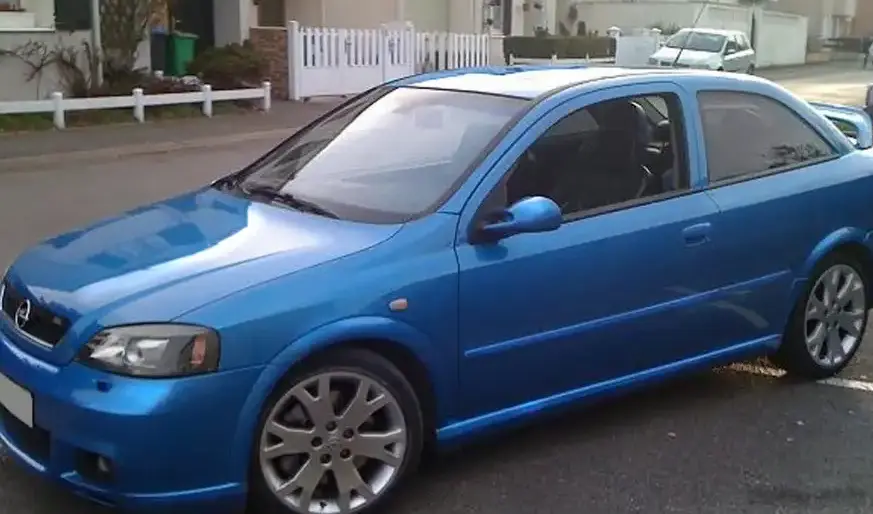
The Opel Astra G (facelift, produced 2002-2004) 1.6-liter (85 horsepower) automatic variant occupied the entry-level position within the broader Astra G range. Designed as a practical and affordable option, it appealed to buyers who prioritized ease of use and fuel efficiency over outright performance. Built on the GM/Opel T-platform (also known as the 1HX0 platform), this version of the Astra G was primarily marketed in Europe, offering a comfortable and relatively economical hatchback experience. It served as an accessible entry point into the Astra lineup, attracting first-time car buyers or those seeking a dependable daily driver.
Powertrain & Engine Architecture
The Astra G 1.6 Automatic was powered by the Opel/Vauxhall Z16SE engine, a 1.6-liter inline-four cylinder gasoline engine. This engine featured a single overhead camshaft (SOHC) valvetrain with two valves per cylinder. Fuel delivery was handled by a multi-point fuel injection system, providing adequate, though not exceptional, combustion control. The Z16SE was known for its relative simplicity and durability, though it wasn’t a powerhouse. The engine produced 85 horsepower at 5400 rpm and 138 Nm (101.78 lb-ft) of torque at 2600 rpm. Paired with this engine was a four-speed automatic transmission, designed for smooth, if not particularly sporty, gear changes. This transmission was a common unit used across various GM platforms at the time, prioritizing comfort and ease of driving over performance.
Driving Characteristics
The 1.6-liter automatic Astra G offered a comfortable, but unhurried, driving experience. Acceleration from 0-60 mph took around 13.8 seconds, and top speed was limited to 106.25 mph. The four-speed automatic transmission, while providing smooth shifts, lacked the responsiveness of a manual gearbox or a more modern automatic with additional gears. The gear ratios were optimized for fuel economy rather than spirited driving. Compared to the more powerful 1.8-liter or the diesel variants, the 1.6 automatic felt noticeably slower, particularly when overtaking or climbing hills. However, for urban commuting and relaxed highway cruising, the powertrain proved adequate. The steering was light and easy, making it maneuverable in city traffic.
Equipment & Trim Levels
The 1.6-liter automatic Astra G typically came with a base level of equipment. Standard features generally included power steering, central locking, electric front windows, and an AM/FM radio. Air conditioning was often an optional extra. Interior upholstery was typically cloth, and the dashboard featured a functional, if somewhat basic, design. Higher trim levels, such as the Elegance or Sport, offered additional features like alloy wheels, upgraded audio systems, and more luxurious interior trim. The base trim focused on providing essential features at an affordable price point.
Chassis & Braking
The Astra G featured a MacPherson strut front suspension and a torsion beam rear suspension. This setup provided a reasonable balance between ride comfort and handling. The front brakes were ventilated discs, while the rear brakes were solid discs. ABS (Anti-lock Braking System) was standard, enhancing safety during emergency braking. The suspension was tuned for comfort, resulting in a relatively soft ride. Stabilizer bars were fitted to both the front and rear axles to reduce body roll during cornering, but the overall handling was not particularly sporty.
Market Reception & Comparison
The Astra G 1.6 Automatic was generally well-received as a practical and affordable family car. Critics praised its comfortable ride and fuel efficiency, but noted its lack of performance. Compared to the more powerful Astra variants, such as the 1.8-liter or the turbocharged models, the 1.6 automatic was significantly slower. However, it offered a lower purchase price and better fuel economy. The 1.6-liter engine was also generally considered more reliable than some of the more complex engines offered in the Astra G range. It was a popular choice for drivers who prioritized practicality and affordability over driving excitement.
Legacy
The Opel Astra G 1.6 Automatic, while not a performance icon, remains a relatively common sight on European roads today. The Z16SE engine is known for its durability and relatively low maintenance costs. Parts availability is generally good, making it a relatively affordable car to maintain. However, age-related issues, such as corrosion and wear and tear on suspension components, are common. In the used car market, these Astras represent a budget-friendly option for those seeking a reliable and practical hatchback. While not highly sought after by enthusiasts, they continue to provide dependable transportation for many drivers.