Technical Specifications
| Brand | Ford |
| Model | Fiesta |
| Generation | Fiesta IV (Mk4) 3 door |
| Type (Engine) | 1.3 i (50 Hp) |
| Start of production | January, 1996 |
| End of production | September, 1999 |
| Powertrain Architecture | Internal Combustion engine |
| Body type | Hatchback |
| Seats | 5 |
| Doors | 3 |
| Fuel consumption (urban) | 8.7 l/100 km (27 US mpg, 32.5 UK mpg, 11.5 km/l) |
| Fuel consumption (extra urban) | 5.9 l/100 km (39.9 US mpg, 47.9 UK mpg, 16.9 km/l) |
| Fuel consumption (combined) | 6.9 l/100 km (34.1 US mpg, 40.9 UK mpg, 14.5 km/l) |
| Fuel Type | Petrol (Gasoline) |
| Acceleration 0 – 100 km/h | 19.5 sec |
| Acceleration 0 – 62 mph | 19.5 sec |
| Acceleration 0 – 60 mph | 18.5 sec |
| Maximum speed | 143 km/h (88.86 mph) |
| Weight-to-power ratio | 20.1 kg/Hp, 49.8 Hp/tonne |
| Weight-to-torque ratio | 10.7 kg/Nm, 93.5 Nm/tonne |
| Power | 50 Hp @ 4500 rpm |
| Power per litre | 38.5 Hp/l |
| Torque | 94 Nm @ 2500 rpm (69.33 lb.-ft. @ 2500 rpm) |
| Engine layout | Front, Transverse |
| Engine Model/Code | JJA, JJC, JJE, JJJ, JJK, JJM |
| Engine displacement | 1299 cm3 (79.27 cu. in.) |
| Number of cylinders | 4 |
| Engine configuration | Inline |
| Cylinder Bore | 74 mm (2.91 in.) |
| Piston Stroke | 75.5 mm (2.97 in.) |
| Compression ratio | 9.5:1 |
| Number of valves per cylinder | 2 |
| Fuel injection system | Multi-port manifold injection |
| Engine aspiration | Naturally aspirated engine |
| Valvetrain | OHC |
| Engine oil capacity | 3.25 l (3.43 US qt, 2.86 UK qt) |
| Coolant | 7.1 l (7.5 US qt, 6.25 UK qt) |
| Kerb Weight | 1005 kg (2215.65 lbs.) |
| Max. weight | 1415 kg (3119.54 lbs.) |
| Max load | 410 kg (903.9 lbs.) |
| Trunk (boot) space – minimum | 250 l (8.83 cu. ft.) |
| Trunk (boot) space – maximum | 930 l (32.84 cu. ft.) |
| Fuel tank capacity | 42 l (11.1 US gal, 9.24 UK gal) |
| Max. roof load | 75 kg (165.35 lbs.) |
| Permitted trailer load with brakes (12%) | 900 kg (1984.16 lbs.) |
| Permitted trailer load without brakes | 310 kg (683.43 lbs.) |
| Length | 3828 mm (150.71 in.) |
| Width | 1634 mm (64.33 in.) |
| Height | 1334 mm (52.52 in.) |
| Wheelbase | 2446 mm (96.3 in.) |
| Front track | 1429 mm (56.26 in.) |
| Rear (Back) track | 1384 mm (54.49 in.) |
| Drivetrain Architecture | The Internal combustion engine (ICE) drives the front wheels of the vehicle. |
| Drive wheel | Front wheel drive |
| Number of gears and type of gearbox | 5 gears, manual transmission |
| Front suspension | Coil spring |
| Rear suspension | Coil spring |
| Front brakes | Disc |
| Rear brakes | Drum |
| Assisting systems | ABS (Anti-lock braking system) |
| Steering type | Steering rack and pinion |
| Power steering | Hydraulic Steering |
| Tires size | 165/70 R13 |
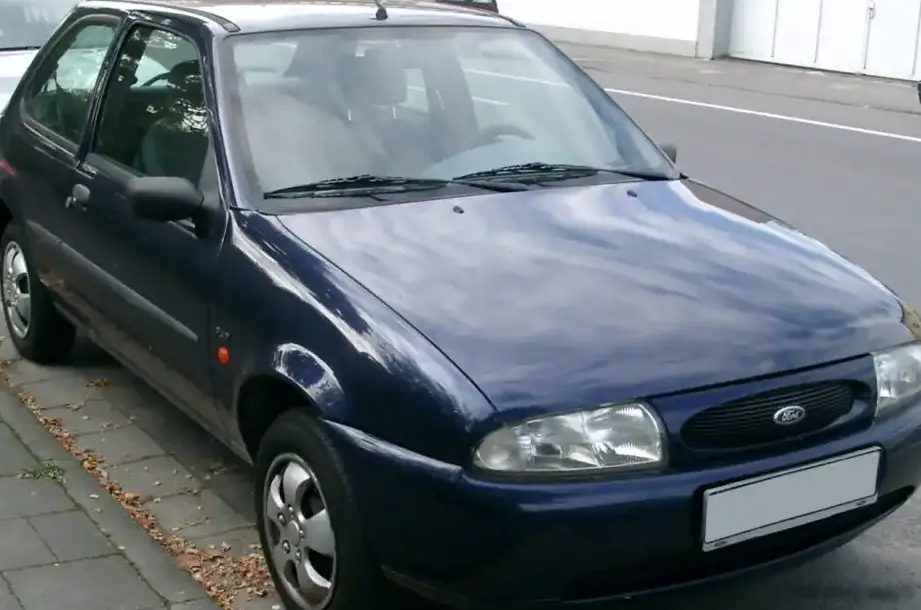
The Ford Fiesta Mk4, produced between 1996 and 1999, marked a significant evolution for Ford’s supermini, prioritizing refinement and safety improvements over its predecessors. The three-door hatchback configuration proved particularly popular in Europe, where its compact size and fuel efficiency were well-suited to densely populated urban environments and rising fuel costs. Within the Mk4 Fiesta lineup, the 1.3 i variant, generating 50 horsepower, served as the entry-level offering, targeting budget-conscious buyers and those for whom fuel economy was paramount. This model occupied the lowest position in the Fiesta hierarchy, positioned below the 1.4, 1.6, and subsequently, the more performance-oriented Zetec models.
Powertrain & Engine Architecture
The 1.3 i Fiesta was powered by the Ford JJA, JJC, JJE, JJJ, JJK, or JJM engine – a 1.3-liter inline-four cylinder gasoline engine. This engine was a relatively straightforward design, employing a single overhead camshaft (SOHC) operating two valves per cylinder. Fuel delivery was managed by a multi-port fuel injection system, a substantial upgrade from the carburetors used in earlier Fiesta generations. The engine produced a modest 50 horsepower at 4500 rpm and 69.33 lb-ft (94 Nm) of torque at 2500 rpm. A compression ratio of 9.5:1 allowed the engine to operate reliably on commonly available gasoline grades. The standard transmission was a five-speed manual gearbox, geared for optimal fuel efficiency rather than rapid acceleration. While an automatic transmission was available on some Mk4 Fiestas, it was not offered in conjunction with the base 1.3-liter engine.
Driving Characteristics
The Fiesta 1.3 i wasn’t built for outright speed. Acceleration was unhurried, requiring approximately 19.5 seconds to reach 62 mph (100 km/h). Its top speed hovered around 88.86 mph (143 km/h). The engine felt noticeably strained when pushed to its limits, and overtaking maneuvers demanded careful consideration. However, within city limits, the Fiesta proved perfectly adequate. The light steering and compact dimensions made it exceptionally easy to maneuver in congested areas. The five-speed gearbox allowed for reasonably efficient cruising on highways, although engine noise became more prominent at higher speeds. Compared to the more powerful 1.4 and 1.6-liter versions, the 1.3 i lacked the responsiveness needed for spirited driving, but it delivered a smoother, more relaxed driving experience.
Equipment & Trim Levels
The 1.3 i Fiesta typically represented the base trim level, and consequently, came equipped with a relatively limited set of standard features. These generally included central locking, power steering, and a basic stereo system. Interior upholstery was typically cloth, and the dashboard was constructed from durable plastic materials. Optional extras, such as electric front windows, a sunroof, and upgraded audio systems, were available. The trim level was often designated simply as “LX” or a similar identifier, signifying a basic specification. The primary focus was on providing affordable transportation, so luxury features were minimized.
Chassis & Braking
The Fiesta Mk4 utilized a straightforward yet effective chassis design. The front suspension consisted of coil springs and MacPherson struts, while the rear employed a torsion beam setup. This configuration provided a comfortable ride quality, although handling wasn’t particularly sharp or engaging. The front brakes were discs, offering adequate stopping power, while the rear brakes were drums – a cost-saving measure. Anti-lock Braking System (ABS) was offered as an optional extra, enhancing safety. The relatively light weight of the 1.3 i model helped to mitigate the limitations of the modest braking performance.
Market Reception & Comparison
The Fiesta 1.3 i was generally well-received as an affordable and economical city car. Critics lauded its fuel efficiency and ease of driving, but acknowledged its lack of performance. When compared to other small cars of the era, such as the Peugeot 205 and Renault Clio, the Fiesta offered a competitive balance of practicality and value. The 1.4 and 1.6-liter Fiesta models provided significantly more performance, but at a higher price point. The 1.8 diesel models offered even greater fuel economy, but were slower and noisier in operation. The 1.3 i appealed to buyers who prioritized low running costs and ease of use over driving excitement.
Legacy
The Ford Fiesta Mk4 1.3 i remains a relatively common sight on European roads today, a testament to its inherent durability and reliability. The JJA/JJC/JJE/JJJ/JJK/JJM engine is known for its robustness, although consistent maintenance is crucial to prevent issues such as oil leaks and corrosion. Parts availability is generally good, and the car is relatively straightforward to repair. In the used car market, the 1.3 i Fiesta represents an affordable option for first-time drivers or those seeking a cheap and reliable vehicle for everyday transportation. While it may not offer the most exhilarating driving experience, it provides a practical and dependable solution for basic transportation needs.