
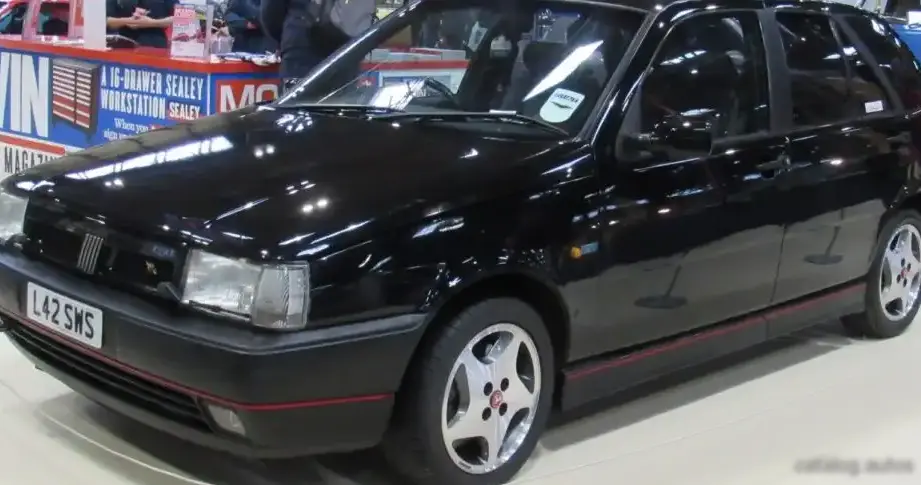
The Fiat Tipo (160) 1.6 i, producing 80 horsepower, was a mainstay of the Tipo range from its introduction in 1990 until 1993. Positioned as an entry-level offering, it provided affordable transportation within the broader Tipo family, which included more powerful and upscale variants. The Tipo (160) itself represented Fiat’s attempt to modernize its compact offerings, replacing the aging Ritmo/Strada and Regata models. Built on the Tipo 160 platform, it aimed to offer a more spacious and refined experience than its predecessors, competing with vehicles like the Volkswagen Golf and Ford Escort in the European market. This particular 1.6L engine and 5-speed manual transmission combination was designed for fuel efficiency and practicality, appealing to a broad customer base.
Technical Specifications
| Brand | Fiat |
| Model | Tipo |
| Generation | Tipo (160) |
| Type (Engine) | 1.6 i (80 Hp) |
| Start of production | 1990 |
| End of production | 1993 |
| Powertrain Architecture | Internal Combustion engine |
| Body type | Hatchback |
| Seats | 5 |
| Doors | 3-5 |
| Fuel consumption (urban) | 10 l/100 km (23.5 US mpg) |
| Fuel consumption (extra urban) | 6 l/100 km (39.2 US mpg) |
| Fuel consumption (combined) | 7.6 l/100 km (30.9 US mpg) |
| Fuel Type | Petrol (Gasoline) |
| Acceleration 0 – 100 km/h | 12.4 sec |
| Acceleration 0 – 62 mph | 12.4 sec |
| Acceleration 0 – 60 mph | 11.8 sec |
| Maximum speed | 170 km/h (105.63 mph) |
| Weight-to-power ratio | 12.5 kg/Hp |
| Weight-to-torque ratio | 7.8 kg/Nm |
| Power | 80 Hp @ 5750 rpm |
| Torque | 128 Nm @ 2750 rpm (94.41 lb.-ft. @ 2750 rpm) |
| Engine layout | Front, Transverse |
| Engine Model/Code | 160 A2.000 |
| Engine displacement | 1581 cm3 (96.48 cu. in.) |
| Number of cylinders | 4 |
| Engine configuration | Inline |
| Cylinder Bore | 86.4 mm (3.4 in.) |
| Piston Stroke | 67.4 mm (2.65 in.) |
| Compression ratio | 9.2:1 |
| Number of valves per cylinder | 2 |
| Fuel injection system | Multi-port manifold injection |
| Engine aspiration | Naturally aspirated |
| Engine oil capacity | 3.7 l (3.91 US qt | 3.26 UK qt) |
| Coolant capacity | 5.5 l (5.81 US qt | 4.84 UK qt) |
| Kerb Weight | 1000 kg (2204.62 lbs.) |
| Max. weight | 1520 kg (3351.03 lbs.) |
| Max load | 520 kg (1146.4 lbs.) |
| Trunk (boot) space – minimum | 350 l (12.36 cu. ft.) |
| Trunk (boot) space – maximum | 710 l (25.07 cu. ft.) |
| Fuel tank capacity | 48 l (12.68 US gal | 10.56 UK gal) |
| Length | 3958 mm (155.83 in.) |
| Width | 1700 mm (66.93 in.) |
| Height | 1450 mm (57.09 in.) |
| Wheelbase | 2540 mm (100 in.) |
| Front track | 1429 mm (56.26 in.) |
| Rear track | 1415 mm (55.71 in.) |
| Drivetrain Architecture | Front wheel drive |
| Number of gears | 5 |
| Gearbox type | Manual transmission |
| Front suspension | Spring Strut |
| Rear suspension | Coil spring |
| Front brakes | Disc |
| Rear brakes | Drum |
| Assisting systems | ABS (Anti-lock braking system) |
| Steering type | Steering rack and pinion |
| Tires size | 165/70 R13 |
Powertrain & Engine Architecture
The heart of the Tipo 1.6 i was the 160 A2.000 engine, a 1.6-liter inline-four cylinder gasoline engine. This engine featured a cast iron block and an aluminum cylinder head, employing a relatively simple two-valve per cylinder configuration. Fuel delivery was handled by a multi-port fuel injection system, a significant upgrade from the carburetors found in older Fiat models. This system improved fuel efficiency and reduced emissions. The engine produced 80 horsepower at 5750 rpm and 128 Nm (94.41 lb-ft) of torque at 2750 rpm. The five-speed manual transmission was the standard offering, providing a reasonable balance between performance and fuel economy. The transmission was a conventional setup, designed for durability and ease of maintenance.
Driving Characteristics
The 1.6 i Tipo offered modest performance. Acceleration from 0 to 60 mph took around 11.8 seconds, and top speed was approximately 105.63 mph. While not particularly quick, the engine provided adequate power for everyday driving. The gear ratios in the five-speed manual transmission were well-spaced, allowing the driver to keep the engine in its optimal power band. Compared to the more powerful 1.8 and 2.0-liter versions of the Tipo, the 1.6 i felt noticeably slower, especially when fully loaded or tackling steep hills. However, it offered a more forgiving and economical driving experience, making it ideal for urban commuting and longer journeys where outright speed wasn’t a priority.
Equipment & Trim Levels
The 1.6 i Tipo typically came with a basic level of equipment. Standard features included central locking, power steering, and a basic stereo system. Interior upholstery was typically cloth, and the dashboard featured a simple, functional design. Optional extras included electric windows, a sunroof, and upgraded audio systems. The trim level was generally considered the base model, focusing on providing essential transportation at an affordable price. Higher trim levels, such as the SX and ES, offered more luxurious features and a more refined interior.
Chassis & Braking
The Tipo 160 featured a front-wheel-drive layout with independent front suspension using MacPherson struts and a semi-independent rear suspension with a twist beam. The front brakes were ventilated discs, while the rear brakes were drums. This braking configuration was adequate for the vehicle’s weight and performance. An anti-lock braking system (ABS) was available as an option, enhancing safety. The suspension setup provided a comfortable ride, although it wasn’t particularly sporty. The steering was light and precise, making the car easy to maneuver in urban environments.
Market Reception & Comparison
The Fiat Tipo 1.6 i was generally well-received as an affordable and practical family car. Critics praised its spacious interior, comfortable ride, and fuel efficiency. However, some criticized its lack of power and somewhat bland styling. Compared to other trims in the Tipo lineup, the 1.6 i offered the best fuel economy but the lowest performance. The 1.8 and 2.0-liter versions provided more power and a more engaging driving experience, but at a higher price point. The 1.6 i was often seen as a sensible choice for buyers who prioritized practicality and economy over performance.
Legacy
The Fiat Tipo 1.6 i, while not the most exciting variant in the range, proved to be a reliable and durable vehicle. The 160 A2.000 engine is known for its longevity, and many examples are still on the road today. The Tipo 160, as a whole, helped to modernize Fiat’s image and establish it as a competitor in the European compact car market. In the used car market, the 1.6 i Tipo remains an affordable and practical option for those seeking a classic Italian hatchback. Its simplicity and relatively low maintenance costs make it an appealing choice for enthusiasts and budget-conscious buyers alike.
