Technical Specifications
| Brand | Jeep |
| Model | Compass |
| Generation | Compass I (MK) |
| Type (Engine) | 2.0 CRD (140 Hp) 4×4 |
| Start of production | 2007 |
| End of production | 2010 |
| Powertrain Architecture | Internal Combustion engine |
| Body type | SUV, Crossover |
| Seats | 5 |
| Doors | 4 |
| Fuel consumption (urban) | 8.3 l/100 km (28.3 US mpg, 34 UK mpg, 12 km/l) |
| Fuel consumption (extra urban) | 5.4 l/100 km (43.6 US mpg, 52.3 UK mpg, 18.5 km/l) |
| Fuel consumption (combined) | 6.5 l/100 km (36.2 US mpg, 43.5 UK mpg, 15.4 km/l) |
| Fuel Type | Diesel |
| Acceleration 0 – 100 km/h | 11 sec |
| Acceleration 0 – 62 mph | 11 sec |
| Acceleration 0 – 60 mph | 10.5 sec |
| Maximum speed | 189 km/h (117.44 mph) |
| Emission standard | Euro 4 |
| Weight-to-power ratio | 11.5 kg/Hp |
| Weight-to-torque ratio | 5.2 kg/Nm |
| Power | 140 Hp @ 4000 rpm |
| Torque | 310 Nm @ 1750 rpm (228.64 lb.-ft. @ 1750 rpm) |
| Engine layout | Front, Transverse |
| Engine displacement | 1968 cm3 (120.09 cu. in.) |
| Number of cylinders | 4 |
| Engine configuration | Inline |
| Cylinder Bore | 81 mm (3.19 in.) |
| Piston Stroke | 95.5 mm (3.76 in.) |
| Compression ratio | 18:1 |
| Number of valves per cylinder | 4 |
| Fuel injection system | Pump-nozzle (Unit Injector) |
| Engine aspiration | Turbocharger, Intercooler |
| Engine oil capacity | 4.3 l (4.54 US qt, 3.78 UK qt) |
| Coolant capacity | 8 l (8.45 US qt, 7.04 UK qt) |
| Kerb Weight | 1615 kg (3560.47 lbs.) |
| Trunk (boot) space – minimum | 334 l (11.8 cu. ft.) |
| Trunk (boot) space – maximum | 1277 l (45.1 cu. ft.) |
| Fuel tank capacity | 51 l (13.47 US gal, 11.22 UK gal) |
| Max. roof load | 68 kg (149.91 lbs.) |
| Length | 4405 mm (173.43 in.) |
| Width | 1810 mm (71.26 in.) |
| Height | 1630 mm (64.17 in.) |
| Wheelbase | 2635 mm (103.74 in.) |
| Front track | 1520 mm (59.84 in.) |
| Rear track | 1520 mm (59.84 in.) |
| Drive wheel | All wheel drive (4×4) |
| Number of gears | 6 |
| Gearbox type | Manual transmission |
| Front suspension | Independent, McPherson with coil spring and anti-roll bar |
| Rear suspension | Independent coil spring |
| Front brakes | Ventilated discs |
| Rear brakes | Disc |
| Assisting systems | ABS (Anti-lock braking system) |
| Steering type | Steering rack and pinion |
| Power steering | Hydraulic |
| Tires size | 215/60 R17 |
| Wheel rims size | 6.5 J x 17 |
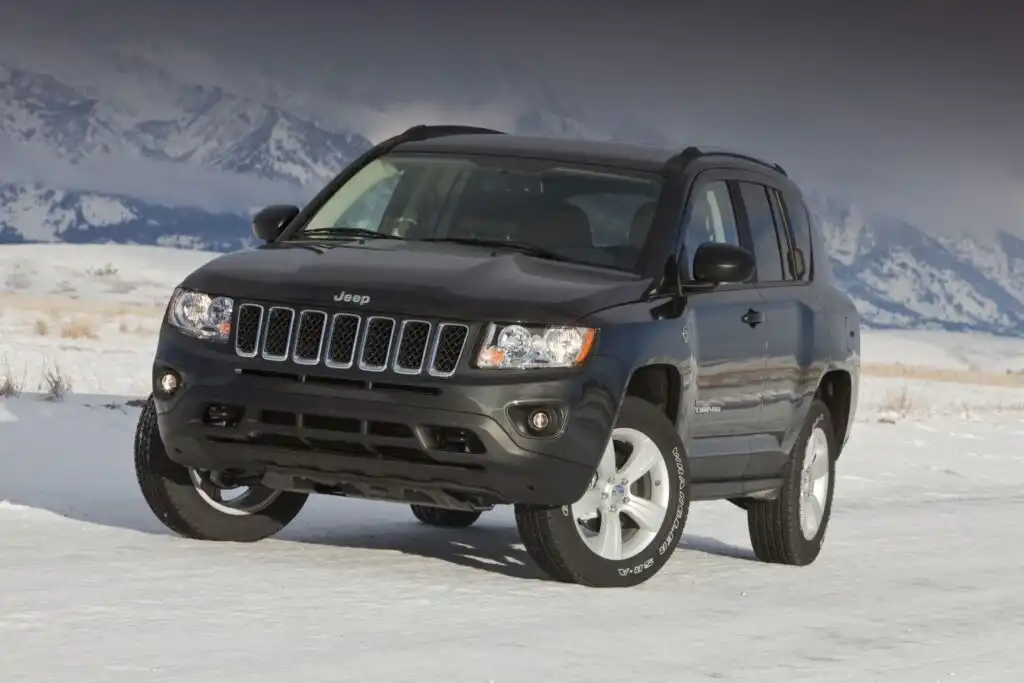
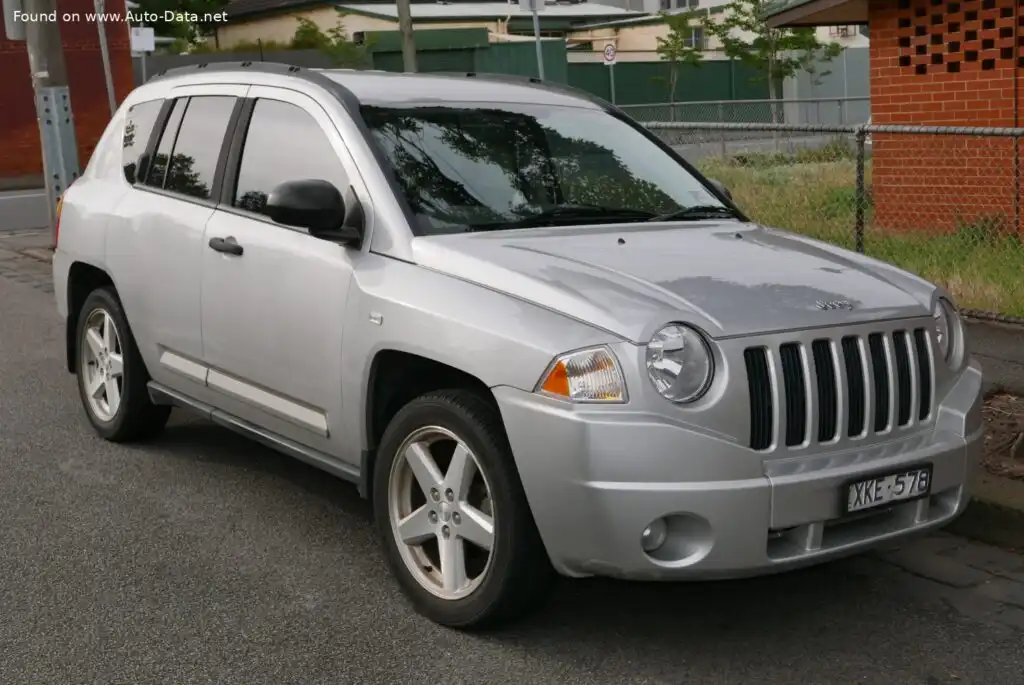
The Jeep Compass (MK) 2.0 CRD 4×4, produced between 2007 and 2010, marked Jeep’s foray into the increasingly popular compact crossover SUV segment. Built on the 230 platform – shared with the Dodge Caliber – the Compass was designed to offer a more accessible and fuel-efficient alternative to the traditionally larger and more rugged Jeep Cherokee. This specific variant, powered by a 2.0-liter Common Rail Diesel engine producing 140 horsepower and coupled with a six-speed manual transmission, occupied a mid-range position within the Compass lineup, aiming to strike a balance between off-road capability and everyday economy. Its primary market was Europe and other international regions where diesel engines were the preferred choice for many drivers.
Powertrain & Engine Architecture
The core of the Compass 2.0 CRD 4×4 is its 1968cc (120.09 cubic inches) four-cylinder diesel engine. This engine, often identified by its European engine code, utilizes a common-rail direct injection system employing pump-nozzle (unit injector) technology. This advanced fuel delivery system allowed for highly precise fuel atomization and injection timing, resulting in improved fuel efficiency, reduced emissions, and enhanced engine responsiveness. The engine features a single overhead camshaft (SOHC) operating four valves per cylinder, optimizing airflow for increased power. A turbocharger, coupled with an intercooler, forces more air into the cylinders, boosting power output to 140 horsepower at 4000 rpm and delivering a robust 310 Nm (228.64 lb.-ft.) of torque at a low 1750 rpm. The six-speed manual transmission was carefully geared to take advantage of the engine’s torque characteristics, providing both adequate acceleration and comfortable highway cruising. The transmission’s ratios were selected to keep the engine operating within its peak efficiency range as much as possible.
Driving Characteristics
The 2.0 CRD 4×4 Compass delivered a competent, though not particularly sporty, driving experience. The 140 hp engine, while adequate for daily commutes and general driving, didn’t offer exhilarating acceleration. A 0-60 mph time of around 10.5 seconds confirms this. However, the engine’s strong low-end torque made it feel more responsive in typical driving scenarios, such as overtaking slower vehicles or navigating hilly terrain. The six-speed manual transmission allowed drivers to maintain control over the engine’s power band. Compared to the gasoline-powered Compass models, the diesel version offered significantly improved fuel economy. It also provided a more relaxed driving experience on longer journeys due to the engine’s lower operating speeds. The 4×4 system, while not designed for serious off-road adventures, provided enhanced traction in challenging conditions like snow or gravel.
Equipment & Trim Levels
The 2.0 CRD 4×4 Compass typically came standard with features such as air conditioning, power windows and door locks, and a basic audio system. Higher trim levels offered optional extras like alloy wheels, a sunroof, upgraded interior upholstery, and a more sophisticated audio system with CD player and MP3 compatibility. Safety features included ABS brakes, front airbags, and side curtain airbags. Interior materials were generally durable and practical, reflecting the Compass’s positioning as an affordable crossover vehicle. The overall interior design prioritized functionality over luxury.
Chassis & Braking
The Compass employed an independent suspension system on all four wheels. The front suspension utilized McPherson struts with coil springs and an anti-roll bar, while the rear featured an independent coil spring arrangement. This suspension setup provided a reasonably comfortable ride quality, although it wasn’t particularly focused on sporty handling. The braking system consisted of ventilated discs at the front and solid discs at the rear. ABS (Anti-lock Braking System) was standard equipment, enhancing braking performance and stability, particularly on slippery surfaces.
Market Reception & Comparison
The Jeep Compass 2.0 CRD 4×4 was generally well-received in European markets as a practical and fuel-efficient crossover SUV. Automotive critics praised the diesel engine’s economy and readily available torque, but some noted that the interior quality and overall driving dynamics were not as refined as those of competitors like the Nissan Qashqai and Volkswagen Tiguan. The diesel variant offered a substantial fuel economy advantage over the gasoline-powered Compass models, making it a popular choice for drivers who frequently covered long distances. Reliability was considered average for the period, with some reports of potential issues related to the diesel injection system.
Legacy
The Jeep Compass (MK) 2.0 CRD 4×4, while not a revolutionary vehicle, played a significant role in broadening Jeep’s appeal and expanding its customer base. The 2.0-liter diesel engine proved to be reasonably durable, and well-maintained examples can still be found in the used car market today. While it doesn’t boast exceptional performance or luxurious appointments, the Compass 2.0 CRD 4×4 remains a practical and affordable option for those seeking a compact crossover with decent fuel economy and all-wheel drive capability. Its relatively straightforward mechanical design can also make it an appealing choice for mechanically inclined owners.