
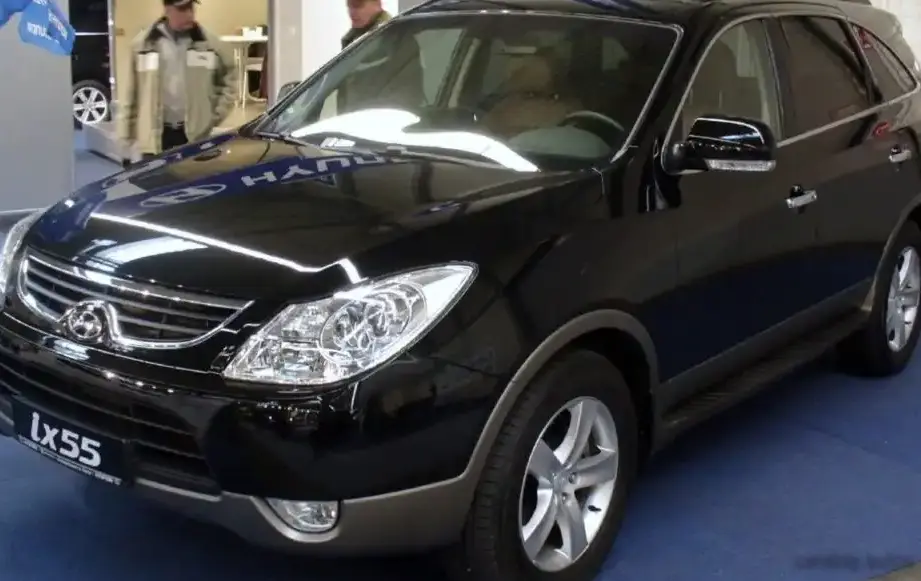
The Hyundai ix55 3.8, a mid-size crossover SUV produced from 2008 to 2012, represented Hyundai’s initial foray into a more premium SUV segment. Marketed primarily in South Korea, North America, and parts of Europe, the ix55 aimed to offer a blend of spaciousness, comfort, and available all-wheel drive capability. This particular variant, equipped with the 3.8-liter Lambda V6 engine and a six-speed automatic transmission, served as the flagship powertrain option for the model. It was positioned as a step up from potential future four-cylinder offerings, targeting buyers seeking a more refined and powerful driving experience within the seven-passenger SUV class.
Technical Specifications
| Brand | Hyundai |
| Model | ix55 |
| Generation | ix55 |
| Type (Engine) | 3.8 (264 Hp) 4WD |
| Start of production | 2008 |
| End of production | 2012 |
| Powertrain Architecture | Internal Combustion engine |
| Body type | SUV |
| Seats | 7 |
| Doors | 5 |
| Fuel consumption (urban) | 14.8 l/100 km (15.9 US mpg, 19.1 UK mpg) |
| Fuel consumption (extra urban) | 10.3 l/100 km (22.8 US mpg, 27.4 UK mpg) |
| Fuel Type | Petrol (Gasoline) |
| Weight-to-power ratio | 8.4 kg/Hp, 118.9 Hp/tonne |
| Weight-to-torque ratio | 6.4 kg/Nm, 156.8 Nm/tonne |
| Power | 264 Hp @ 6000 rpm |
| Power per litre | 69.9 Hp/l |
| Torque | 348 Nm (256.67 lb.-ft.) |
| Engine layout | Front, Transverse |
| Engine Model/Code | Lambda / G6DA |
| Engine displacement | 3778 cm3 (230.55 cu. in.) |
| Number of cylinders | 6 |
| Engine configuration | V-engine |
| Number of valves per cylinder | 4 |
| Fuel injection system | Multi-port manifold injection |
| Engine aspiration | Naturally aspirated engine |
| Valvetrain | DOHC |
| Engine oil capacity | 5.2 l (5.49 US qt | 4.58 UK qt) |
| Coolant capacity | 10.5 l (11.1 US qt | 9.24 UK qt) |
| Kerb Weight | 2220 kg (4894.26 lbs.) |
| Max. weight | 2780 kg (6128.85 lbs.) |
| Max load | 560 kg (1234.59 lbs.) |
| Trunk (boot) space – minimum | 598 l (21.12 cu. ft.) |
| Trunk (boot) space – maximum | 1746 l (61.66 cu. ft.) |
| Fuel tank capacity | 78 l (20.61 US gal | 17.16 UK gal) |
| Length | 4840 mm (190.55 in.) |
| Width | 1945 mm (76.57 in.) |
| Height | 1750 mm (68.9 in.) |
| Wheelbase | 2805 mm (110.43 in.) |
| Front track | 1670 mm (65.75 in.) |
| Rear (Back) track | 1670 mm (65.75 in.) |
| Drive wheel | All wheel drive (4×4) |
| Number of gears and type of gearbox | 6 gears, automatic transmission |
| Front suspension | Independent, type McPherson with coil spring and anti-roll bar |
| Rear suspension | Independent multi-link spring suspension with stabilizer |
| Front brakes | Ventilated discs |
| Rear brakes | Disc |
| Assisting systems | ABS (Anti-lock braking system) |
| Tires size | 245/60 R18 |
Powertrain & Engine Architecture
The heart of the ix55 3.8 is Hyundai’s Lambda 3.8-liter V6 engine, designated as the G6DA. This engine is a naturally aspirated, 60-degree V6 featuring a dual overhead camshaft (DOHC) valvetrain with four valves per cylinder. It utilizes a multi-port fuel injection system, delivering fuel directly into the intake ports. The engine’s design prioritized smooth operation and adequate power delivery for a full-size SUV. The 3.8L Lambda engine was part of Hyundai’s broader engine family, sharing core design elements with other V6 engines used in various Hyundai and Kia models. The six-speed automatic transmission, sourced from Hyundai’s own development, was chosen for its smooth shifting characteristics and ability to handle the engine’s torque output. This transmission featured a conventional torque converter and electronically controlled gear changes.
Driving Characteristics
The ix55 3.8 with the automatic transmission offered a comfortable and relatively refined driving experience. While not a performance-oriented SUV, the 264 horsepower and 256.67 lb.-ft. of torque provided sufficient power for everyday driving and highway cruising. Acceleration from a standstill was adequate, though not particularly brisk. The automatic transmission was programmed for smooth shifts, prioritizing comfort over aggressive downshifts. The all-wheel-drive system provided enhanced traction in inclement weather conditions, making it a capable vehicle for a variety of terrains. Compared to a potential manual transmission version (not widely available), the automatic offered greater convenience, especially in urban environments. However, it did result in a slight reduction in fuel economy and a less engaging driving experience.
Equipment & Trim Levels
The ix55 3.8 typically came well-equipped, reflecting its positioning as a premium offering. Standard features often included leather upholstery, power-adjustable front seats, a premium audio system, automatic climate control, and a sunroof. Safety features such as ABS, electronic stability control, and multiple airbags were also standard. Optional extras could include navigation system, rear-seat entertainment system, and upgraded interior trim materials. The trim levels varied by market, but generally offered increasing levels of luxury and convenience features. The all-wheel-drive system was typically standard on the 3.8-liter model.
Chassis & Braking
The ix55 utilized a robust chassis designed to handle the weight of the vehicle and provide a comfortable ride. The front suspension employed a McPherson strut design with coil springs and an anti-roll bar, while the rear suspension featured an independent multi-link setup with a stabilizer bar. This configuration aimed to balance ride comfort with handling stability. The braking system consisted of ventilated discs at the front and solid discs at the rear, providing adequate stopping power for the vehicle’s weight. ABS (Anti-lock Braking System) was standard, enhancing braking performance and control in emergency situations.
Market Reception & Comparison
The Hyundai ix55 3.8 received mixed reviews from automotive critics. While praised for its spacious interior, comfortable ride, and generous standard features, it was sometimes criticized for its somewhat bland styling and lack of a truly sporty driving experience. Compared to competitors like the Honda Pilot, Toyota Highlander, and Ford Explorer, the ix55 offered a competitive value proposition, often undercutting its rivals in price while offering similar levels of equipment. Fuel economy was average for its class, and reliability reports were generally positive, though not exceptional. The 3.8-liter engine offered a noticeable performance advantage over potential future four-cylinder options, making it the preferred choice for buyers prioritizing power and towing capacity.
Legacy
The Hyundai ix55, while not a massive sales success, played a significant role in establishing Hyundai as a credible player in the mid-size SUV segment. The 3.8-liter Lambda V6 engine proved to be a reliable and durable powertrain, with many examples still on the road today. While maintenance costs for older examples may be increasing, the engine is generally considered to be relatively trouble-free. In the used car market, the ix55 3.8 offers a compelling value proposition for buyers seeking a spacious, comfortable, and well-equipped SUV at an affordable price. It represents a transitional vehicle for Hyundai, showcasing the brand’s growing ambition and commitment to quality and innovation.
