
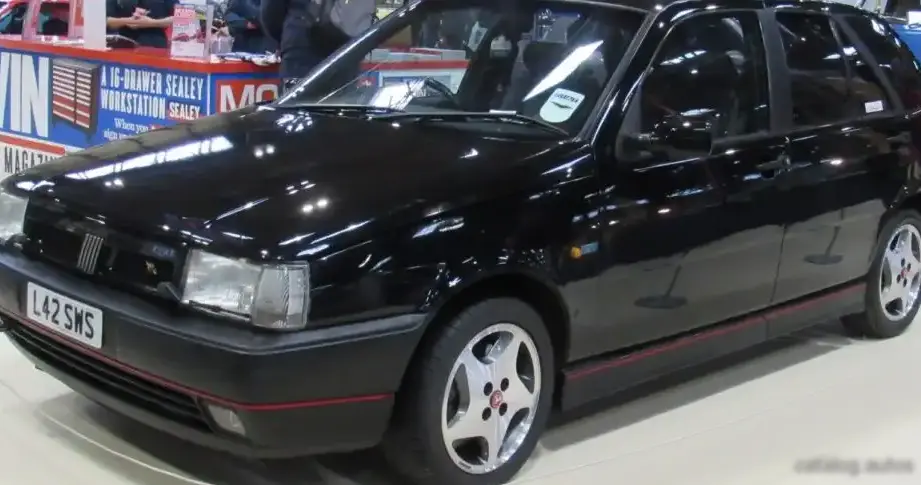
The Fiat Tipo (160) 1.7 D (160.AG), producing 58 horsepower, was a mainstay of the Tipo range, particularly in European markets, from 1988 to 1994. Positioned as the entry-level diesel variant, it offered economical transportation for buyers prioritizing fuel efficiency over outright performance. This model occupied a crucial space in the Tipo lineup, appealing to those seeking a practical and affordable family car. The Tipo (160) itself was a significant vehicle for Fiat, representing a move towards more modern design and engineering, replacing the aging Ritmo and Regata models. It was built on the Tipo Four platform, a front-wheel-drive architecture that would underpin several other Fiat and Lancia models.
Technical Specifications
| Brand | Fiat |
| Model | Tipo |
| Generation | Tipo (160) |
| Type (Engine) | 1.7 D (160.AG) (58 Hp) |
| Start of production | 1988 |
| End of production | 1994 |
| Powertrain Architecture | Internal Combustion engine |
| Body type | Hatchback |
| Seats | 5 |
| Doors | 3 |
| Fuel consumption (combined) | 6.1 l/100 km (38.6 US mpg, 46.3 UK mpg, 16.4 km/l) |
| Fuel Type | Diesel |
| Acceleration 0 – 100 km/h | 17.8 sec |
| Acceleration 0 – 62 mph | 17.8 sec |
| Acceleration 0 – 60 mph | 16.9 sec |
| Maximum speed | 150 km/h (93.21 mph) |
| Weight-to-power ratio | 18.3 kg/Hp, 54.7 Hp/tonne |
| Weight-to-torque ratio | 10.8 kg/Nm, 92.5 Nm/tonne |
| Power | 58 Hp @ 4600 rpm |
| Power per litre | 34.2 Hp/l |
| Torque | 98 Nm @ 2900 rpm (72.28 lb.-ft. @ 2900 rpm) |
| Engine layout | Front, Transverse |
| Engine Model/Code | 149 B4.000 |
| Engine displacement | 1697 cm3 (103.56 cu. in.) |
| Number of cylinders | 4 |
| Engine configuration | Inline |
| Cylinder Bore | 82.6 mm (3.25 in.) |
| Piston Stroke | 79.2 mm (3.12 in.) |
| Compression ratio | 20.5:1 |
| Number of valves per cylinder | 2 |
| Fuel injection system | Precombustion chamber injection |
| Engine aspiration | Naturally aspirated engine |
| Valvetrain | OHC |
| Engine oil capacity | 5 l (5.28 US qt | 4.4 UK qt) |
| Coolant | 8 l (8.45 US qt | 7.04 UK qt) |
| Kerb Weight | 1060 kg (2336.9 lbs.) |
| Trunk (boot) space – minimum | 350 l (12.36 cu. ft.) |
| Trunk (boot) space – maximum | 1100 l (38.85 cu. ft.) |
| Fuel tank capacity | 55 l (14.53 US gal | 12.1 UK gal) |
| Length | 3958 mm (155.83 in.) |
| Width | 1700 mm (66.93 in.) |
| Height | 1450 mm (57.09 in.) |
| Wheelbase | 2540 mm (100 in.) |
| Front track | 1436 mm (56.54 in.) |
| Rear (Back) track | 1415 mm (55.71 in.) |
| Drivetrain Architecture | The Internal combustion engine (ICE) drives the front wheels of the vehicle. |
| Drive wheel | Front wheel drive |
| Number of gears and type of gearbox | 5 gears, manual transmission |
| Front suspension | Spring Strut |
| Rear suspension | Coil spring |
| Front brakes | Disc |
| Rear brakes | Drum |
| Steering type | Steering rack and pinion |
| Tires size | 165/65 R14 T |
Powertrain & Engine Architecture
The heart of the Tipo 1.7 D was the 149 B4.000 engine, a 1.7-liter inline-four diesel. This engine utilized precombustion chamber injection, a common diesel technology of the era. This system involved injecting fuel into a small pre-chamber within the cylinder head, where it ignited and then ignited the main charge in the cylinder. This design aided in smoother combustion and reduced engine noise compared to direct injection systems of the time. The engine featured an overhead camshaft (OHC) valvetrain operating two valves per cylinder. The 58 horsepower output was modest, but the engine was known for its durability and relatively low maintenance requirements. The engine was paired with a five-speed manual transmission, chosen for its efficiency and cost-effectiveness. An automatic transmission was not offered with this engine.
Driving Characteristics
The 1.7 D Tipo was not designed for speed. Acceleration was leisurely, taking nearly 18 seconds to reach 60 mph. However, the engine provided adequate torque for everyday driving, making it suitable for city commutes and highway cruising, albeit with limited passing power. The five-speed manual transmission allowed drivers to keep the engine in its optimal power band, but frequent downshifting was often necessary, especially when encountering hills. Compared to the more powerful gasoline variants of the Tipo, the 1.7 D prioritized fuel economy and longevity over performance. The manual gearbox provided a more engaging driving experience than an automatic would have, but it also demanded more driver involvement.
Equipment & Trim Levels
The 1.7 D typically represented the base trim level within the Tipo range. Standard equipment generally included basic cloth upholstery, a simple dashboard layout, and manual windows and door locks. Power steering was often an optional extra, as were features like a radio and upgraded interior trim. The focus was on providing a functional and affordable vehicle, so luxury features were kept to a minimum. The interior was designed with practicality in mind, offering a reasonable amount of space for passengers and luggage. The 350-liter trunk (expanding to 1100 liters with the rear seats folded) provided ample cargo capacity for a vehicle of its size.
Chassis & Braking
The Tipo 1.7 D utilized a relatively simple chassis design. Front suspension consisted of MacPherson strut springs, while the rear employed a coil spring setup. Front brakes were discs, providing adequate stopping power, while the rear brakes were drums, a cost-saving measure common in entry-level models of the time. The steering was a rack and pinion system, offering reasonable precision. The suspension was tuned for comfort rather than sporty handling, providing a compliant ride on most road surfaces. Stabilizer bars were often omitted from the base trim level to further reduce costs.
Market Reception & Comparison
The Fiat Tipo 1.7 D was well-received in European markets as an economical and reliable family car. Critics praised its fuel efficiency and durability, but noted its lack of performance. Compared to the gasoline-powered Tipo variants, the 1.7 D offered significantly better fuel economy but considerably slower acceleration. Against competitors like the Volkswagen Golf Diesel and Peugeot 205 Diesel, the Tipo 1.7 D offered a competitive price point and a spacious interior. Its precombustion chamber diesel engine, while not as refined as some contemporary designs, proved to be robust and relatively easy to maintain.
Legacy
The Fiat Tipo 1.7 D has earned a reputation for long-term reliability, particularly its engine. Many examples remain on the road today, testament to its robust construction. In the used car market, these models are often sought after by those looking for a simple, affordable, and economical vehicle. While not a performance icon, the Tipo 1.7 D played a significant role in providing affordable transportation to a wide range of buyers during the late 1980s and early 1990s. Its enduring popularity among classic car enthusiasts and budget-conscious drivers alike ensures its place in automotive history.
