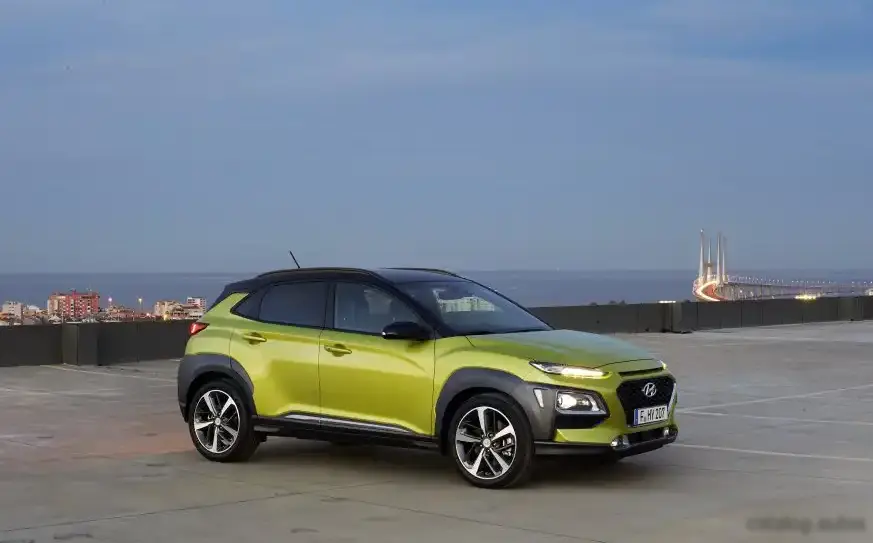
The Hyundai Kona I 1.6 CRDi (136 Hp) 4WD DCT is a compact sport utility vehicle (SUV) produced by the South Korean manufacturer Hyundai from 2018 to September 2020. This variant occupied a significant position within the first generation (Kona I) lineup, offering a blend of fuel efficiency, all-wheel-drive capability, and a convenient dual-clutch transmission (DCT). It was aimed at buyers seeking a versatile and economical crossover with enhanced traction for varied weather conditions. The Kona, as a whole, represented Hyundai’s entry into the rapidly growing subcompact SUV segment, competing with vehicles like the Mazda CX-3 and Honda HR-V.
Technical Specifications
| Brand | Hyundai |
| Model | Kona |
| Generation | Kona I |
| Type (Engine) | 1.6 CRDi (136 Hp) 4WD DCT |
| Start of production | 2018 |
| End of production | September, 2020 |
| Powertrain Architecture | Internal Combustion engine |
| Body type | SUV |
| Seats | 5 |
| Doors | 5 |
| Fuel consumption (urban) | 5.0-5.3 l/100 km (47 – 44.4 US mpg, 56.5 – 53.3 UK mpg, 20 – 18.9 km/l) |
| Fuel consumption (extra urban) | 4.5-4.8 l/100 km (52.3 – 49 US mpg, 62.8 – 58.9 UK mpg, 22.2 – 20.8 km/l) |
| Fuel consumption (combined) | 4.6-4.9 l/100 km (51.1 – 48 US mpg, 61.4 – 57.6 UK mpg, 21.7 – 20.4 km/l) |
| CO2 emissions | 119-127 g/km |
| Fuel Type | Diesel |
| Acceleration 0 – 100 km/h | 11.2 sec |
| Acceleration 0 – 62 mph | 11.2 sec |
| Acceleration 0 – 60 mph | 10.6 sec |
| Maximum speed | 186 km/h (115.58 mph) |
| Emission standard | Euro 6d |
| Weight-to-power ratio | 11 kg/Hp, 90.8 Hp/tonne |
| Weight-to-torque ratio | 4.7 kg/Nm, 213.8 Nm/tonne |
| Power | 136 Hp @ 4000 rpm |
| Torque | 320 Nm @ 1750-2250 rpm (236.02 lb.-ft. @ 1750-2250 rpm) |
| Engine layout | Front, Transverse |
| Engine Model/Code | Smartstream / D4FE |
| Engine displacement | 1598 cm3 (97.52 cu. in.) |
| Number of cylinders | 4 |
| Engine configuration | Inline |
| Cylinder Bore | 77 mm (3.03 in.) |
| Piston Stroke | 85.8 mm (3.38 in.) |
| Compression ratio | 15.9:1 |
| Number of valves per cylinder | 4 |
| Fuel injection system | Diesel Commonrail |
| Engine aspiration | Turbocharger, Intercooler |
| Engine oil capacity | 5.3 l (5.6 US qt | 4.66 UK qt) |
| Coolant | 7.8 l (8.24 US qt | 6.86 UK qt) |
| Kerb Weight | 1497-1611 kg (3300.32 – 3551.65 lbs.) |
| Max. weight | 1950 kg (4299.01 lbs.) |
| Max load | 339-453 kg (747.37 – 998.69 lbs.) |
| Trunk (boot) space – minimum | 361 l (12.75 cu. ft.) |
| Trunk (boot) space – maximum | 1143 l (40.36 cu. ft.) |
| Fuel tank capacity | 50 l (13.21 US gal | 11 UK gal) |
| Max. roof load | 80 kg (176.37 lbs.) |
| Permitted trailer load with brakes (12%) | 1250 kg (2755.78 lbs.) |
| Permitted trailer load without brakes | 600 kg (1322.77 lbs.) |
| Permitted towbar download | 80 kg (176.37 lbs.) |
| Length | 4165 mm (163.98 in.) |
| Width | 1800 mm (70.87 in.) |
| Width including mirrors | 2070 mm (81.5 in.) |
| Height | 1565 mm (61.61 in.) |
| Wheelbase | 2600 mm (102.36 in.) |
| Front track | 1559-1575 mm (61.38 – 62.01 in.) |
| Rear (Back) track | 1568-1584 mm (61.73 – 62.36 in.) |
| Front overhang | 845 mm (33.27 in.) |
| Rear overhang | 720 mm (28.35 in.) |
| Ride height (ground clearance) | 177.5 mm (6.99 in.) |
| Drag coefficient (Cd) | 0.33 |
| Minimum turning circle (turning diameter) | 10.6 m (34.78 ft.) |
| Approach angle | 15.7° |
| Departure angle | 29.6° |
| Ramp-over (brakeover) angle | 16.7° |
| Wading depth | 500 mm (19.69 in.) |
| Drive wheel | All wheel drive (4×4) |
| Number of gears and type of gearbox | 7 gears, automatic transmission DCT |
| Front suspension | Independent, type McPherson with coil spring and anti-roll bar |
| Rear suspension | independent torsion suspension |
| Front brakes | Ventilated discs |
| Rear brakes | Disc |
| Assisting systems | ABS (Anti-lock braking system) |
| Steering type | Steering rack and pinion |
| Power steering | Electric Steering |
| Tires size | 205/60 R16; 215/55 R17; 235/45 R18 |
| Wheel rims size | 6.5J x 16; 7.0J x 17; 7.5J x 18 |
Powertrain & Engine Architecture
The Kona 1.6 CRDi 4WD DCT is powered by Hyundai’s Smartstream 1.6-liter four-cylinder diesel engine, internally designated as the D4FE. This engine utilizes a common-rail direct injection system, delivering fuel at extremely high pressure for optimized combustion. A turbocharger with an intercooler is employed to boost power and torque, mitigating turbo lag and improving responsiveness. The engine produces 136 horsepower at 4,000 rpm and 320 Nm (236 lb-ft) of torque between 1,750 and 2,250 rpm. The engine features a cast iron block and aluminum cylinder head, contributing to its durability. The dual-clutch transmission (DCT) is a seven-speed unit, offering quick and smooth gear changes. This DCT is known for its efficiency and responsiveness compared to traditional automatic transmissions.
Driving Characteristics
The 1.6 CRDi with the DCT provides a comfortable and refined driving experience. While not exceptionally quick – achieving 0-60 mph in around 10.6 seconds – the engine delivers ample torque for everyday driving situations. The DCT contributes to brisk acceleration, particularly during overtaking maneuvers. The all-wheel-drive system enhances traction, especially on slippery surfaces, providing a secure feel. Compared to the base 1.0-liter turbocharged gasoline engine, the 1.6 CRDi offers significantly more torque, resulting in stronger pulling power. However, it lacks the outright punch of higher-spec gasoline engines available in the Kona range. The DCT’s gear ratios are tuned for fuel efficiency, prioritizing smooth transitions over aggressive shifts.
Equipment & Trim Levels
The 1.6 CRDi 4WD DCT trim typically included a generous array of standard features. These commonly included air conditioning, a touchscreen infotainment system with Apple CarPlay and Android Auto compatibility, Bluetooth connectivity, and a suite of safety features such as lane departure warning, forward collision avoidance assist, and automatic emergency braking. Interior upholstery was typically cloth, with options for leather upgrades. Higher trim levels offered features like heated seats, a sunroof, and upgraded audio systems. The Kona’s interior design is modern and functional, with a focus on user-friendliness.
Chassis & Braking
The Kona utilizes a McPherson strut front suspension and a torsion beam rear suspension. This setup provides a good balance between ride comfort and handling. The all-wheel-drive system adds to the vehicle’s stability and cornering ability. Braking duties are handled by ventilated discs at the front and solid discs at the rear. The Kona is equipped with ABS (Anti-lock Braking System) and Electronic Stability Control (ESC) as standard safety features. The steering is electrically assisted, providing a light and responsive feel.
Market Reception & Comparison
The Hyundai Kona 1.6 CRDi 4WD DCT was generally well-received by automotive critics. It was praised for its fuel efficiency, comfortable ride, and practical interior. The all-wheel-drive system was a significant selling point for buyers in regions with inclement weather. Compared to other trims in the Kona lineup, the 1.6 CRDi offered a compelling balance of performance and economy. While the gasoline engines were more affordable, they lacked the torque and fuel efficiency of the diesel. The 1.6 CRDi’s fuel economy figures of 4.6-4.9 l/100 km (51.1-48 US mpg) were particularly attractive to buyers prioritizing running costs.
Legacy
The Hyundai Kona I 1.6 CRDi 4WD DCT has proven to be a reliable and durable vehicle. The Smartstream diesel engine, while subject to the general concerns surrounding diesel emissions, has demonstrated good longevity when properly maintained. The DCT transmission, while requiring occasional servicing, is generally robust. On the used car market, these Konas hold their value reasonably well, particularly those with lower mileage and a full service history. The combination of all-wheel drive, fuel efficiency, and practicality makes it a popular choice for buyers seeking a versatile and economical compact SUV.