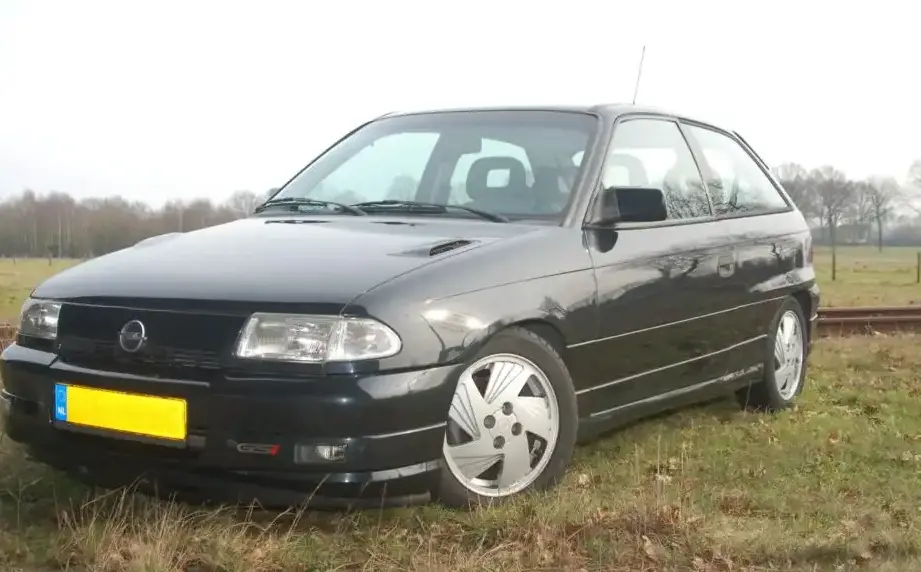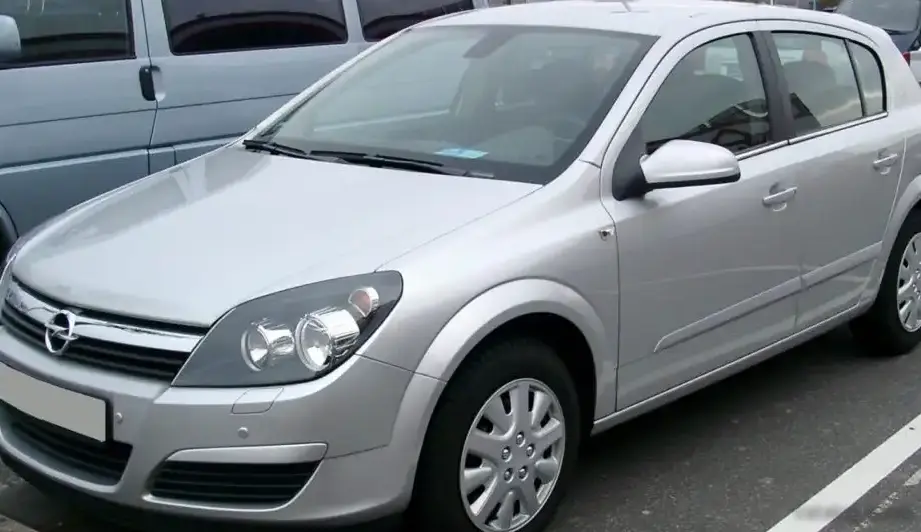
The Opel Astra H 1.3 CDTI, producing 90 horsepower, was a key variant within the broader Astra H range (2004-2009). Introduced in 2005 and remaining in production through 2006, this model served as an entry-level diesel option, primarily aimed at economy-minded buyers in the European market. It was positioned within the H generation, which represented a significant step forward for the Astra, built on the GM Delta platform (also known as the 1HX0/A3 platform) and offering improved refinement and safety features compared to its predecessor. This particular engine and transmission combination offered a balance between fuel efficiency and practicality, making it a popular choice for daily commuting and longer journeys.
Technical Specifications
| Brand | Opel |
| Model | Astra |
| Generation | Astra H |
| Type (Engine) | 1.3 CDTI (90 Hp) |
| Start of production | 2005 |
| End of production | 2006 |
| Powertrain Architecture | Internal Combustion engine |
| Body type | Hatchback |
| Seats | 5 |
| Doors | 5 |
| Fuel consumption (urban) | 6.2 l/100 km (37.9 US mpg, 45.6 UK mpg, 16.1 km/l) |
| Fuel consumption (extra urban) | 4 l/100 km (58.8 US mpg, 70.6 UK mpg, 25 km/l) |
| Fuel consumption (combined) | 4.8 l/100 km (49 US mpg, 58.9 UK mpg, 20.8 km/l) |
| CO2 emissions | 130 g/km |
| Fuel Type | Diesel |
| Acceleration 0 – 100 km/h | 13.7 sec |
| Acceleration 0 – 62 mph | 13.7 sec |
| Acceleration 0 – 60 mph | 13 sec |
| Maximum speed | 172 km/h (106.88 mph) |
| Weight-to-power ratio | 13.7 kg/Hp, 73.2 Hp/tonne |
| Weight-to-torque ratio | 6.2 kg/Nm, 162.6 Nm/tonne |
| Power | 90 Hp @ 4000 rpm |
| Power per litre | 72.1 Hp/l |
| Torque | 200 Nm @ 1750 rpm (147.51 lb.-ft. @ 1750 rpm) |
| Engine layout | Front, Transverse |
| Engine Model/Code | Z13DTH |
| Engine displacement | 1248 cm3 (76.16 cu. in.) |
| Number of cylinders | 4 |
| Engine configuration | Inline |
| Cylinder Bore | 69.6 mm (2.74 in.) |
| Piston Stroke | 82 mm (3.23 in.) |
| Compression ratio | 18.4:1 |
| Number of valves per cylinder | 4 |
| Fuel injection system | Diesel Commonrail |
| Engine aspiration | Turbocharger, Intercooler |
| Valvetrain | DOHC |
| Engine oil capacity | 3.1 l (3.28 US qt | 2.73 UK qt) |
| Coolant | 6.8 l (7.19 US qt | 5.98 UK qt) |
| Kerb Weight | 1230 kg (2711.69 lbs.) |
| Max. weight | 1805 kg (3979.34 lbs.) |
| Max load | 575 kg (1267.66 lbs.) |
| Trunk (boot) space – minimum | 380 l (13.42 cu. ft.) |
| Trunk (boot) space – maximum | 1330 l (46.97 cu. ft.) |
| Fuel tank capacity | 52 l (13.74 US gal | 11.44 UK gal) |
| Length | 4249 mm (167.28 in.) |
| Width | 1753 mm (69.02 in.) |
| Width including mirrors | 2033 mm (80.04 in.) |
| Height | 1467 mm (57.76 in.) |
| Wheelbase | 2614 mm (102.91 in.) |
| Front track | 1488 mm (58.58 in.) |
| Rear (Back) track | 1488 mm (58.58 in.) |
| Front overhang | 871 mm (34.29 in.) |
| Rear overhang | 764 mm (30.08 in.) |
| Ride height (ground clearance) | 160 mm (6.3 in.) |
| Drag coefficient (Cd) | 0.32 |
| Drivetrain Architecture | The Internal combustion engine (ICE) drives the front wheels of the vehicle. |
| Drive wheel | Front wheel drive |
| Number of gears and type of gearbox | 6 gears, manual transmission |
| Front suspension | Spring Strut |
| Rear suspension | Spring Strut |
| Front brakes | Ventilated discs |
| Rear brakes | Disc |
| Assisting systems | ABS (Anti-lock braking system) |
| Steering type | Steering rack and pinion |
| Tires size | 195/65 R15 |
| Wheel rims size | 6.5J x 15 |
Powertrain & Engine Architecture
The heart of the Astra H 1.3 CDTI 90 was the Z13DTH engine, a 1.3-liter inline-four cylinder diesel. This engine was part of Opel/Fiat’s family of small-displacement diesel engines, known for their fuel efficiency. The Z13DTH featured a common rail direct injection system, delivering fuel at extremely high pressure for optimized combustion. A turbocharger with an intercooler was employed to boost power output, overcoming the limitations of the small displacement. The engine utilized a double overhead camshaft (DOHC) valvetrain with four valves per cylinder, enhancing breathing and contributing to improved performance. The 6-speed manual transmission was the standard offering, chosen for its efficiency and driver engagement. The gear ratios were tuned to maximize fuel economy and provide adequate acceleration for everyday driving.
Driving Characteristics
The 1.3 CDTI 90 hp variant of the Astra H offered a decidedly economy-focused driving experience. Acceleration was modest, with a 0-62 mph (0-100 km/h) time of around 13.7 seconds. While not sporty, the engine provided sufficient torque (200 Nm or 147 lb-ft) at relatively low RPMs, making it suitable for overtaking and navigating urban traffic. The manual transmission allowed for precise control, but required frequent shifting to maintain momentum. Compared to the more powerful 1.8-liter petrol or 1.9-liter CDTI variants, the 1.3 CDTI felt noticeably slower, but it excelled in fuel efficiency, achieving combined fuel economy figures of around 4.8 l/100 km (49 US mpg). The suspension was tuned for comfort, providing a reasonably smooth ride, although it wasn’t as engaging as the setups found in higher-spec Astra models.
Equipment & Trim Levels
The Astra H 1.3 CDTI 90 typically came with a base level of equipment, reflecting its position as the entry-level diesel model. Standard features generally included power steering, central locking, electric front windows, and an ABS anti-lock braking system. Interior upholstery was typically cloth, and the dashboard featured a functional, if somewhat basic, design. Optional extras included air conditioning, alloy wheels, a CD player, and upgraded trim levels with additional comfort and convenience features. The trim levels varied slightly depending on the specific market, but generally followed a progression from ‘Essentia’ to ‘Enjoy’ and ‘Cosmo’, with each step up offering more features and refinements.
Chassis & Braking
The Astra H 1.3 CDTI utilized a MacPherson strut suspension setup at the front and a torsion beam suspension at the rear. This configuration provided a good balance between ride comfort and handling. The braking system consisted of ventilated discs at the front and solid discs at the rear, providing adequate stopping power for the vehicle’s weight and performance. The ABS system helped to maintain control during emergency braking situations. The steering was a rack and pinion system, offering precise and responsive steering feel.
Market Reception & Comparison
The Astra H 1.3 CDTI 90 was generally well-received by critics as a practical and economical choice. It was praised for its fuel efficiency and low running costs, making it an attractive option for budget-conscious buyers. However, it was also criticized for its relatively slow acceleration and lack of refinement compared to more powerful and expensive Astra variants. Compared to the 1.8-liter petrol engine, the 1.3 CDTI offered significantly better fuel economy but less power. The 1.9-liter CDTI provided a more compelling performance upgrade, but at a higher price point. The Astra H 1.3 CDTI competed with other small-family hatchbacks such as the Ford Focus, Volkswagen Golf, and Renault Megane.
Legacy
The Z13DTH engine, while not known for being a powerhouse, proved to be relatively reliable when properly maintained. Common issues included turbocharger wear and potential problems with the diesel particulate filter (DPF) if the vehicle was primarily used for short journeys. Today, the Astra H 1.3 CDTI 90 can be found on the used car market at affordable prices. It remains a viable option for those seeking a fuel-efficient and practical hatchback, but potential buyers should be aware of the potential maintenance costs associated with a diesel engine and the importance of regular servicing. Its enduring appeal lies in its simplicity, economy, and relatively low cost of ownership.