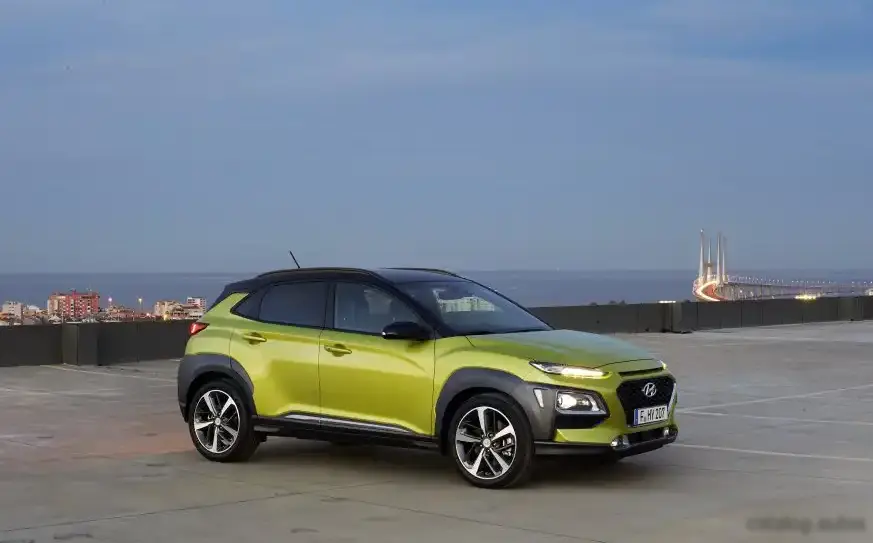
The Hyundai Kona 1.6 T-GDI Automatic, produced from 2017 to September 2020, represents a significant entry in Hyundai’s burgeoning SUV lineup. Positioned as a mid-range offering within the first generation (Kona I) of the Kona, this variant combined a turbocharged gasoline engine with a dual-clutch transmission (DCT) to deliver a balance of performance and fuel efficiency. The Kona, designed as a subcompact crossover, aimed to attract a younger demographic with its distinctive styling and available technology. This specific 1.6 T-GDI Automatic model was primarily marketed in Europe and other global markets, offering a compelling alternative to established competitors like the Nissan Juke and Renault Captur.
Technical Specifications
| Brand | Hyundai |
| Model | Kona |
| Generation | Kona I |
| Type (Engine) | 1.6 T-GDI (177 Hp) Automatic |
| Start of production | 2017 |
| End of production | September, 2020 |
| Powertrain Architecture | Internal Combustion engine |
| Body type | SUV |
| Seats | 5 |
| Doors | 5 |
| Fuel Type | Petrol (Gasoline) |
| Maximum speed | 205 km/h (127.38 mph) |
| Emission standard | Euro 6 |
| Weight-to-power ratio | 7.8 kg/Hp, 128.3 Hp/tonne |
| Weight-to-torque ratio | 5.2 kg/Nm, 191.3 Nm/tonne |
| Power | 177 Hp @ 5500 rpm |
| Power per litre | 111.3 Hp/l |
| Torque | 264 Nm @ 1500-4500 rpm (194.72 lb.-ft. @ 1500-4500 rpm) |
| Engine layout | Front, Transverse |
| Engine Model/Code | Gamma II / G4FJ |
| Engine displacement | 1591 cm3 (97.09 cu. in.) |
| Number of cylinders | 4 |
| Engine configuration | Inline |
| Cylinder Bore | 77 mm (3.03 in.) |
| Piston Stroke | 85.44 mm (3.36 in.) |
| Compression ratio | 10:1 |
| Number of valves per cylinder | 4 |
| Fuel injection system | Direct injection |
| Engine aspiration | Turbocharger, Intercooler |
| Valvetrain | DOHC, D-CVVT |
| Engine oil capacity | 4.5 l (4.76 US qt | 3.96 UK qt) |
| Coolant | 7.1 l (7.5 US qt | 6.25 UK qt) |
| Kerb Weight | 1380-1418 kg (3042.38 – 3126.15 lbs.) |
| Max. weight | 1835 kg (4045.48 lbs.) |
| Max load | 417-455 kg (919.33 – 1003.1 lbs.) |
| Trunk (boot) space – minimum | 544 l (19.21 cu. ft.) |
| Trunk (boot) space – maximum | 1297 l (45.8 cu. ft.) |
| Fuel tank capacity | 50 l (13.21 US gal | 11 UK gal) |
| Length | 4165 mm (163.98 in.) |
| Width | 1801 mm (70.91 in.) |
| Height | 1565 mm (61.61 in.) |
| Wheelbase | 2600 mm (102.36 in.) |
| Front track | 1560 mm (61.42 in.) |
| Rear (Back) track | 1567 mm (61.69 in.) |
| Front overhang | 846 mm (33.31 in.) |
| Rear overhang | 719 mm (28.31 in.) |
| Ride height (ground clearance) | 170 mm (6.69 in.) |
| Drag coefficient (Cd) | 0.32 |
| Minimum turning circle (turning diameter) | 10.6 m (34.78 ft.) |
| Drivetrain Architecture | The Internal combustion engine (ICE) drives the front wheels of the vehicle. |
| Drive wheel | Front wheel drive |
| Number of gears and type of gearbox | 7 gears, automatic transmission DCT |
| Front suspension | Independent, type McPherson with coil spring and anti-roll bar |
| Rear suspension | Torsion |
| Front brakes | Ventilated discs |
| Rear brakes | Disc |
| Assisting systems | ABS (Anti-lock braking system) |
| Steering type | Steering rack and pinion |
| Power steering | Electric Steering |
| Tires size | 235/45 R18 |
| Wheel rims size | 7.5J x 18 |
Powertrain & Engine Architecture
At the heart of the Kona 1.6 T-GDI Automatic lies the Hyundai Gamma II engine, specifically the G4FJ code. This 1.6-liter inline-four cylinder engine utilizes direct fuel injection and a single turbocharger with an intercooler to boost power output. The engine employs a Double Overhead Camshaft (DOHC) valvetrain with Hyundai’s Dual Continuously Variable Valve Timing (D-CVVT) technology, optimizing valve timing for improved efficiency and responsiveness. The 7-speed Dual Clutch Transmission (DCT) was a key component, offering quicker and smoother gear changes compared to a traditional automatic transmission. This DCT, sourced from Hyundai’s own development, contributed to the vehicle’s overall driving experience and fuel economy. The engine is transversely mounted, driving the front wheels.
Driving Characteristics
The 177 horsepower and 194.72 lb.-ft. of torque delivered by the 1.6 T-GDI engine, coupled with the 7-speed DCT, provided a reasonably spirited driving experience. While not a performance-oriented trim, the Kona 1.6 T-GDI Automatic offered adequate acceleration for everyday driving and highway merging. The DCT’s quick shifts helped to keep the engine in its optimal power band. Compared to the base engine options, this variant provided a noticeable improvement in performance. However, it didn’t match the responsiveness of a manual transmission or the higher output of potential performance trims. The gear ratios were tuned for a balance between acceleration and fuel efficiency, prioritizing usability over outright speed.
Equipment & Trim Levels
The Kona 1.6 T-GDI Automatic typically came equipped with a respectable level of standard features. These included air conditioning, power windows and locks, a touchscreen infotainment system with Bluetooth connectivity, and a suite of safety features like ABS, Electronic Stability Control, and multiple airbags. Interior upholstery was generally cloth, with options for leather upgrades available. Higher trim levels within the 1.6 T-GDI range offered features like a sunroof, heated seats, a premium audio system, and advanced driver-assistance systems such as lane departure warning and automatic emergency braking. Dashboard configuration was modern and driver-focused, with a clear instrument cluster and intuitive controls.
Chassis & Braking
The Kona’s chassis featured an independent McPherson strut suspension in the front, providing a comfortable ride and responsive handling. The rear suspension utilized a torsion beam setup, a cost-effective solution that offered a good balance of ride quality and space efficiency. Braking duties were handled by ventilated discs at the front and solid discs at the rear. The ABS system ensured safe and controlled braking in various conditions. The steering system employed an electric power steering (EPS) setup, providing light and precise steering feel. Stabilizer bars were included both front and rear to reduce body roll during cornering.
Market Reception & Comparison
The Hyundai Kona 1.6 T-GDI Automatic was generally well-received by automotive critics. Reviewers praised its stylish design, comfortable interior, and engaging driving dynamics. The 1.6 T-GDI engine was considered a good compromise between performance and fuel economy. Compared to lower-powered Kona variants, the 1.6 T-GDI offered a more refined and enjoyable driving experience. Fuel economy figures were competitive within the subcompact SUV segment, typically achieving around 30-35 mpg combined. Reliability reports have been generally positive, with few major issues reported with the powertrain.
Legacy
The Hyundai Kona 1.6 T-GDI Automatic has proven to be a reliable and durable vehicle in the used car market. The Gamma II engine, while not without its minor quirks, has demonstrated good long-term reliability when properly maintained. The DCT transmission, however, requires regular servicing to ensure optimal performance. Today, these models represent a good value proposition for buyers seeking a stylish, fuel-efficient, and well-equipped subcompact SUV. The Kona’s success helped establish Hyundai as a major player in the competitive crossover market, paving the way for future models and innovations.