
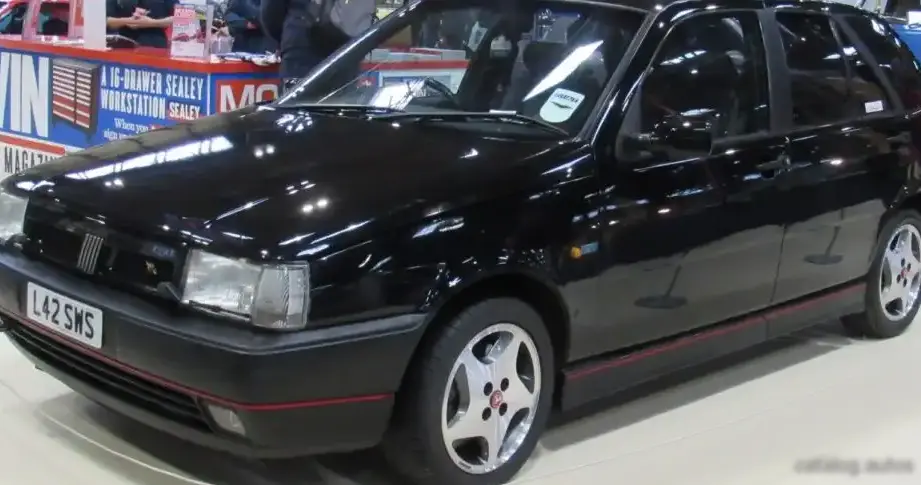
The Fiat Tipo (160) 1.9 D, producing 65 horsepower, was a mainstay of the Tipo range from 1990 to 1993. Positioned as the entry-level diesel variant, it offered economical transportation within the broader Tipo family, which was Fiat’s replacement for the aging Ritmo. The Tipo (160) itself represented a significant step forward for Fiat in terms of design and engineering, moving away from the sharp angles of the 1980s towards a more rounded, contemporary aesthetic. This particular diesel model was primarily aimed at buyers prioritizing fuel efficiency and practicality over outright performance, particularly in European markets where diesel engines were gaining popularity due to favorable taxation and fuel costs.
Technical Specifications
| Brand | Fiat |
| Model | Tipo |
| Generation | Tipo (160) |
| Type (Engine) | 1.9 D (65 Hp) |
| Start of production | 1990 |
| End of production | 1993 |
| Powertrain Architecture | Internal Combustion engine |
| Body type | Hatchback |
| Seats | 5 |
| Doors | 3-5 |
| Fuel consumption (urban) | 6.7 l/100 km (35.1 US mpg, 42.2 UK mpg, 14.9 km/l) |
| Fuel consumption (extra urban) | 4.9 l/100 km (48 US mpg, 57.6 UK mpg, 20.4 km/l) |
| Fuel consumption (combined) | 6.7 l/100 km (35.1 US mpg, 42.2 UK mpg, 14.9 km/l) |
| Fuel Type | Diesel |
| Acceleration 0 – 100 km/h | 17.8 sec |
| Acceleration 0 – 62 mph | 17.8 sec |
| Acceleration 0 – 60 mph | 16.9 sec |
| Maximum speed | 150 km/h (93.21 mph) |
| Weight-to-power ratio | 16.3 kg/Hp |
| Weight-to-torque ratio | 8.9 kg/Nm |
| Power | 65 Hp @ 4600 rpm |
| Power per litre | 33.7 Hp/l |
| Torque | 119 Nm @ 2000 rpm (87.77 lb.-ft. @ 2000 rpm) |
| Engine layout | Front, Transverse |
| Engine Model/Code | 160 A7.000 |
| Engine displacement | 1929 cm3 (117.71 cu. in.) |
| Number of cylinders | 4 |
| Engine configuration | Inline |
| Cylinder Bore | 82.6 mm (3.25 in.) |
| Piston Stroke | 90 mm (3.54 in.) |
| Compression ratio | 21:1 |
| Number of valves per cylinder | 2 |
| Fuel injection system | Precombustion chamber injection |
| Engine aspiration | Naturally aspirated |
| Valvetrain | OHC |
| Engine oil capacity | 5 l (5.28 US qt | 4.4 UK qt) |
| Coolant capacity | 8.8 l (9.3 US qt | 7.74 UK qt) |
| Kerb Weight | 1060 kg (2336.9 lbs.) |
| Max. weight | 1590 kg (3505.35 lbs.) |
| Max load | 530 kg (1168.45 lbs.) |
| Trunk (boot) space – minimum | 350 l (12.36 cu. ft.) |
| Trunk (boot) space – maximum | 710 l (25.07 cu. ft.) |
| Fuel tank capacity | 48 l (12.68 US gal | 10.56 UK gal) |
| Length | 3958 mm (155.83 in.) |
| Width | 1700 mm (66.93 in.) |
| Height | 1450 mm (57.09 in.) |
| Wheelbase | 2540 mm (100 in.) |
| Front track | 1429 mm (56.26 in.) |
| Rear track | 1415 mm (55.71 in.) |
| Drivetrain Architecture | Front wheel drive |
| Number of gears | 5 |
| Gearbox type | Manual transmission |
| Front suspension | Spring Strut |
| Rear suspension | Coil spring |
| Front brakes | Disc |
| Rear brakes | Drum |
| Assisting systems | ABS (Anti-lock braking system) |
| Steering type | Steering rack and pinion |
| Tires size | 165/70 R13 |
Powertrain & Engine Architecture
The heart of the Tipo 1.9 D was the 160 A7.000 engine, a 1929cc inline-four diesel. This engine utilized precombustion chamber injection, a common diesel technology of the era. This system involved injecting fuel into a small precombustion chamber connected to the main cylinder, where it ignited before entering the main combustion chamber, promoting more complete combustion. The engine featured an overhead camshaft (OHC) valvetrain operating two valves per cylinder. The 1.9-liter diesel produced 65 horsepower at 4600 rpm and 119 Nm (87.77 lb-ft) of torque at 2000 rpm. The engine was transversely mounted, driving the front wheels. The transmission was a five-speed manual, chosen for its simplicity and cost-effectiveness in this entry-level model.
Driving Characteristics
The Tipo 1.9 D Automatic was not designed for spirited driving. Acceleration was leisurely, taking approximately 17.8 seconds to reach 62 mph (100 km/h). Top speed was around 93 mph (150 km/h). The focus was on fuel economy and low-speed torque. The five-speed manual transmission offered a reasonable spread of gears, but the engine’s limited power meant frequent downshifts were necessary, especially when overtaking or climbing hills. Compared to the more powerful petrol versions of the Tipo, the 1.9 D felt significantly slower. However, it offered a more relaxed driving experience at cruising speeds, thanks to its low engine speeds and ample torque.
Equipment & Trim Levels
The 1.9 D typically represented the base trim level within the Tipo range. Standard equipment generally included basic cloth upholstery, a simple dashboard layout, and manual windows and door locks. Power steering was often an optional extra. Air conditioning was rarely fitted to this base model. The interior was functional and durable, prioritizing practicality over luxury. Optional extras could include a radio/cassette player and upgraded seat fabrics.
Chassis & Braking
The Tipo 1.9 D utilized a relatively simple chassis design. Front suspension consisted of MacPherson strut springs, while the rear employed a coil spring setup. Brakes were discs on the front wheels and drums on the rear, a common configuration for vehicles in this price range at the time. ABS (Anti-lock Braking System) was available as an option, enhancing safety. The suspension was tuned for comfort, providing a reasonably compliant ride, although it could feel somewhat wallowy when pushed hard. The relatively light weight of the diesel engine helped to maintain a balanced handling characteristic.
Market Reception & Comparison
The Tipo 1.9 D was well-received in markets where diesel cars were popular, such as Italy, France, and Germany. Critics praised its fuel efficiency and low running costs. However, its lack of performance was often noted. Compared to the petrol-powered Tipo variants, the 1.9 D offered significantly better fuel economy but considerably slower acceleration. Against competitors like the Volkswagen Golf Diesel and Peugeot 205 Diesel, the Tipo 1.9 D offered a competitive package in terms of price and fuel efficiency, although it often lagged behind in terms of refinement and performance.
Legacy
The Fiat Tipo 1.9 D, while not a performance icon, proved to be a reliable and economical workhorse for many owners. The 160 A7.000 engine, while simple in design, was generally robust and capable of high mileage with proper maintenance. Today, these cars are relatively rare, and well-maintained examples are sought after by enthusiasts and collectors. The Tipo 1.9 D represents a significant chapter in Fiat’s history, showcasing the company’s commitment to providing affordable and practical transportation to a wide range of customers. Its enduring appeal lies in its simplicity, durability, and fuel efficiency, qualities that remain desirable even in the modern automotive landscape.
