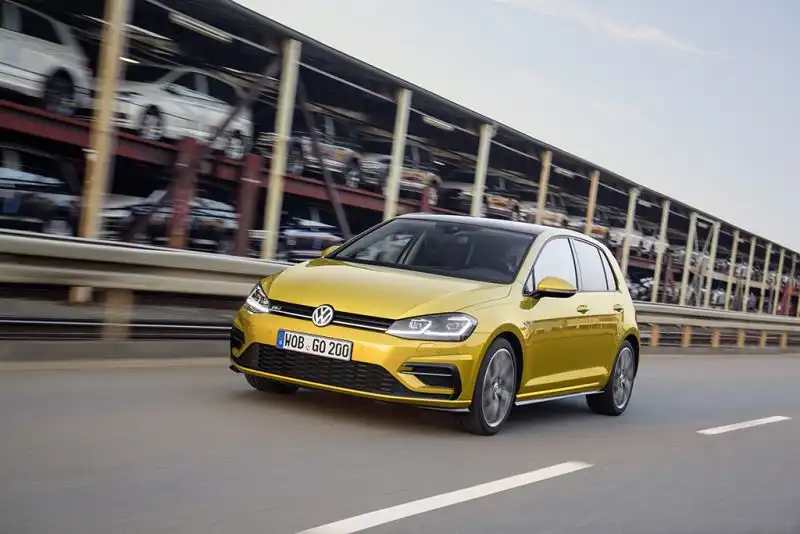
The Volkswagen Golf VII, specifically the 5-door hatchback produced from 2017 to 2019, represents a mid-cycle refresh of the seventh-generation Golf. This iteration, designated as a facelift, brought updated styling, enhanced technology, and refined engine options. Among these, the 2.0 TDI variant producing 150 horsepower (Hp) was a significant offering, particularly in European markets where diesel engines remained highly popular. This model occupied a middle ground in the Golf VII lineup, offering a balance between fuel efficiency, performance, and equipment levels. It served as a step up from the lower-powered diesel options and a more economical alternative to the gasoline-powered GTI.
Technical Specifications
| Brand | Volkswagen |
| Model | Golf |
| Generation | Golf VII (5-door, facelift 2017) |
| Type (Engine) | 2.0 TDI (150 Hp) |
| Start of production | 2017 |
| End of production | 2019 |
| Powertrain Architecture | Internal Combustion engine |
| Body type | Hatchback |
| Seats | 5 |
| Doors | 5 |
| Fuel consumption (urban) | 5.0-5.1 l/100 km (47 – 46.1 US mpg) |
| Fuel consumption (extra urban) | 3.7-3.8 l/100 km (63.6 – 61.9 US mpg) |
| Fuel consumption (combined) | 4.2-4.3 l/100 km (56 – 54.7 US mpg) |
| CO2 emissions | 109-111 g/km |
| Fuel Type | Diesel |
| Acceleration 0 – 100 km/h | 8.6 sec |
| Acceleration 0 – 62 mph | 8.6 sec |
| Acceleration 0 – 60 mph | 8.2 sec |
| Maximum speed | 216 km/h (134.22 mph) |
| Emission standard | Euro 6 |
| Weight-to-power ratio | 8.6 kg/Hp |
| Weight-to-torque ratio | 3.8 kg/Nm |
| Power | 150 Hp @ 3500-4000 rpm |
| Torque | 340 Nm @ 1750-3000 rpm (250.77 lb.-ft.) |
| Engine layout | Front, Transverse |
| Engine Model/Code | CRLB, DCYA, DEJA, DFGA |
| Engine displacement | 1968 cm3 (120.09 cu. in.) |
| Number of cylinders | 4 |
| Engine configuration | Inline |
| Number of valves per cylinder | 4 |
| Fuel injection system | Diesel Commonrail |
| Engine aspiration | Turbocharger, Intercooler |
| Engine oil capacity | 4.7 l (4.97 US qt | 4.14 UK qt) |
| Kerb Weight | 1291 kg (2846.17 lbs.) |
| Max. weight | 1850 kg (4078.55 lbs.) |
| Max load | 559 kg (1232.38 lbs.) |
| Trunk (boot) space – minimum | 380 l (13.42 cu. ft.) |
| Trunk (boot) space – maximum | 1270 l (44.85 cu. ft.) |
| Fuel tank capacity | 50 l (13.21 US gal | 11 UK gal) |
| Max. roof load | 75 kg (165.35 lbs.) |
| Permitted trailer load with brakes (8%) | 1800 kg (3968.32 lbs.) |
| Permitted trailer load with brakes (12%) | 1600 kg (3527.4 lbs.) |
| Permitted trailer load without brakes | 680 kg (1499.14 lbs.) |
| Permitted towbar download | 80 kg (176.37 lbs.) |
| Length | 4258 mm (167.64 in.) |
| Width | 1799 mm (70.83 in.) |
| Height | 1492 mm (58.74 in.) |
| Wheelbase | 2620 mm (103.15 in.) |
| Front track | 1549 mm (60.98 in.) |
| Rear track | 1521 mm (59.88 in.) |
| Minimum turning circle | 10.9 m (35.76 ft.) |
| Drivetrain | Front wheel drive |
| Number of gears | 6 |
| Gearbox type | Manual transmission |
| Front brakes | Disc |
| Rear brakes | Disc |
| Tires size | 205/55 R16; 205/50 R17; 225/45 R17 |
| Wheel rims size | 6.5J x 16; 7J x 17 |
Powertrain & Engine Architecture
The heart of this Golf variant is the 2.0-liter TDI engine, falling under the Volkswagen Group’s engine codes CRLB, DCYA, DEJA, or DFGA depending on the specific production date and market. This engine is a four-cylinder, inline diesel utilizing a common rail direct injection system. This system, operating at extremely high pressures, ensures precise fuel delivery for optimized combustion. The engine also features a turbocharger with an intercooler, boosting power output and improving efficiency. The turbocharger provides increased air intake, while the intercooler cools the compressed air, further enhancing performance. The engine’s valvetrain employs four valves per cylinder, contributing to improved breathing and power delivery. The 6-speed manual transmission was standard, offering a balance between fuel economy and driver engagement.
Driving Characteristics
The 150 Hp 2.0 TDI with a manual transmission provided a respectable driving experience. Acceleration from 0 to 60 mph took approximately 8.2 seconds, making it suitable for everyday driving and occasional highway overtaking. The engine’s 340 Nm (250.77 lb-ft) of torque, available from 1750-3000 rpm, provided strong pulling power at lower engine speeds, making it easy to navigate city traffic and maintain comfortable cruising speeds on the highway. Compared to the lower-powered 1.6 TDI variants, the 2.0 TDI offered noticeably more responsive acceleration. However, it didn’t possess the sporty character of the gasoline-powered GTI models. The gear ratios in the 6-speed manual were well-spaced, allowing for efficient cruising and responsive downshifts.
Equipment & Trim Levels
The 2.0 TDI variant typically came equipped with a solid base level of features. Standard equipment often included air conditioning, power windows, power mirrors, a touchscreen infotainment system with Bluetooth connectivity, and alloy wheels. Higher trim levels, such as Comfortline and Highline, added features like automatic climate control, parking sensors, rain-sensing wipers, and upgraded upholstery. Optional extras included a panoramic sunroof, navigation system, and advanced driver-assistance systems like adaptive cruise control and lane-keeping assist. Interior upholstery was typically cloth on lower trims, with leather options available on higher-spec models.
Chassis & Braking
The Golf VII’s chassis was well-regarded for its balance and handling. The 2.0 TDI variant utilized independent suspension at the front, typically a MacPherson strut setup, and a multi-link rear suspension. This configuration provided a comfortable ride while maintaining good handling characteristics. Braking systems consisted of disc brakes on all four wheels, providing adequate stopping power. Anti-lock Braking System (ABS) was standard, enhancing safety during emergency braking situations. Stabilizer bars were fitted to both the front and rear axles to reduce body roll during cornering.
Market Reception & Comparison
The 2.0 TDI 150 Hp variant of the Golf VII was generally well-received by automotive critics. It was praised for its fuel efficiency, comfortable ride, and refined engine. Compared to the lower-powered diesel options, the 2.0 TDI offered a noticeable performance improvement. However, some critics noted that it lacked the excitement of the GTI models. In terms of reliability, the 2.0 TDI engine proved to be generally robust, although diesel particulate filter (DPF) issues could occur with frequent short trips. Fuel economy was a key selling point, with combined figures averaging around 54.7 US mpg.
Legacy
The Volkswagen Golf VII 2.0 TDI 150 Hp remains a popular choice in the used car market. Its reputation for reliability, fuel efficiency, and practicality continues to attract buyers. While diesel engines have faced increased scrutiny in recent years, the Golf VII TDI remains a viable option for those seeking an economical and comfortable hatchback. Regular maintenance, including timely DPF regeneration and oil changes, is crucial for ensuring the long-term reliability of this powertrain. The Golf VII’s enduring popularity is a testament to its well-rounded design and engineering.