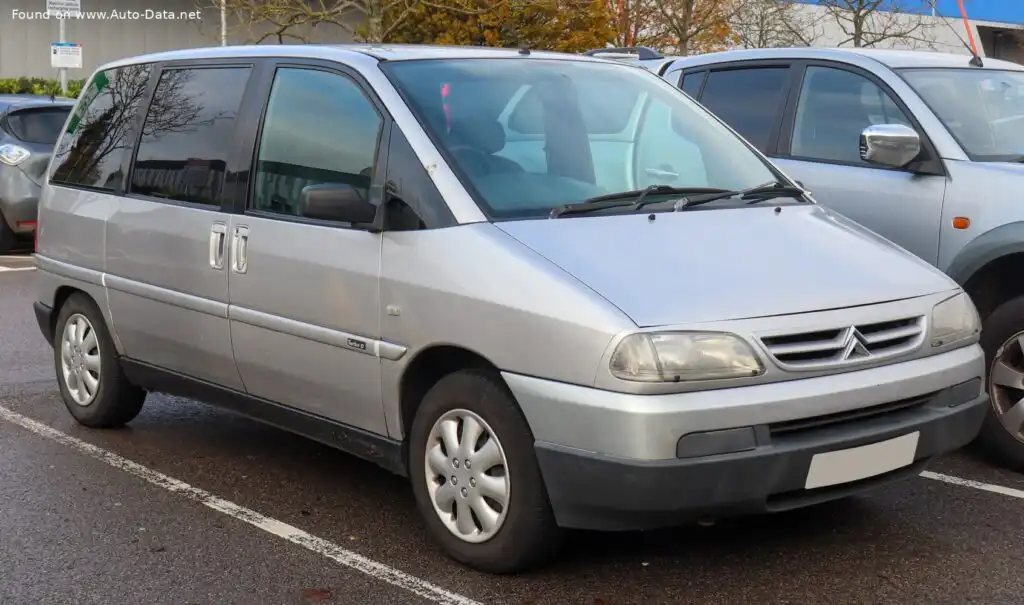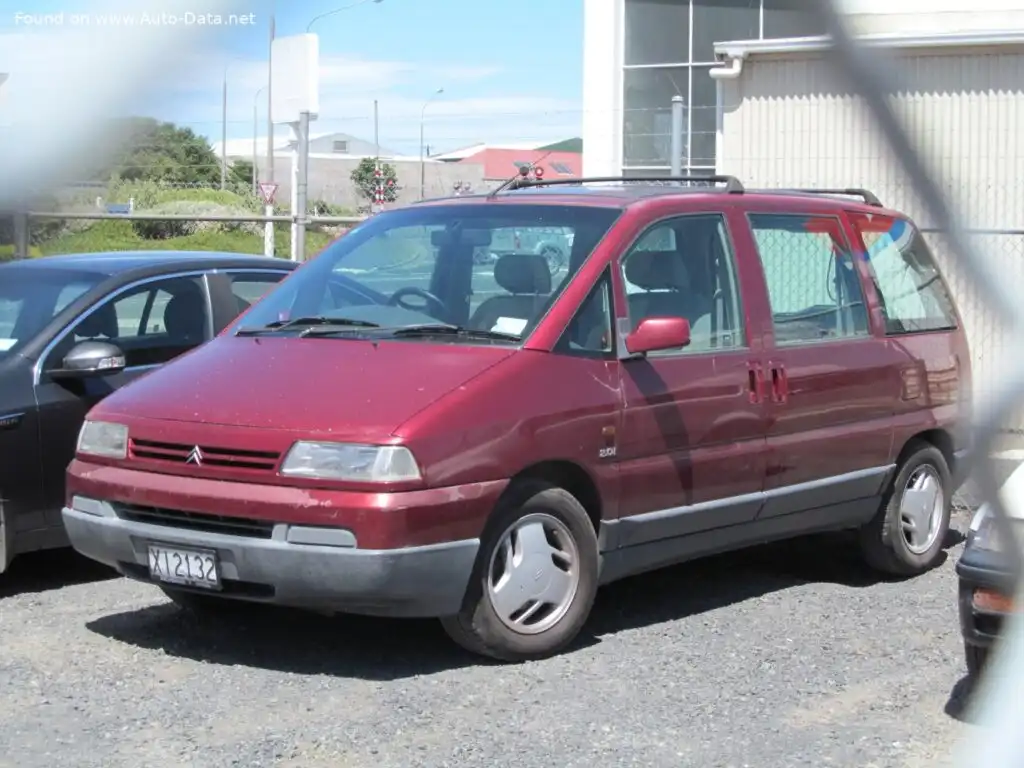
The Citroën Evasion 2.1 TD (109 hp) was a diesel-powered minivan produced between 1996 and 1998. Part of the second generation of the Citroën Evasion (known as the Citroën C8 after a 2002 facelift), this variant occupied a middle ground in the lineup, offering a balance between fuel economy and practicality for families. The Evasion, along with its Peugeot 806 and Fiat Ulysse siblings, was a collaborative effort – a product of the Sevel Nord joint venture between the PSA Group (Peugeot-Citroën) and Fiat. It was designed to compete with the Renault Espace and other multi-purpose vehicles (MPVs) gaining popularity in Europe during the 1990s.
Technical Specifications
| Brand | Citroen |
| Model | Evasion |
| Generation | Evasion (22) |
| Type (Engine) | 2.1 TD (109 Hp) |
| Start of production | 1996 |
| End of production | 1998 |
| Powertrain Architecture | Internal Combustion engine |
| Body type | Minivan |
| Seats | 5 |
| Doors | 5 |
| Fuel consumption (economy) – urban (NEDC) | 10.8 l/100 km (21.8 US mpg, 26.2 UK mpg, 9.3 km/l) |
| Fuel consumption (economy) – extra urban (NEDC) | 6.7 l/100 km (35.1 US mpg, 42.2 UK mpg, 14.9 km/l) |
| Fuel consumption (economy) – combined (NEDC) | 8.2 l/100 km (28.7 US mpg, 34.4 UK mpg, 12.2 km/l) |
| CO2 emissions (NEDC) | 219 g/km |
| Fuel Type | Diesel |
| Acceleration 0 – 100 km/h | 14.1 sec |
| Acceleration 0 – 62 mph | 14.1 sec |
| Acceleration 0 – 60 mph | 13.4 sec |
| Maximum speed | 175 km/h (108.74 mph) |
| Weight-to-power ratio | 14.8 kg/Hp, 67.5 Hp/tonne |
| Weight-to-torque ratio | 6.5 kg/Nm, 154.8 Nm/tonne |
| Power | 109 Hp @ 4300 rpm |
| Power per litre | 52.2 Hp/l |
| Torque | 250 Nm @ 2000 rpm (184.39 lb.-ft. @ 2000 rpm) |
| Engine layout | Front, Transverse |
| Engine Model/Code | P8C XUD11BTE |
| Engine displacement | 2088 cm3 (127.42 cu. in.) |
| Number of cylinders | 4 |
| Engine configuration | Inline |
| Cylinder Bore | 85 mm (3.35 in.) |
| Piston Stroke | 92 mm (3.62 in.) |
| Compression ratio | 21.5:1 |
| Number of valves per cylinder | 3 |
| Fuel injection system | Precombustion chamber injection |
| Engine aspiration | Turbocharger |
| Valvetrain | OHC |
| Engine oil capacity | 4.5 l (4.76 US qt | 3.96 UK qt) |
| Coolant | 10.5 l (11.1 US qt | 9.24 UK qt) |
| Kerb Weight | 1615 kg (3560.47 lbs.) |
| Max. weight | 2385 kg (5258.02 lbs.) |
| Max load | 770 kg (1697.56 lbs.) |
| Trunk (boot) space – minimum | 340 l (12.01 cu. ft.) |
| Trunk (boot) space – maximum | 3300 l (116.54 cu. ft.) |
| Fuel tank capacity | 80 l (21.13 US gal | 17.6 UK gal) |
| Max. roof load | 100 kg (220.46 lbs.) |
| Permitted trailer load with brakes (12%) | 1300 kg (2866.01 lbs.) |
| Permitted trailer load without brakes | 750 kg (1653.47 lbs.) |
| Length | 4454 mm (175.35 in.) |
| Width | 1834 mm (72.2 in.) |
| Height | 1714 mm (67.48 in.) |
| Wheelbase | 2824 mm (111.18 in.) |
| Front track | 1534 mm (60.39 in.) |
| Rear (Back) track | 1540 mm (60.63 in.) |
| Front overhang | 881 mm (34.69 in.) |
| Rear overhang | 749 mm (29.49 in.) |
| Drag coefficient (Cd) | 0.39 |
| Minimum turning circle (turning diameter) | 12.35 m (40.52 ft.) |
| Drivetrain Architecture | The Internal combustion engine (ICE) drives the front wheels of the vehicle. |
| Drive wheel | Front wheel drive |
| Number of gears and type of gearbox | 5 gears, manual transmission |
| Front suspension | Independent type McPherson, Wishbone |
| Rear suspension | independent torsion suspension, Wishbone |
| Front brakes | Ventilated discs |
| Rear brakes | Drum |
| Assisting systems | ABS (Anti-lock braking system) |
| Steering type | Steering rack and pinion |
| Power steering | Hydraulic Steering |
| Tires size | 205/65 R15 |
| Wheel rims size | 15 |
INTRODUCTION
The Citroën Evasion 2.1 TD, produced from 1996 to 1998, represented a practical and economical option within the Evasion range. Positioned as a mid-range trim, it aimed to provide family transportation with a focus on fuel efficiency and durability. Built on the shared Sevel Nord platform (designated 1HX0 for the first generation and A3 for later iterations), the Evasion was mechanically very similar to the Peugeot 806 and Fiat Ulysse, differing primarily in styling and some equipment details. The 2.1 TD variant was particularly popular in European markets where diesel engines were favored for their lower running costs and suitability for long distances.
Powertrain & Engine Architecture
The heart of the Evasion 2.1 TD is the P8C XUD11BTE engine, a 2.1-liter inline-four cylinder diesel. This engine is a descendant of the long-running XUD series of diesel engines developed by Peugeot and Citroën, known for their robustness and longevity. The ‘BTE’ designation indicates a turbocharged and intercooled version, boosting power output to 109 horsepower at 4300 rpm and 250 Nm (184 lb-ft) of torque at 2000 rpm. The engine utilizes precombustion chamber injection, a system common in older diesel engines where fuel is injected into a small pre-chamber before entering the main combustion chamber. This aids in more complete combustion and reduces engine noise. The Evasion 2.1 TD was typically paired with a five-speed manual transmission, although a four-speed automatic transmission was also available, albeit less common. The automatic gearbox, while offering convenience, generally resulted in slightly reduced fuel economy and performance.
Driving Characteristics
The 2.1 TD engine in the Evasion provided adequate, though not exhilarating, performance. Acceleration from 0 to 60 mph took around 13.4 to 14.1 seconds, and top speed was approximately 108.74 mph. The engine’s strength lay in its mid-range torque, making it well-suited for carrying passengers and luggage, even on inclines. The five-speed manual transmission allowed drivers to keep the engine in its optimal power band, while the optional automatic transmission offered smoother, but less engaging, driving experience. Compared to the more powerful petrol (gasoline) versions of the Evasion, the 2.1 TD prioritized fuel economy over outright speed. The gear ratios in the manual transmission were relatively long, emphasizing cruising efficiency over rapid acceleration.
Equipment & Trim Levels
The Evasion 2.1 TD typically came with a reasonable level of standard equipment. This included power steering, central locking, electric front windows, and an adjustable steering column. Interior upholstery was usually cloth, with options for upgraded materials. Higher trim levels offered features such as air conditioning, rear windows, a sunroof, and upgraded audio systems. The Evasion was designed with practicality in mind, offering a flexible interior with removable seats and a large cargo area. The rear seats could be folded or removed entirely, creating a substantial amount of space for luggage or other items.
Chassis & Braking
The Evasion 2.1 TD featured an independent suspension system, with McPherson struts at the front and a torsion beam setup at the rear. This provided a comfortable ride, although handling was not particularly sporty. The front brakes were ventilated discs, offering good stopping power, while the rear brakes were drums. Anti-lock Braking System (ABS) was standard equipment, enhancing safety. The Evasion’s chassis was designed to accommodate the vehicle’s weight and provide a stable platform for carrying passengers and cargo. Stabilizer bars were fitted to both the front and rear axles to reduce body roll during cornering.
Market Reception & Comparison
The Citroën Evasion 2.1 TD was generally well-received by critics and buyers alike. It was praised for its spacious interior, comfortable ride, and fuel efficiency. However, some reviewers noted its relatively slow acceleration and somewhat dated interior design. Compared to the petrol-powered Evasion models, the 2.1 TD offered significantly better fuel economy, making it a popular choice for families who frequently undertook long journeys. Against competitors like the Renault Espace, the Evasion offered a similar level of practicality and comfort, but often at a slightly lower price point. The Peugeot 806 and Fiat Ulysse, being mechanically identical, offered similar performance and features.
Legacy
The Citroën Evasion 2.1 TD, along with its Peugeot and Fiat counterparts, has proven to be a relatively reliable vehicle. The XUD engine is known for its durability, and many examples are still on the road today. However, like any older vehicle, maintenance is key to ensuring long-term reliability. Common issues include wear and tear on suspension components, corrosion, and potential problems with the fuel injection system. In the used car market, the Evasion 2.1 TD remains an affordable and practical option for those seeking a spacious and economical family vehicle. Its simple mechanical design makes it relatively easy to maintain and repair, appealing to DIY mechanics and those seeking a low-cost transportation solution.