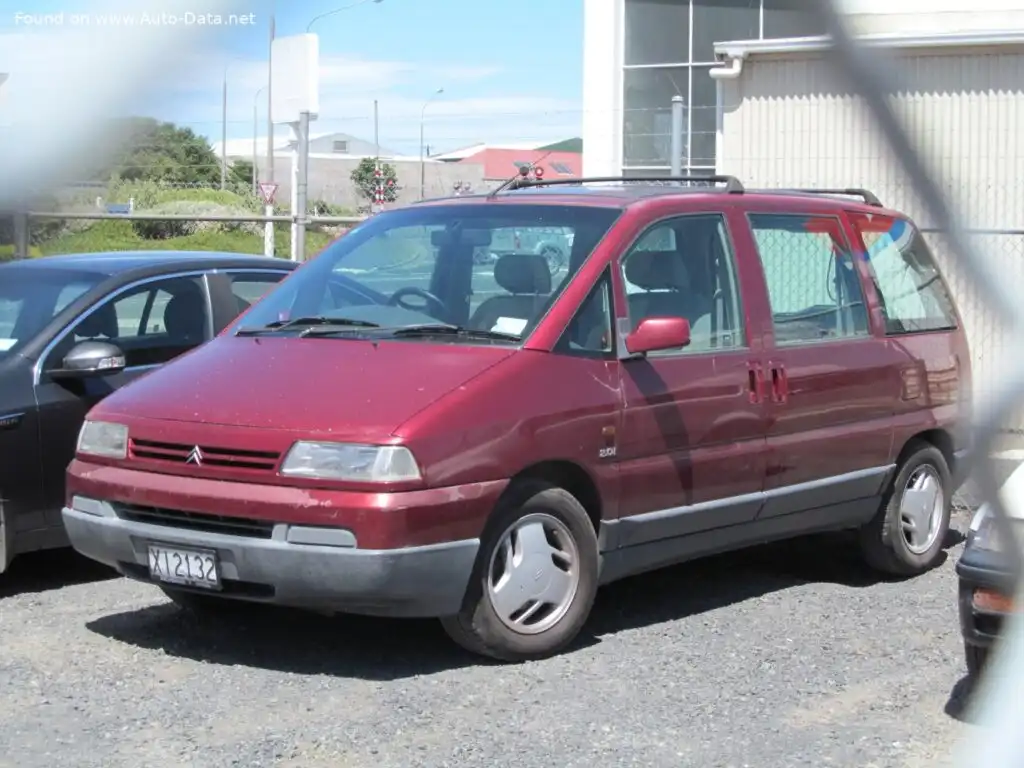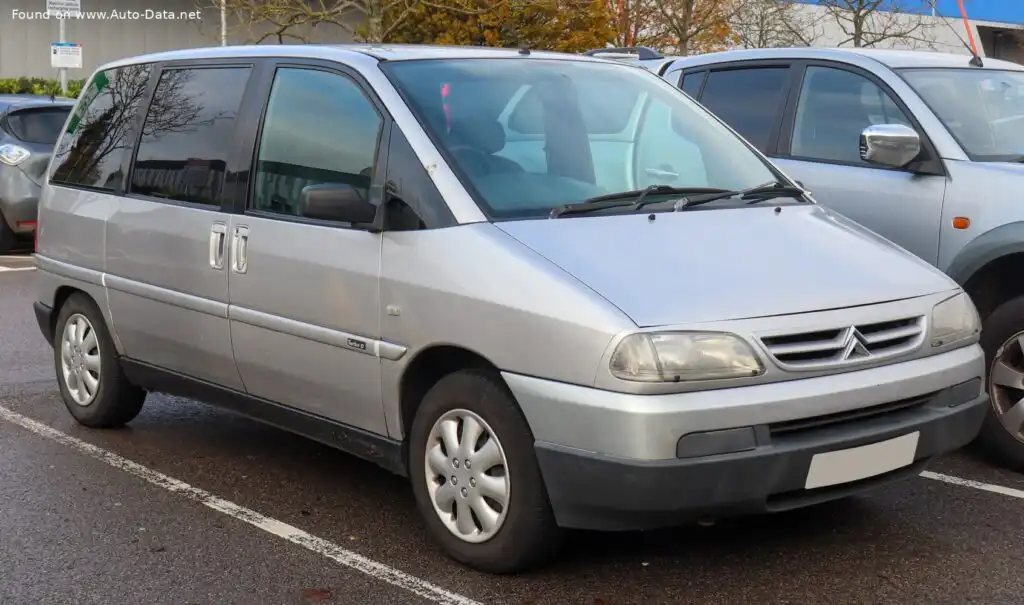
The Citroen Evasion, produced between 1994 and 2002, was Citroen’s entry into the large, multi-purpose vehicle (MPV) segment. The 2.0-liter (121 hp) variant, manufactured from 1999 to 2000, represented a mid-range offering within the Evasion lineup, positioned between the base 1.8-liter engine and the more powerful 2.1-liter Turbo Diesel. This version, designated as the U6U, was primarily sold in European markets, offering a spacious and practical vehicle for families. It shared its platform and much of its mechanical underpinnings with the Peugeot 806 and Fiat Ulysse, a result of the joint venture known as SEVEL (Société Européenne de Véhicules Légers). The Evasion aimed to provide a comfortable and versatile alternative to traditional station wagons and vans.
Technical Specifications
| Brand | Citroen |
| Model | Evasion |
| Generation | Evasion (U6U) |
| Type (Engine) | 2.0 (121 Hp) |
| Start of production | 1999 year |
| End of production | 2000 year |
| Powertrain Architecture | Internal Combustion engine |
| Body type | Minivan |
| Seats | 8 |
| Doors | 5 |
| Fuel consumption (urban) | 13.8 l/100 km (17 US mpg, 20.5 UK mpg, 7.2 km/l) |
| Fuel consumption (extra urban) | 8.1 l/100 km (29 US mpg, 34.9 UK mpg, 12.3 km/l) |
| Fuel consumption (combined) | 10.2 l/100 km (23.1 US mpg, 27.7 UK mpg, 9.8 km/l) |
| CO2 emissions | 252 g/km |
| Fuel Type | Petrol (Gasoline) |
| Acceleration 0 – 100 km/h | 14.6 sec |
| Acceleration 0 – 62 mph | 14.6 sec |
| Acceleration 0 – 60 mph | 13.9 sec |
| Maximum speed | 177 km/h (109.98 mph) |
| Weight-to-power ratio | 12.5 kg/Hp, 80.1 Hp/tonne |
| Weight-to-torque ratio | 8.9 kg/Nm, 112.6 Nm/tonne |
| Power | 121 Hp @ 5750 rpm |
| Power per litre | 60.6 Hp/l |
| Torque | 170 Nm @ 2650 rpm (125.39 lb.-ft. @ 2650 rpm) |
| Engine layout | Front, Transverse |
| Engine Model/Code | RFU XU10J2, RFU XU10J2C |
| Engine displacement | 1998 cm3 (121.93 cu. in.) |
| Number of cylinders | 4 |
| Engine configuration | Inline |
| Cylinder Bore | 86 mm (3.39 in.) |
| Piston Stroke | 86 mm (3.39 in.) |
| Compression ratio | 9.5:1 |
| Number of valves per cylinder | 2 |
| Fuel injection system | Multi-port manifold injection |
| Engine aspiration | Naturally aspirated engine |
| Valvetrain | OHC |
| Engine oil capacity | 5 l (5.28 US qt | 4.4 UK qt) |
| Coolant | 9 l (9.51 US qt | 7.92 UK qt) |
| Kerb Weight | 1510 kg (3328.98 lbs.) |
| Max. weight | 2300 kg (5070.63 lbs.) |
| Max load | 790 kg (1741.65 lbs.) |
| Trunk (boot) space – minimum | 340 l (12.01 cu. ft.) |
| Trunk (boot) space – maximum | 2100 l (74.16 cu. ft.) |
| Fuel tank capacity | 80 l (21.13 US gal | 17.6 UK gal) |
| Max. roof load | 100 kg (220.46 lbs.) |
| Permitted trailer load with brakes (12%) | 1300 kg (2866.01 lbs.) |
| Permitted trailer load without brakes | 750 kg (1653.47 lbs.) |
| Permitted towbar download | 60 kg (132.28 lbs.) |
| Length | 4454 mm (175.35 in.) |
| Width | 1816 mm (71.5 in.) |
| Height | 1714 mm (67.48 in.) |
| Wheelbase | 2824 mm (111.18 in.) |
| Front track | 1534 mm (60.39 in.) |
| Rear (Back) track | 1540 mm (60.63 in.) |
| Front overhang | 881 mm (34.69 in.) |
| Rear overhang | 749 mm (29.49 in.) |
| Drivetrain Architecture | The Internal combustion engine (ICE) drives the front wheels of the vehicle. |
| Drive wheel | Front wheel drive |
| Number of gears and type of gearbox | 5 gears, manual transmission |
| Front suspension | Independent type McPherson, Wishbone |
| Rear suspension | independent torsion suspension, Wishbone |
| Front brakes | Ventilated discs |
| Rear brakes | Drum |
| Assisting systems | ABS (Anti-lock braking system) |
| Steering type | Steering rack and pinion |
| Power steering | Hydraulic Steering |
| Tires size | 195/65 R15 |
| Wheel rims size | 6J x 15 |
Powertrain & Engine Architecture
The 2.0-liter engine in the Evasion, identified by the RFU XU10J2 or RFU XU10J2C engine code, is a naturally aspirated, inline-four cylinder gasoline engine. This engine was a staple in Peugeot and Citroen vehicles of the era. It features a single overhead camshaft (OHC) valvetrain with two valves per cylinder. Fuel delivery is managed by a multi-port fuel injection system, providing a balance between efficiency and performance. The XU10J2 engine is known for its relative simplicity and durability. The 5-speed manual transmission was the standard offering for this variant, providing adequate gear ratios for everyday driving. The engine’s 170 Nm (125.39 lb.-ft.) of torque is delivered at 2650 rpm, offering reasonable pulling power for a vehicle of this size.
Driving Characteristics
The 121 hp 2.0-liter engine in the Evasion, coupled with the 5-speed manual transmission, provided adequate, but not exhilarating, performance. Acceleration from 0 to 100 km/h (0-62 mph) took approximately 14.6 seconds. The engine felt somewhat strained when fully loaded with passengers and luggage, particularly on inclines. Compared to the more powerful 2.1-liter Turbo Diesel, the 2.0-liter petrol engine offered less low-end torque, requiring more frequent gear changes to maintain momentum. However, it provided a smoother and quieter driving experience than the diesel. The gear ratios were well-suited for cruising on highways, but the engine lacked the punch for quick overtaking maneuvers.
Equipment & Trim Levels
The 2.0-liter Evasion typically came with a reasonable level of standard equipment. This included power steering, central locking, electric front windows, and an adjustable steering column. Interior upholstery was typically cloth, with a functional, if somewhat basic, dashboard layout. Optional extras included air conditioning, rear windows, upgraded audio systems, and alloy wheels. Higher trim levels offered features like velour upholstery, wood trim, and additional soundproofing. The Evasion prioritized practicality and space over luxury, but offered a comfortable and well-equipped environment for family transportation.
Chassis & Braking
The Evasion utilized an independent McPherson strut suspension at the front and an independent torsion beam suspension at the rear. This setup provided a comfortable ride quality, absorbing bumps and imperfections in the road surface effectively. Front brakes were ventilated discs, offering good stopping power, while the rear brakes were drums. ABS (Anti-lock Braking System) was standard, enhancing safety during emergency braking situations. The Evasion’s relatively long wheelbase contributed to its stability and predictable handling. The steering was hydraulic, making it easy to maneuver at low speeds.
Market Reception & Comparison
The Citroen Evasion, and its sister vehicles, were generally well-received in Europe as practical and spacious MPVs. The 2.0-liter petrol engine was considered a good compromise between performance and fuel economy, although it wasn’t the most economical option in the lineup. Critics noted that the engine could feel underpowered when the vehicle was fully loaded. Compared to the 2.1-liter Turbo Diesel, the 2.0-liter offered a smoother and quieter driving experience, but lacked the diesel’s superior torque and fuel efficiency. The Evasion’s spacious interior and versatile seating arrangements were consistently praised.
Legacy
The Citroen Evasion, along with the Peugeot 806 and Fiat Ulysse, represented a significant step forward in the MPV segment. The XU10J2 engine, while not known for being particularly high-performance, proved to be a reliable and durable unit when properly maintained. Today, the Evasion is a relatively rare sight on the roads, but well-maintained examples are sought after by enthusiasts and collectors. The 2.0-liter petrol engine, while not the most desirable variant, remains a viable option for those seeking a classic MPV with a relatively simple and straightforward mechanical setup. Parts availability can be a challenge, but many components are still available through specialist suppliers.