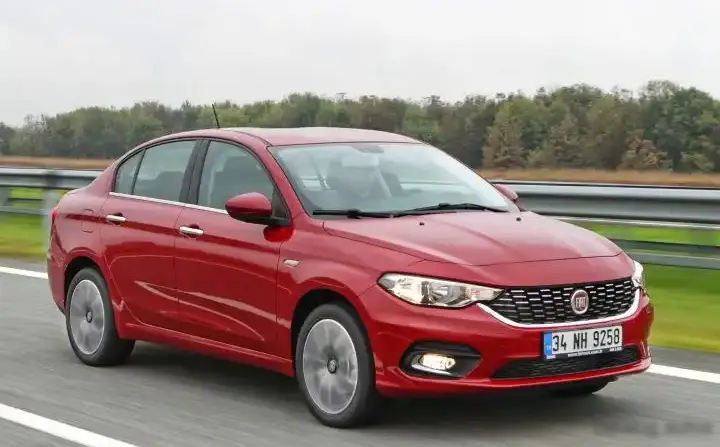
The Fiat Tipo (356) 1.3 (95 hp) was a compact sedan produced by Fiat between 2015 and 2018. Positioned as an entry-level offering within the Tipo range, it aimed to provide affordable and efficient transportation for families and individuals. This variant played a significant role in re-establishing the Tipo nameplate, which had been absent from Fiat’s lineup for over two decades, particularly in European markets. It was designed to compete with other mainstream compact sedans like the Volkswagen Jetta, Skoda Octavia, and Peugeot 308, offering a compelling blend of practicality, fuel economy, and value. The 1.3-liter diesel engine, coupled with a five-speed manual transmission, was intended to appeal to buyers prioritizing running costs over outright performance.
Technical Specifications
| Brand | Fiat |
| Model | Tipo |
| Generation | Tipo (356) |
| Type (Engine) | 1.3 (95 Hp) |
| Start of production | 2015 |
| End of production | 2018 |
| Powertrain Architecture | Internal Combustion engine |
| Body type | Sedan |
| Seats | 5 |
| Doors | 4 |
| Fuel consumption (urban) | 5.2 l/100 km (45.2 US mpg, 54.3 UK mpg, 19.2 km/l) |
| Fuel consumption (extra urban) | 3.5 l/100 km (67.2 US mpg, 80.7 UK mpg, 28.6 km/l) |
| Fuel consumption (combined) | 4.1 l/100 km (57.4 US mpg, 68.9 UK mpg, 24.4 km/l) |
| CO2 emissions | 108 g/km |
| Fuel Type | Diesel |
| Acceleration 0 – 100 km/h | 11.7 sec |
| Acceleration 0 – 62 mph | 11.7 sec |
| Acceleration 0 – 60 mph | 11.1 sec |
| Maximum speed | 180 km/h (111.85 mph) |
| Emission standard | Euro 6 |
| Weight-to-power ratio | 12.7 kg/Hp, 78.8 Hp/tonne |
| Weight-to-torque ratio | 6 kg/Nm, 166 Nm/tonne |
| Power | 95 Hp @ 3750 rpm |
| Power per litre | 76.1 Hp/l |
| Torque | 200 Nm @ 1500 rpm (147.51 lb.-ft. @ 1500 rpm) |
| Engine layout | Front, Transverse |
| Engine Model/Code | 55283775 |
| Engine displacement | 1248 cm3 (76.16 cu. in.) |
| Number of cylinders | 4 |
| Engine configuration | Inline |
| Cylinder Bore | 69.6 mm (2.74 in.) |
| Piston Stroke | 82 mm (3.23 in.) |
| Compression ratio | 16.8:1 |
| Number of valves per cylinder | 4 |
| Fuel injection system | Diesel Commonrail |
| Engine aspiration | Turbocharger, Intercooler |
| Engine oil capacity | 3.9 l (4.12 US qt | 3.43 UK qt) |
| Coolant capacity | 6.1 l (6.45 US qt | 5.37 UK qt) |
| Kerb Weight | 1205 kg (2656.57 lbs.) |
| Max. weight | 1705 kg (3758.88 lbs.) |
| Max load | 500 kg (1102.31 lbs.) |
| Trunk (boot) space – minimum | 520 l (18.36 cu. ft.) |
| Fuel tank capacity | 45 l (11.89 US gal | 9.9 UK gal) |
| Permitted trailer load with brakes (12%) | 1200 kg (2645.55 lbs.) |
| Length | 4532 mm (178.43 in.) |
| Width | 1792 mm (70.55 in.) |
| Height | 1497 mm (58.94 in.) |
| Wheelbase | 2636 mm (103.78 in.) |
| Front track | 1542 mm (60.71 in.) |
| Rear track | 1543 mm (60.75 in.) |
| Minimum turning circle | 10.93 m (35.86 ft.) |
| Drivetrain Architecture | Front wheel drive |
| Number of gears | 5 |
| Gearbox type | Manual transmission |
| Front suspension | Independent type McPherson |
| Rear suspension | Semi-independent, coil spring |
| Front brakes | Disc |
| Rear brakes | Drum |
| Assisting systems | ABS (Anti-lock braking system) |
| Steering type | Steering rack and pinion |
| Tires size | 195/65 R15; 205/55 R16 |
| Wheel rims size | 15; 16 |
Powertrain & Engine Architecture
The Fiat Tipo 1.3 (95 hp) was powered by a 1.3-liter, four-cylinder diesel engine, specifically the Fiat MultiJet engine family. This engine, often identified by code 55283775, utilized a common rail direct injection system, delivering fuel at extremely high pressure for improved combustion efficiency and reduced emissions. The engine featured a turbocharger with an intercooler, enhancing power output and responsiveness. The valvetrain employed four valves per cylinder, contributing to improved breathing and overall performance. The engine’s 16.8:1 compression ratio was typical for a diesel engine, maximizing energy extraction from the fuel. The five-speed manual transmission was chosen for its simplicity, reliability, and contribution to fuel economy. This transmission was a standard configuration for the entry-level Tipo models.
Driving Characteristics
The 95 hp output and 200 Nm of torque provided adequate, though not exhilarating, performance. Acceleration from 0 to 60 mph took approximately 11.1 seconds, and the top speed was around 112 mph. The engine’s peak torque was available from a low 1500 rpm, offering reasonable pulling power for everyday driving situations. However, compared to higher-output versions of the Tipo, such as those equipped with the 1.6-liter gasoline engine, the 1.3 diesel felt noticeably slower, particularly when fully loaded or tackling steep inclines. The five-speed gearbox was well-matched to the engine’s characteristics, with gear ratios optimized for fuel efficiency rather than outright acceleration. The gear change was generally smooth, but the shift linkage wasn’t particularly sporty. The focus was clearly on providing a comfortable and economical driving experience.
Equipment & Trim Levels
The 1.3 (95 hp) Tipo typically came with a base level of equipment, focusing on essential features. Standard equipment generally included air conditioning, power steering, electric front windows, a basic audio system with USB connectivity, and ABS brakes. Safety features such as driver and passenger airbags were also standard. Interior upholstery was typically cloth, and the dashboard featured a functional, if somewhat basic, design. Optional extras included alloy wheels, rear parking sensors, a touchscreen infotainment system with navigation, and cruise control. Higher trim levels offered more luxurious interior appointments and additional convenience features.
Chassis & Braking
The Tipo 1.3 utilized a McPherson strut independent suspension at the front and a semi-independent coil spring suspension at the rear. This setup provided a reasonable balance between ride comfort and handling. The front brakes were ventilated discs, while the rear brakes were drums. This configuration was typical for vehicles in this weight class and price range. ABS (Anti-lock Braking System) was standard, enhancing braking safety. The steering was a rack and pinion system, providing precise and responsive steering feel.
Market Reception & Comparison
The Fiat Tipo 1.3 (95 hp) was generally well-received by critics as a practical and affordable family car. Its fuel economy was a major selling point, with combined fuel consumption figures around 57.4 US mpg. However, some reviewers criticized its lack of outright performance and its somewhat basic interior. Compared to the higher-output gasoline versions of the Tipo, the 1.3 diesel offered significantly better fuel economy but at the expense of performance. The 1.6-liter gasoline engine provided a more engaging driving experience, but it was less fuel-efficient. The diesel variant appealed to buyers prioritizing running costs and long-distance comfort.
Legacy
The 1.3 MultiJet engine proved to be a relatively reliable unit, although, like all diesel engines, it required regular maintenance, including oil changes and filter replacements. The Tipo 1.3 (95 hp) has maintained a reasonable presence in the used car market, appealing to buyers seeking an affordable and economical vehicle. While not known for its performance or luxury, it remains a practical and dependable option for those prioritizing value and fuel efficiency. Common issues reported by owners include occasional problems with the turbocharger and the diesel particulate filter (DPF), particularly on vehicles that have primarily been used for short journeys.