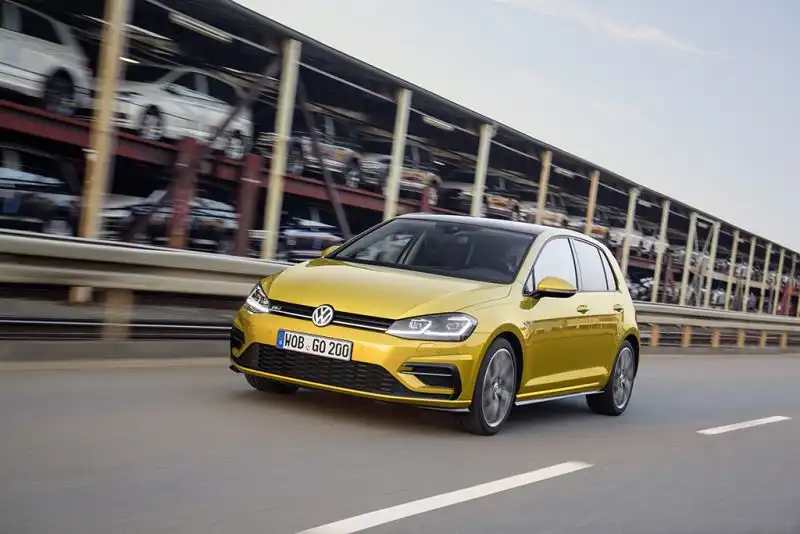
The Volkswagen Golf VII, specifically the 5-door hatchback produced from 2017 to 2019 as part of the facelifted generation, represented a significant refinement of the seventh generation Golf. Among the various engine and transmission options available, the GTD 2.0 TDI with 184 horsepower and a dual-clutch gearbox (DSG) occupied a prominent position as a performance-oriented diesel variant. This model aimed to deliver a blend of efficiency, driving pleasure, and practicality, appealing to buyers seeking a sporty yet economical hatchback. It built upon the established Golf formula, offering a more sophisticated and technologically advanced package than its predecessors.
Technical Specifications
| Brand | Volkswagen |
| Model | Golf |
| Generation | Golf VII (5-door, facelift 2017) |
| Type (Engine) | GTD 2.0 TDI (184 Hp) DSG |
| Start of production | 2017 |
| End of production | 2019 |
| Powertrain Architecture | Internal Combustion engine |
| Body type | Hatchback |
| Seats | 5 |
| Doors | 5 |
| Fuel consumption (urban) | 5.4-5.6 l/100 km (43.6 – 42 US mpg, 52.3 – 50.4 UK mpg, 18.5 – 17.9 km/l) |
| Fuel consumption (extra urban) | 4.2-4.5 l/100 km (56 – 52.3 US mpg, 67.3 – 62.8 UK mpg, 23.8 – 22.2 km/l) |
| Fuel consumption (combined) | 4.6-4.9 l/100 km (51.1 – 48 US mpg, 61.4 – 57.6 UK mpg, 21.7 – 20.4 km/l) |
| CO2 emissions | 122-129 g/km |
| Fuel Type | Diesel |
| Acceleration 0 – 100 km/h | 7.5 sec |
| Acceleration 0 – 62 mph | 7.5 sec |
| Acceleration 0 – 60 mph | 7.1 sec |
| Maximum speed | 230 km/h (142.92 mph) |
| Emission standard | Euro 6 |
| Weight-to-power ratio | 7.3 kg/Hp, 137.2 Hp/tonne |
| Weight-to-torque ratio | 3.5 kg/Nm, 283.4 Nm/tonne |
| Power | 184 Hp @ 3500-4000 rpm |
| Power per litre | 93.5 Hp/l |
| Torque | 380 Nm @ 1750-3250 rpm (280.27 lb.-ft. @ 1750-3250 rpm) |
| Engine layout | Front, Transverse |
| Engine Model/Code | CUNA, DGCA |
| Engine displacement | 1968 cm3 (120.09 cu. in.) |
| Number of cylinders | 4 |
| Engine configuration | Inline |
| Number of valves per cylinder | 4 |
| Fuel injection system | Diesel Commonrail |
| Engine aspiration | Turbocharger, Intercooler |
| Engine oil capacity | 4.7 l (4.97 US qt | 4.14 UK qt) |
| Kerb Weight | 1341 kg (2956.4 lbs.) |
| Max. weight | 1900 kg (4188.78 lbs.) |
| Max load | 559 kg (1232.38 lbs.) |
| Trunk (boot) space – minimum | 380 l (13.42 cu. ft.) |
| Trunk (boot) space – maximum | 1270 l (44.85 cu. ft.) |
| Fuel tank capacity | 50 l (13.21 US gal | 11 UK gal) |
| Max. roof load | 75 kg (165.35 lbs.) |
| Permitted trailer load with brakes (8%) | 1800 kg (3968.32 lbs.) |
| Permitted trailer load with brakes (12%) | 1600 kg (3527.4 lbs.) |
| Permitted trailer load without brakes | 700 kg (1543.24 lbs.) |
| Permitted towbar download | 80 kg (176.37 lbs.) |
| Length | 4268 mm (168.03 in.) |
| Width | 1790 mm (70.47 in.) |
| Width including mirrors | 2027 mm (79.8 in.) |
| Height | 1482 mm (58.35 in.) |
| Wheelbase | 2626 mm (103.39 in.) |
| Front track | 1527-1550 mm (60.12 – 61.02 in.) |
| Rear (Back) track | 1503-1521 mm (59.17 – 59.88 in.) |
| Ride height (ground clearance) | 133 mm (5.24 in.) |
| Minimum turning circle (turning diameter) | 10.9 m (35.76 ft.) |
| Drive wheel | Front wheel drive |
| Number of gears and type of gearbox | 7 gears, automatic transmission DSG |
| Front brakes | Ventilated discs |
| Rear brakes | Disc |
| Assisting systems | ABS (Anti-lock braking system) |
| Steering type | Steering rack and pinion |
| Power steering | Electric Steering |
| Tires size | 205/55 R16; 225/40 R18 |
| Wheel rims size | 6J x 16; 7.5J x 18 |
INTRODUCTION
The Golf VII GTD 2.0 TDI DSG, produced from 2017-2019, was a key variant within the facelifted seventh-generation Golf range. Positioned as a sporty diesel, it sat above the entry-level petrol and diesel models but below the full-blown Golf GTI. It was designed to appeal to drivers who wanted a balance of performance, fuel economy, and practicality. The facelift brought styling updates, improved technology, and refined engine options, making the GTD a compelling choice in the competitive European hatchback market. The Golf VII platform (PQ25) was known for its versatility and widespread adoption across various Volkswagen Group models.
Powertrain & Engine Architecture
At the heart of the GTD was the 2.0-liter four-cylinder diesel engine, specifically utilizing the CUNA or DGCA engine codes depending on the specific market and production date. This engine featured common-rail direct injection, a turbocharger with an intercooler, and four valves per cylinder. The common-rail system allowed for precise fuel delivery, optimizing combustion efficiency and reducing emissions. The turbocharger boosted power output, providing strong torque across a wide rev range. The engine produced 184 horsepower at 3500-4000 rpm and a substantial 380 Nm (280 lb-ft) of torque between 1750 and 3250 rpm. This torque figure was a key characteristic of the GTD, providing strong acceleration in everyday driving situations. The engine was transversely mounted at the front of the vehicle. The DSG (Direct-Shift Gearbox) was a seven-speed dual-clutch transmission. This type of transmission offered quick and smooth gear changes, enhancing both performance and driving comfort. It operated similarly to a manual transmission but without the need for a clutch pedal, and provided both fully automatic and manual shifting modes.
Driving Characteristics
The GTD 2.0 TDI DSG offered a noticeably more engaging driving experience than the lower-powered Golf diesel variants. The 184 hp and 380 Nm of torque provided brisk acceleration, with a 0-60 mph time of around 7.1 seconds. The DSG transmission contributed to this performance, delivering rapid gear changes and keeping the engine in its optimal power band. While not as overtly sporty as the GTI, the GTD offered a good balance of performance and refinement. The steering was precise and well-weighted, and the suspension provided a comfortable ride without sacrificing handling. The DSG transmission’s gear ratios were tuned to prioritize both acceleration and fuel efficiency. In automatic mode, the transmission would shift smoothly and efficiently, while in manual mode, drivers could take full control of gear selection. Compared to the 1.6 TDI models, the GTD felt significantly more powerful and responsive. Compared to the GTI, the GTD offered a more relaxed and fuel-efficient driving experience, albeit with slightly less outright performance.
Equipment & Trim Levels
The GTD trim level came well-equipped as standard. Key features included sports seats upholstered in fabric and Alcantara, a leather-wrapped multi-function steering wheel, and distinctive GTD badging both inside and out. The infotainment system typically featured a touchscreen display with navigation, Bluetooth connectivity, and Apple CarPlay/Android Auto compatibility. Standard safety equipment included ABS, electronic stability control, and multiple airbags. Optional extras included adaptive cruise control, park assist, a panoramic sunroof, and upgraded sound systems. The interior design was generally understated but well-built, with a focus on functionality and ergonomics. The GTD also featured unique exterior styling cues, such as a black honeycomb grille, dark-tinted rear windows, and a rear diffuser.
Chassis & Braking
The Golf VII GTD utilized a MacPherson strut front suspension and a multi-link rear suspension. This setup provided a good balance of ride comfort and handling precision. The suspension was typically slightly firmer than that of the standard Golf models, reflecting the GTD’s sporty character. The braking system consisted of ventilated front discs and solid rear discs. ABS (Anti-lock Braking System) was standard, providing enhanced braking performance and stability. The GTD typically featured larger brake discs than the lower-powered Golf variants, offering improved stopping power. Stabilizer bars were fitted to both the front and rear axles to reduce body roll during cornering.
Market Reception & Comparison
The Golf VII GTD 2.0 TDI DSG was generally well-received by automotive critics. It was praised for its strong performance, fuel efficiency, and refined driving experience. Reviewers noted that the GTD offered a compelling alternative to petrol-powered hot hatchbacks, providing similar levels of performance with significantly lower running costs. Compared to the Golf GTI, the GTD was often seen as a more mature and practical choice, appealing to drivers who prioritized fuel economy and comfort. The 1.6 TDI models were significantly less powerful and offered a less engaging driving experience, while the higher-output diesel variants (like those found in some Passats) were typically more expensive. Fuel economy was a major selling point, with the GTD achieving combined fuel consumption figures of around 4.6-4.9 l/100 km (51.1-48 US mpg).
Legacy
The Golf VII GTD 2.0 TDI DSG has proven to be a reliable and durable vehicle. The 2.0-liter TDI engine is known for its longevity, provided it is properly maintained. Common issues include diesel particulate filter (DPF) clogging, particularly on vehicles that are primarily used for short journeys. The DSG transmission is generally reliable, but regular servicing is essential to ensure smooth operation. In the used car market, the GTD 2.0 TDI DSG remains a popular choice, commanding a premium over the lower-powered Golf models. Its blend of performance, efficiency, and practicality continues to appeal to buyers seeking a well-rounded and capable hatchback.