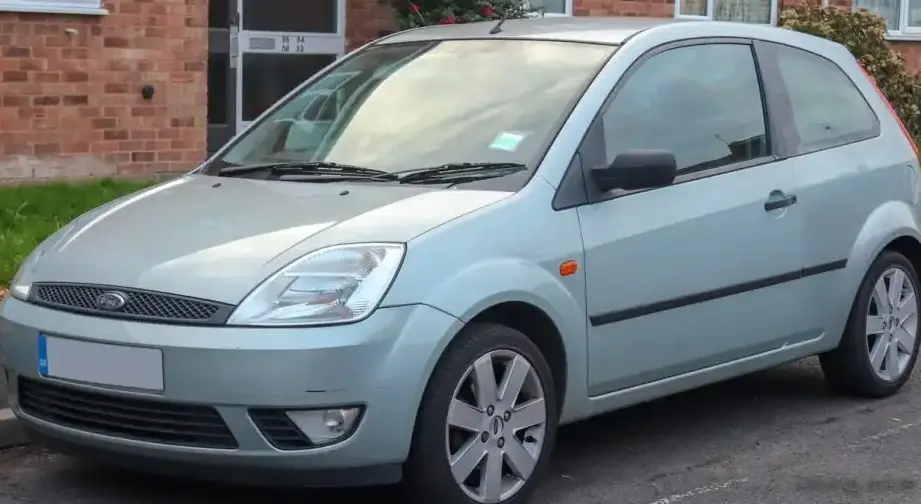
The Ford Fiesta Mk6, produced from 2002 to 2008, represented a significant step forward for Ford’s supermini. The 3-door 1.4 Duratec 16V variant, equipped with the Durashift EST automatic transmission, was a popular choice for drivers seeking a comfortable and economical city car. This specific configuration was available from 2002 through 2005 and occupied the entry to mid-level position within the Mk6 Fiesta lineup, offering a balance between affordability and convenience. It was positioned below the more powerful 1.6 and 2.0-liter models, and also differed significantly from the diesel options like the 1.4 TDCi.
Technical Specifications
| Brand | Ford |
| Model | Fiesta |
| Generation | Fiesta VI (Mk6) 3 door |
| Type (Engine) | 1.4 Duratec 16V (80 Hp) Durashift EST |
| Start of production | 2002 |
| End of production | 2005 |
| Powertrain Architecture | Internal Combustion engine |
| Body type | Hatchback |
| Seats | 5 |
| Doors | 3 |
| Fuel consumption (urban) | 8.3 l/100 km (28.3 US mpg, 34 UK mpg, 12 km/l) |
| Fuel consumption (extra urban) | 5.2 l/100 km (45.2 US mpg, 54.3 UK mpg, 19.2 km/l) |
| Fuel consumption (combined) | 6.3 l/100 km (37.3 US mpg, 44.8 UK mpg, 15.9 km/l) |
| CO2 emissions | 150 g/km |
| Fuel Type | Petrol (Gasoline) |
| Acceleration 0 – 100 km/h | 14.3 sec |
| Acceleration 0 – 62 mph | 14.3 sec |
| Acceleration 0 – 60 mph | 13.6 sec |
| Maximum speed | 166 km/h (103.15 mph) |
| Emission standard | Euro 4 |
| Weight-to-power ratio | 13 kg/Hp, 77.1 Hp/tonne |
| Weight-to-torque ratio | 8.4 kg/Nm, 119.5 Nm/tonne |
| Power | 80 Hp @ 5700 rpm |
| Power per litre | 57.6 Hp/l |
| Torque | 124 Nm @ 3500 rpm (91.46 lb.-ft. @ 3500 rpm) |
| Engine layout | Front, Transverse |
| Engine Model/Code | FXJA |
| Engine displacement | 1388 cm3 (84.7 cu. in.) |
| Number of cylinders | 4 |
| Engine configuration | Inline |
| Cylinder Bore | 76 mm (2.99 in.) |
| Piston Stroke | 76.5 mm (3.01 in.) |
| Compression ratio | 11:1 |
| Number of valves per cylinder | 4 |
| Fuel injection system | Multi-port manifold injection |
| Engine aspiration | Naturally aspirated engine |
| Valvetrain | DOHC |
| Engine oil capacity | 3.8 l (4.02 US qt | 3.34 UK qt) |
| Coolant capacity | 5 l (5.28 US qt | 4.4 UK qt) |
| Kerb Weight | 1038 kg (2288.4 lbs.) |
| Max. weight | 1525 kg (3362.05 lbs.) |
| Max load | 487 kg (1073.65 lbs.) |
| Trunk (boot) space – minimum | 268 l (9.46 cu. ft.) |
| Trunk (boot) space – maximum | 945 l (33.37 cu. ft.) |
| Fuel tank capacity | 45 l (11.89 US gal | 9.9 UK gal) |
| Permitted trailer load with brakes (12%) | 500 kg (1102.31 lbs.) |
| Permitted trailer load without brakes | 500 kg (1102.31 lbs.) |
| Length | 3917 mm (154.21 in.) |
| Width | 1683 mm (66.26 in.) |
| Width including mirrors | 1905 mm (75 in.) |
| Height | 1467 mm (57.76 in.) |
| Wheelbase | 2487 mm (97.91 in.) |
| Front track | 1474 mm (58.03 in.) |
| Rear track | 1444 mm (56.85 in.) |
| Minimum turning circle | 9.8 m (32.15 ft.) |
| Drivetrain | Front wheel drive |
| Number of gears and type of gearbox | 5 gears, automatic transmission Durashift EST |
| Front suspension | Independent type McPherson, Transverse stabilizer |
| Rear suspension | Coil spring, Torsion |
| Front brakes | Disc |
| Rear brakes | Drum |
| Assisting systems | ABS (Anti-lock braking system) |
| Steering type | Steering rack and pinion |
| Power steering | Hydraulic Steering |
| Tires size | 175/65 R14 |
| Wheel rims size | 5.5J x 14 |
Powertrain & Engine Architecture
The heart of this Fiesta variant is the 1.4-liter Duratec 16V engine, designated FXJA. This engine is a naturally aspirated, inline-four cylinder unit featuring a double overhead camshaft (DOHC) valvetrain and multi-port fuel injection. The Duratec engine family was designed for modularity and efficiency, and the 1.4L version prioritized fuel economy over outright performance. The engine’s 16 valves (four per cylinder) contribute to improved breathing and a relatively flat torque curve. The Durashift EST automatic transmission is a four-speed unit designed for smooth operation and ease of use. It utilizes a torque converter for initial acceleration and offers a ‘Sport’ mode for more responsive shifting, although it doesn’t offer manual override capabilities.
Driving Characteristics
The 1.4L Duratec with the Durashift EST transmission delivers a comfortable, if not particularly exhilarating, driving experience. Acceleration from 0-60 mph takes around 13.6-14.3 seconds, and the top speed is approximately 103 mph. The automatic transmission prioritizes smooth gear changes, which can sometimes feel sluggish compared to the more responsive manual gearbox options. The gear ratios are tuned for fuel efficiency, meaning the engine can feel strained when accelerating quickly or climbing hills. However, for typical urban driving and highway cruising, the powertrain provides adequate performance. The automatic transmission makes it a particularly appealing option for drivers who prefer the convenience of not having to manually shift gears.
Equipment & Trim Levels
The 1.4 Duratec automatic Fiesta typically came equipped with features such as power steering, central locking, electric front windows, and an AM/FM radio. Higher trim levels, such as the Style or Zetec, added features like alloy wheels, air conditioning, and upgraded interior trim. Interior upholstery was generally cloth, with a relatively simple dashboard layout. Optional extras included a sunroof, upgraded sound system, and metallic paint finishes. Safety features included driver and passenger airbags and ABS (Anti-lock Braking System).
Chassis & Braking
The Fiesta Mk6 utilizes a McPherson strut front suspension and a torsion beam rear suspension. This setup provides a good balance between ride comfort and handling. The front brakes are discs, while the rear brakes are drums, a common configuration for this class of vehicle and weight. The hydraulic power steering provides light and easy steering, making it ideal for maneuvering in tight spaces. The relatively lightweight nature of the Fiesta contributes to its nimble handling characteristics.
Market Reception & Comparison
The 1.4 Duratec automatic Fiesta was generally well-received as a practical and affordable city car. Critics praised its fuel efficiency and comfortable ride, but noted its lack of outright performance. Compared to the 1.6-liter models, the 1.4 offered significantly less power and acceleration. However, it was more economical and generally cheaper to insure. The 1.4 TDCi diesel variant offered superior fuel economy but came with a higher purchase price and potentially higher maintenance costs. The automatic transmission was a key selling point for drivers who prioritized convenience over sporty driving dynamics.
Legacy
The 1.4 Duratec engine, while not known for being particularly groundbreaking, proved to be a reliable and durable unit. The Durashift EST automatic transmission also generally held up well over time, although like any automatic transmission, it requires regular fluid changes to maintain optimal performance. Today, these Fiesta Mk6 models are relatively affordable on the used car market. They represent a good value for drivers seeking a cheap and cheerful runabout, but potential buyers should be aware of the typical wear and tear associated with older vehicles, including potential issues with rust and suspension components. The 1.4 automatic Fiesta remains a popular choice for first-time drivers and those looking for a simple, economical, and easy-to-drive car.