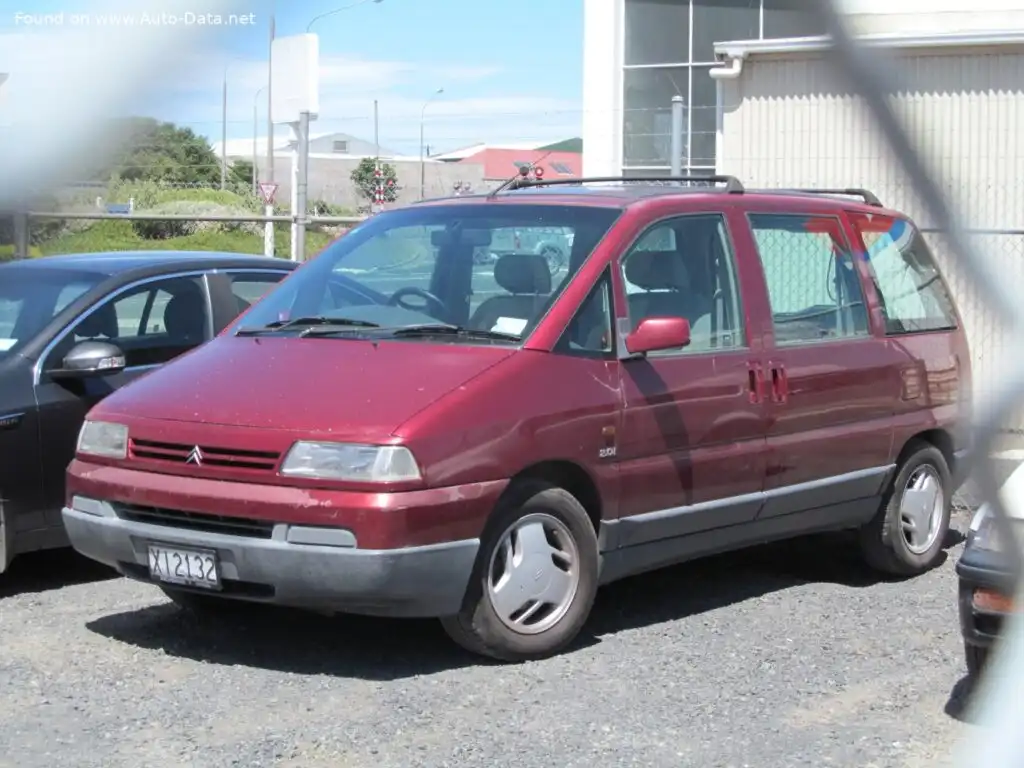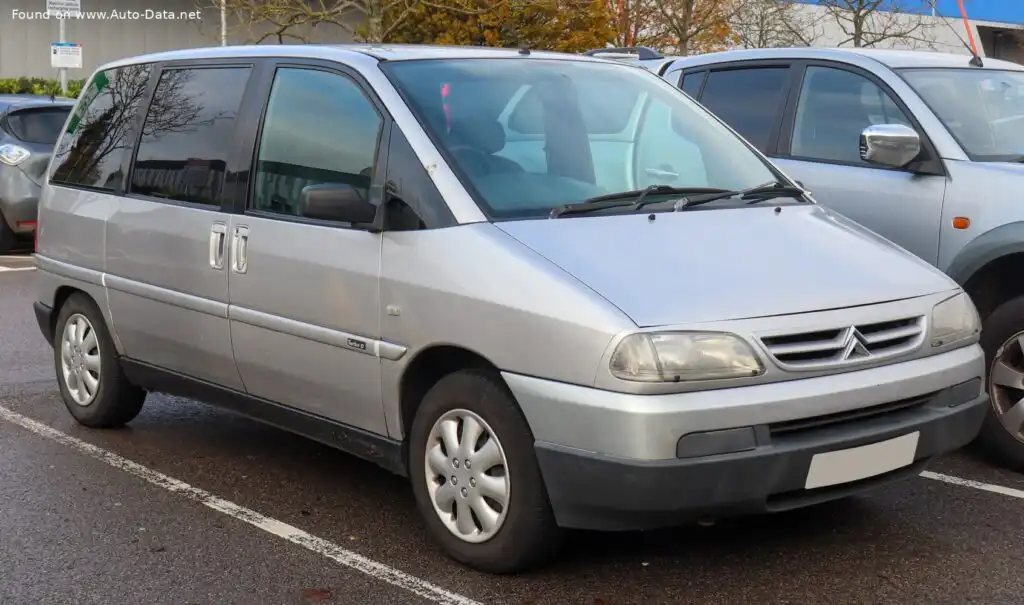
The Citroen Evasion 2.0 16V, produced between 2000 and 2001, represents a refined iteration of Citroen’s large MPV offering, the U6U series. Positioned as a comfortable and practical family vehicle, the Evasion competed with other European multi-purpose vehicles like the Renault Espace and Peugeot 806. This particular variant, equipped with the 2.0-liter 16-valve engine producing 136 horsepower, aimed to balance performance with reasonable fuel economy within the Evasion lineup. It was generally considered a mid-range offering, slotting between the base engine options and the more powerful, though less common, variants.
Technical Specifications
| Brand | Citroen |
| Model | Evasion |
| Generation | Evasion (U6U) |
| Type (Engine) | 2.0 16V (136 Hp) |
| Start of production | 2000 year |
| End of production | 2001 year |
| Powertrain Architecture | Internal Combustion engine |
| Body type | Minivan |
| Seats | 8 |
| Doors | 5 |
| Fuel consumption (economy) – urban | 12.3 l/100 km (19.1 US mpg, 23 UK mpg, 8.1 km/l) |
| Fuel consumption (economy) – extra urban | 7.4 l/100 km (31.8 US mpg, 38.2 UK mpg, 13.5 km/l) |
| Fuel consumption (economy) – combined | 9.2 l/100 km (25.6 US mpg, 30.7 UK mpg, 10.9 km/l) |
| CO2 emissions | 217-221 g/km |
| Fuel Type | Petrol (Gasoline) |
| Acceleration 0 – 100 km/h | 11.9 sec |
| Acceleration 0 – 62 mph | 11.9 sec |
| Acceleration 0 – 60 mph | 11.3 sec |
| Maximum speed | 186 km/h (115.58 mph) |
| Emission standard | Euro 3 |
| Weight-to-power ratio | 11.2 kg/Hp, 89.2 Hp/tonne |
| Weight-to-torque ratio | 8 kg/Nm, 124.6 Nm/tonne |
| Power | 136 Hp @ 6000 rpm |
| Power per litre | 68.1 Hp/l |
| Torque | 190 Nm @ 4100 rpm (140.14 lb.-ft. @ 4100 rpm) |
| Engine layout | Front, Transverse |
| Engine Model/Code | RFN EW10 J4-L3 |
| Engine displacement | 1997 cm3 (121.86 cu. in.) |
| Number of cylinders | 4 |
| Engine configuration | Inline |
| Cylinder Bore | 85 mm (3.35 in.) |
| Piston Stroke | 88 mm (3.46 in.) |
| Compression ratio | 10.8:1 |
| Number of valves per cylinder | 4 |
| Fuel injection system | Multi-port manifold injection |
| Engine aspiration | Naturally aspirated engine |
| Valvetrain | DOHC |
| Engine oil capacity | 4.25 l (4.49 US qt, 3.74 UK qt) |
| Coolant | 7 l (7.4 US qt, 6.16 UK qt) |
| Kerb Weight | 1525 kg (3362.05 lbs.) |
| Max. weight | 2315 kg (5103.7 lbs.) |
| Max load | 790 kg (1741.65 lbs.) |
| Trunk (boot) space – minimum | 340 l (12.01 cu. ft.) |
| Trunk (boot) space – maximum | 2100 l (74.16 cu. ft.) |
| Fuel tank capacity | 80 l (21.13 US gal, 17.6 UK gal) |
| Max. roof load | 100 kg (220.46 lbs.) |
| Permitted trailer load with brakes (12%) | 1300 kg (2866.01 lbs.) |
| Permitted trailer load without brakes | 750 kg (1653.47 lbs.) |
| Permitted towbar download | 60 kg (132.28 lbs.) |
| Length | 4454 mm (175.35 in.) |
| Width | 1816 mm (71.5 in.) |
| Height | 1714 mm (67.48 in.) |
| Wheelbase | 2824 mm (111.18 in.) |
| Front track | 1534 mm (60.39 in.) |
| Rear (Back) track | 1540 mm (60.63 in.) |
| Front overhang | 881 mm (34.69 in.) |
| Rear overhang | 749 mm (29.49 in.) |
| Drivetrain Architecture | The Internal combustion engine (ICE) drives the front wheels of the vehicle. |
| Drive wheel | Front wheel drive |
| Number of gears and type of gearbox | 5 gears, manual transmission |
| Front suspension | Independent type McPherson, Transverse stabilizer |
| Rear suspension | independent torsion suspension, Wishbone |
| Front brakes | Ventilated discs |
| Rear brakes | Disc |
| Assisting systems | ABS (Anti-lock braking system) |
| Steering type | Steering rack and pinion |
| Power steering | Hydraulic Steering |
| Tires size | 205/60 R15 |
| Wheel rims size | 6.5J x 15 |
INTRODUCTION
The Citroen Evasion, launched in 1994 as part of the first generation of the 806/Evasion/Eurovan platform (shared with Peugeot and Volkswagen), was Citroen’s entry into the increasingly popular large MPV segment. The U6U series underwent several revisions throughout its production run. The 2.0 16V variant, introduced around the year 2000, offered a balance between performance and economy, appealing to families needing space and versatility without the expense of the larger engine options. This model year saw refinements to the interior and exterior styling, along with improvements to the engine management system.
Powertrain & Engine Architecture
The heart of the Evasion 2.0 16V is the RFN (or EW10 J4-L3) engine, a 1997cc inline-four cylinder petrol engine. This engine is a naturally aspirated unit featuring a multi-port fuel injection system and a double overhead camshaft (DOHC) valvetrain with four valves per cylinder. The 16-valve configuration contributes to improved breathing and higher power output compared to earlier 8-valve versions. The engine’s design prioritized smooth operation and reasonable fuel efficiency. The engine’s block is cast iron, while the cylinder head is aluminum. The 5-speed manual transmission was the standard offering, designed to efficiently deliver power to the front wheels. The transmission’s gear ratios were tuned for a blend of acceleration and highway cruising, though it wasn’t particularly sporty in its feel.
Driving Characteristics
The 136 horsepower and 190 Nm (140 lb-ft) of torque provided by the 2.0 16V engine delivered adequate performance for the Evasion’s size and weight. Acceleration to 60 mph took around 11.3 seconds, and top speed was approximately 115 mph. While not a particularly quick vehicle, it was sufficient for comfortable highway cruising and everyday driving. The manual transmission allowed for a degree of driver control, but the Evasion’s bulk meant it wasn’t an engaging vehicle to drive. The gear ratios were spaced to prioritize fuel economy and smooth progress, rather than outright acceleration. Compared to the more powerful 2.1 TD engine, the 2.0 16V offered less low-end torque but a more responsive feel at higher RPMs. The 2.0 16V was noticeably quicker than the base 1.8L engine options.
Equipment & Trim Levels
The Evasion 2.0 16V typically came with a reasonable level of standard equipment. This included power steering, central locking, electric front windows, and an adjustable steering column. Interior upholstery was typically cloth, with options for upgraded materials. Air conditioning was a common option, as were features like a radio/cassette player (later upgraded to CD players). Higher trim levels offered features like alloy wheels, rear parking sensors, and upgraded interior trim. The Evasion was designed with practicality in mind, offering a flexible seating arrangement with removable rear seats to maximize cargo space.
Chassis & Braking
The Evasion utilized an independent McPherson strut suspension at the front and an independent torsion beam suspension at the rear. This setup aimed to provide a comfortable ride, absorbing bumps and irregularities in the road surface. Front brakes were ventilated discs, providing good stopping power, while rear brakes were solid discs. Anti-lock Braking System (ABS) was standard, enhancing safety. The Evasion’s chassis was designed to prioritize comfort and stability over sporty handling. The relatively soft suspension settings contributed to a comfortable ride but also resulted in noticeable body roll during cornering.
Market Reception & Comparison
The Citroen Evasion 2.0 16V was generally well-received by critics as a practical and comfortable family vehicle. It was praised for its spacious interior, flexible seating arrangement, and relatively smooth ride. However, it was also criticized for its somewhat bland styling and lack of driving excitement. Compared to the diesel-powered variants, the 2.0 16V offered better refinement and a more responsive engine, but at the cost of fuel economy. The 2.0 16V was often seen as a good compromise for those who didn’t need the low-end grunt of a diesel but wanted more power than the base petrol engines offered.
Legacy
The Citroen Evasion, and the U6U platform as a whole, proved to be a durable and reliable vehicle. The 2.0 16V engine, while not without its quirks, is generally considered a robust unit when properly maintained. Today, the Evasion can be found in the used car market at relatively affordable prices. Common issues include wear and tear on suspension components, electrical glitches, and occasional oil leaks. However, parts availability is generally good, and the Evasion’s relatively simple mechanical design makes it a relatively easy vehicle to maintain for those with some mechanical aptitude. The Evasion remains a popular choice for families needing a spacious and practical vehicle on a budget.