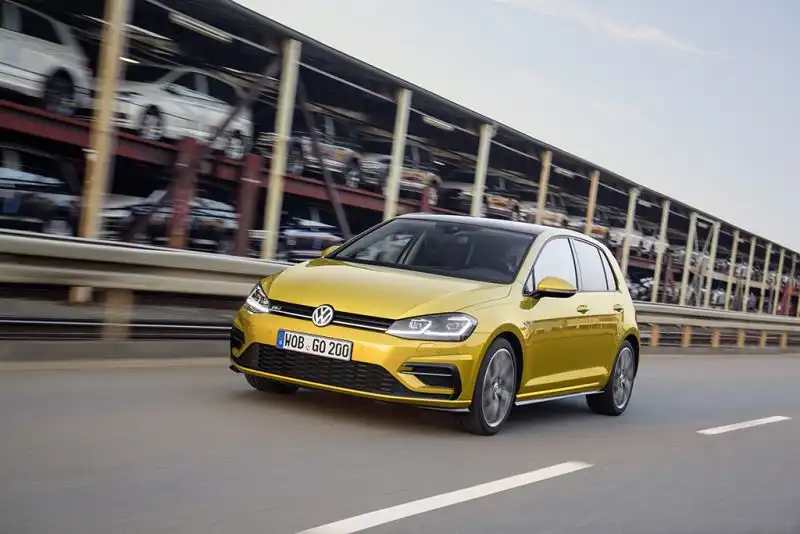
The Volkswagen Golf VII GTE 1.4 TSI, produced from March 2017 to May 2018, represents Volkswagen’s foray into the plug-in hybrid market within the highly successful Golf VII range. Positioned as a performance-oriented, yet fuel-efficient option, the GTE (Gran Turismo Executive) aimed to bridge the gap between the standard Golf models and the more potent GTI. This variant, utilizing a 1.4-liter turbocharged gasoline engine paired with an electric motor and a 6-speed DSG dual-clutch transmission, was a key component of Volkswagen’s strategy to meet increasingly stringent emissions regulations while appealing to environmentally conscious drivers. The facelifted model, introduced in 2017, brought styling updates and refinements to the GTE, further solidifying its place in the Golf lineup.
Technical Specifications
| Brand | Volkswagen |
| Model | Golf |
| Generation | Golf VII (5-door, facelift 2017) |
| Type (Engine) | GTE 1.4 TSI (204 Hp) Plug-in Hybrid DSG |
| Start of production | March, 2017 |
| End of production | May, 2018 |
| Powertrain Architecture | PHEV (Plug-in Hybrid Electric Vehicle) |
| Body type | Hatchback |
| Seats | 5 |
| Doors | 5 |
| Fuel consumption (combined) | 1.6-1.8 l/100 km (147 – 130.7 US mpg, 176.6 – 156.9 UK mpg, 62.5 – 55.6 km/l) |
| CO2 emissions | 36-40 g/km |
| Fuel Type | Petrol / electricity |
| Acceleration 0 – 100 km/h | 7.6 sec |
| Acceleration 0 – 62 mph | 7.6 sec |
| Acceleration 0 – 60 mph | 7.2 sec |
| Maximum speed | 222 km/h (137.94 mph) |
| Emission standard | Euro 6 |
| Weight-to-power ratio | 7.5 kg/Hp, 132.5 Hp/tonne |
| Weight-to-torque ratio | 4.4 kg/Nm, 227.3 Nm/tonne |
| Gross battery capacity | 8.7 kWh |
| Battery technology | Lithium-ion (Li-Ion) |
| Battery location | Under the rear seats |
| All-electric range | 45-50 km (27.96 – 31.07 mi) |
| Average Energy consumption | 11.4-12 kWh/100 km (18.35 – 19.31 kWh/100 mi, 184 – 175 MPGe, 8.8 – 8.3 km/kWh, 5.5 – 5.2 mi/kWh) |
| Electric motor power | 102 Hp @ 2500 rpm |
| Electric motor Torque | 330 Nm (243.4 lb.-ft.) |
| Maximum revolutions of the electric motor | 7000 rpm |
| Electric motor type | Synchronous |
| System power | 204 Hp |
| System torque | 350 Nm (258.15 lb.-ft.) |
| Engine Power | 150 Hp @ 5000-6000 rpm |
| Engine Torque | 250 Nm @ 1500-3500 rpm (184.39 lb.-ft. @ 1500-3500 rpm) |
| Engine layout | Front, Transverse |
| Engine Model/Code | EA211 / CUKB |
| Engine displacement | 1395 cm3 (85.13 cu. in.) |
| Number of cylinders | 4 |
| Engine configuration | Inline |
| Cylinder Bore | 74.5 mm (2.93 in.) |
| Piston Stroke | 80 mm (3.15 in.) |
| Compression ratio | 10:1 |
| Number of valves per cylinder | 4 |
| Fuel injection system | Direct injection |
| Engine aspiration | Turbocharger, Intercooler |
| Valvetrain | DOHC |
| Engine oil capacity | 4 l (4.23 US qt | 3.52 UK qt) |
| Kerb Weight | 1540 kg (3395.12 lbs.) |
| Max. weight | 2040 kg (4497.43 lbs.) |
| Max load | 500 kg (1102.31 lbs.) |
| Trunk (boot) space – minimum | 272 l (9.61 cu. ft.) |
| Trunk (boot) space – maximum | 1162 l (41.04 cu. ft.) |
| Fuel tank capacity | 40 l (10.57 US gal | 8.8 UK gal) |
| Max. roof load | 75 kg (165.35 lbs.) |
| Permitted trailer load with brakes (8%) | 1700 kg (3747.86 lbs.) |
| Permitted trailer load with brakes (12%) | 1500 kg (3306.93 lbs.) |
| Permitted trailer load without brakes | 750 kg (1653.47 lbs.) |
| Permitted towbar download | 80 kg (176.37 lbs.) |
| Length | 4276 mm (168.35 in.) |
| Width | 1799 mm (70.83 in.) |
| Width including mirrors | 2027 mm (79.8 in.) |
| Height | 1484 mm (58.43 in.) |
| Wheelbase | 2630 mm (103.54 in.) |
| Front track | 1533-1549 mm (60.35 – 60.98 in.) |
| Rear (Back) track | 1503-1521 mm (59.17 – 59.88 in.) |
| Ride height (ground clearance) | 140 mm (5.51 in.) |
| Minimum turning circle (turning diameter) | 10.9 m (35.76 ft.) |
| Drivetrain Architecture | The Internal combustion engine (ICE) and electric motor drive the front wheels of the car with the ability to work in full electric or mixed mode. |
| Drive wheel | Front wheel drive |
| Number of gears and type of gearbox | 6 gears, automatic transmission DSG |
| Front suspension | Independent, type McPherson with coil spring and anti-roll bar |
| Rear suspension | Independent multi-link spring suspension with stabilizer |
| Front brakes | Ventilated discs |
| Rear brakes | Disc |
| Assisting systems | ABS (Anti-lock braking system) |
| Steering type | Steering rack and pinion |
| Power steering | Electric Steering |
| Tires size | 205/55 R16; 225/45 R17; 225/40 R18 |
| Wheel rims size | 6.5J x 16; 7.5J x 17; 7.5J x 18 |
INTRODUCTION
The Volkswagen Golf VII GTE 1.4 TSI, launched in 2017 as part of the Golf VII’s facelift, represented a significant step in Volkswagen’s electrification strategy. Built on the MQB (Modular Transverse Matrix) platform – specifically the 1HX0/A3 variant – the GTE aimed to offer a compelling alternative to traditional gasoline-powered vehicles. It slotted into the Golf lineup above the standard models but below the performance-focused GTI and R, targeting buyers seeking a blend of efficiency, moderate performance, and advanced technology. The GTE distinguished itself with unique styling cues, including blue accents on the front grille and brake calipers, signifying its hybrid nature. Production continued until May 2018, paving the way for the next-generation Golf VIII GTE.
Powertrain & Engine Architecture
At the heart of the Golf VII GTE lies the EA211 series 1.4-liter turbocharged four-cylinder gasoline engine, specifically the CUKB engine code. This engine produces 150 horsepower at 5,000-6,000 rpm and 184 lb-ft of torque between 1,500 and 3,500 rpm. It features direct fuel injection and an intercooled turbocharger for improved efficiency and power delivery. Complementing the gasoline engine is an 8.7 kWh lithium-ion battery pack located under the rear seats and a 102 horsepower electric motor. The electric motor generates 243 lb-ft of torque, available instantly at 2,500 rpm. The combined system output is 204 horsepower and 258 lb-ft of torque. Power is delivered to the front wheels via a 6-speed DSG (Direct-Shift Gearbox) dual-clutch transmission. The DSG provides quick and seamless gear changes, enhancing both performance and fuel economy. The GTE offers various driving modes, including E-Mode (all-electric), Hybrid Auto, and GTE mode (maximum performance), allowing drivers to tailor the powertrain to their preferences.
Driving Characteristics
The Golf VII GTE 1.4 TSI offers a unique driving experience. In E-Mode, the vehicle operates solely on electric power, providing a quiet and emission-free driving range of approximately 30-40 miles. In Hybrid Auto mode, the car intelligently switches between the gasoline engine and electric motor to optimize fuel efficiency. GTE mode combines the power of both engines for maximum acceleration and performance. While not as overtly sporty as the GTI, the GTE delivers respectable acceleration, achieving 0-60 mph in around 7.2 seconds. The DSG transmission contributes to smooth and responsive gear changes. The GTE’s suspension is tuned for a balance between comfort and handling, providing a composed ride on most road surfaces. Compared to the standard Golf models, the GTE feels more responsive due to the instant torque from the electric motor. However, it doesn’t possess the same level of agility as the GTI, which benefits from a more aggressive suspension setup.
Equipment & Trim Levels
The Golf VII GTE came well-equipped as standard. Key features included sport seats upholstered in unique GTE-specific fabric, a leather-wrapped multi-function steering wheel, and a touchscreen infotainment system with navigation. Standard safety features included automatic emergency braking, lane departure warning, and adaptive cruise control. Optional extras included leather upholstery, a panoramic sunroof, and a premium sound system. The interior featured blue accents on the stitching and air vents, further emphasizing the GTE’s hybrid identity. The dashboard layout was similar to other Golf VII models, but with GTE-specific graphics and displays providing information about the hybrid system’s operation.
Chassis & Braking
The Golf VII GTE utilizes an independent McPherson strut suspension at the front and a multi-link suspension at the rear, providing a comfortable and controlled ride. The suspension components were slightly stiffer than those found in standard Golf models to accommodate the added weight of the battery pack and electric motor. Braking duties are handled by ventilated discs at the front and solid discs at the rear. The GTE also incorporates regenerative braking, which captures energy during deceleration and stores it in the battery, further enhancing efficiency. Anti-lock brakes (ABS) and electronic stability control (ESC) are standard features, providing enhanced safety and control.
Market Reception & Comparison
The Golf VII GTE was generally well-received by automotive critics. It was praised for its fuel efficiency, smooth and refined driving experience, and advanced technology. However, some critics noted that its performance didn’t quite match that of the GTI. Compared to the Golf 1.8 TSI, the GTE offered significantly better fuel economy and lower emissions, but at a higher price point. Compared to the Golf TDI, the GTE provided a zero-emission driving range, but with a slightly lower overall range. The GTE’s plug-in hybrid system required regular charging to maximize its benefits, which could be a drawback for some drivers.
Legacy
The Golf VII GTE 1.4 TSI played a crucial role in establishing Volkswagen as a leader in plug-in hybrid technology. While the EA211 engine and DSG transmission proved to be generally reliable, the hybrid system components, particularly the battery pack, required careful maintenance to ensure long-term durability. On the used car market, the GTE holds its value relatively well, appealing to buyers seeking a fuel-efficient and technologically advanced hatchback. The Golf GTE paved the way for subsequent generations of hybrid and electric Golf models, solidifying Volkswagen’s commitment to sustainable mobility.